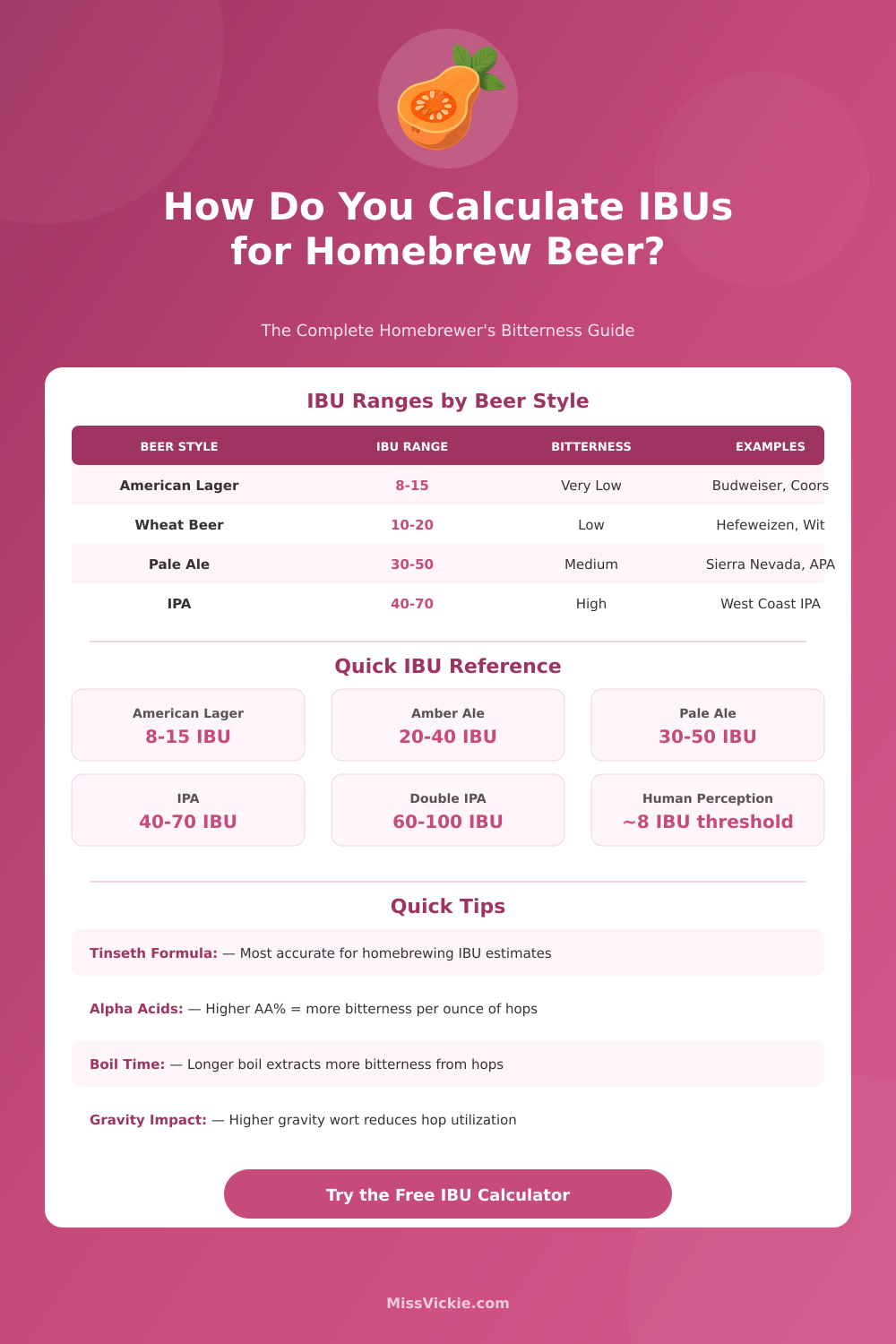
🍺 Homebrew IBU Calculator
Calculate International Bitterness Units for your homebrew using the Tinseth formula
| Hop Variety | Alpha Acid % | Character | Common Use |
|---|---|---|---|
| Cascade | 4.5-7% | Floral, citrus, grapefruit | Pale Ale, IPA |
| Centennial | 9.5-11.5% | Floral, citrus, lemon | IPA, Pale Ale |
| Chinook | 12-14% | Piney, spicy, grapefruit | IPA, Stout |
| Citra | 11-13% | Tropical, citrus, lime | IPA, Pale Ale |
| Columbus / CTZ | 14-16% | Pungent, earthy, citrus | Bittering, IPA |
| Hallertau | 3.5-5.5% | Mild, herbal, floral | Lager, Wheat |
| Magnum | 12-14% | Clean, mild, neutral | Bittering |
| Mosaic | 11.5-13.5% | Tropical, blueberry, citrus | IPA, NEIPA |
| Nugget | 12-14% | Herbal, spicy, fruity | Bittering |
| Saaz | 2.5-4.5% | Earthy, spicy, herbal | Pilsner, Lager |
| Simcoe | 12-14% | Piney, citrus, passionfruit | IPA, Pale Ale |
| Willamette | 4-6% | Floral, earthy, spicy | Amber, Porter |
| Boil Time | Utilization (1.050 OG) | Utilization (1.070 OG) | Usage |
|---|---|---|---|
| 5 min | ~5% | ~4% | Aroma, late addition |
| 10 min | ~9% | ~8% | Flavor addition |
| 15 min | ~13% | ~11% | Flavor / aroma |
| 20 min | ~17% | ~14% | Flavor |
| 30 min | ~22% | ~19% | Flavor / bittering |
| 45 min | ~27% | ~23% | Bittering |
| 60 min | ~30% | ~26% | Primary bittering |
| 90 min | ~33% | ~29% | High-gravity bittering |
| BU:GU Ratio | Balance | Example Styles |
|---|---|---|
| Below 0.4 | Very malty, sweet | Doppelbock, Sweet Stout |
| 0.4 - 0.6 | Malt-forward, balanced | Amber Ale, Dunkel |
| 0.6 - 0.8 | Balanced | Pale Ale, Kolsch |
| 0.8 - 1.0 | Hop-forward, balanced | APA, ESB |
| 1.0 - 1.5 | Bitter, hoppy | IPA, DIPA |
| Above 1.5 | Very bitter, aggressive | Imperial IPA, Experimental |
Homebrewing is a wonderful world where folks make beer, wine, cider and mead in their own kitchens or garages. It attracts brewers, vintners and cider makers who love the craft and science of fermentation. The key idea of the homebrew movement is simple but great: a homebrewer in every neighborhood and a club in every city That goal wants to celebrate and spread the pure joy of fermentation, while it feeds a community of brewers, now and for the coming years.
Here is something surprising: homebrewing was not even legal at the federal level until 1978. Before the Ban, you could freely make beer at home, and George Washington himself did that. If you mention that to folks, their jaws usually fall.
Homebrewing for Beginners
The usual size for many homebrewers is around 19 liters, or 5 US gallons, if you like imperial measures. Here is the reason: many lovers favor kegging their finished beer in Cornelius kegs, which store exactly 19 liters. If you recently start, though, a 2.5-gallon brew-in-a-bag setup could be your ideal for entering all-grain brewing.
Some swear that it is genuinely the best size, period.
Entering homebrewing requires you to understand yeast, grains, kits and a range of ingredients. Happily, good starter kits and proven recipes simplify the process much more than before. Quality supplies and ingredients are almost everywhere currently.
There are also programs for brewing, recipe designers, calculators, planners for brew days and journals, that help to produce terrific beer every time.
Online forums form the nucleus of the community. Here happen discussions about general homebrewing topics, all-grain methods, recipe swaps, wine and mead. The best step?
Research popular homebrew forums and recipe sites first, later create your own recipes according to your tastes. Nice about general forums is that every question, about stopped fermentation, yeast or beginner issues… Receives an answer in one place, instead of searching the right section.
Cooking with beer opens a whole new dimension of the hobby. Sean Paxton, known as The Homebrew Chef, shows how to use beer genuinely in everyday meals and special occasions. He works with pub owners and craft brewers to arrange exclusive multi-course dinners with beer in the center.
His website offers scalable recipes with beer as a basic ingredient. Homemade beer mustard? Very easy, you need beer, mustard seeds and a food processor or mortar.
Local homebrew shops usually have many kinds of malts and rare grains like wheat, rye and spelt. Some bakers make bread from their homebrew mash, although controlling the moisture is tricky. The whole thing rewards trying things out and fixing failures.