🍞 Sourdough Fermentation Calculator
Calculate bulk fermentation & proofing times based on temperature, starter %, and hydration
⏰ Your Bake Schedule Will Appear Here After Calculating
Enter your parameters above and click Calculate to generate a step-by-step baking schedule.
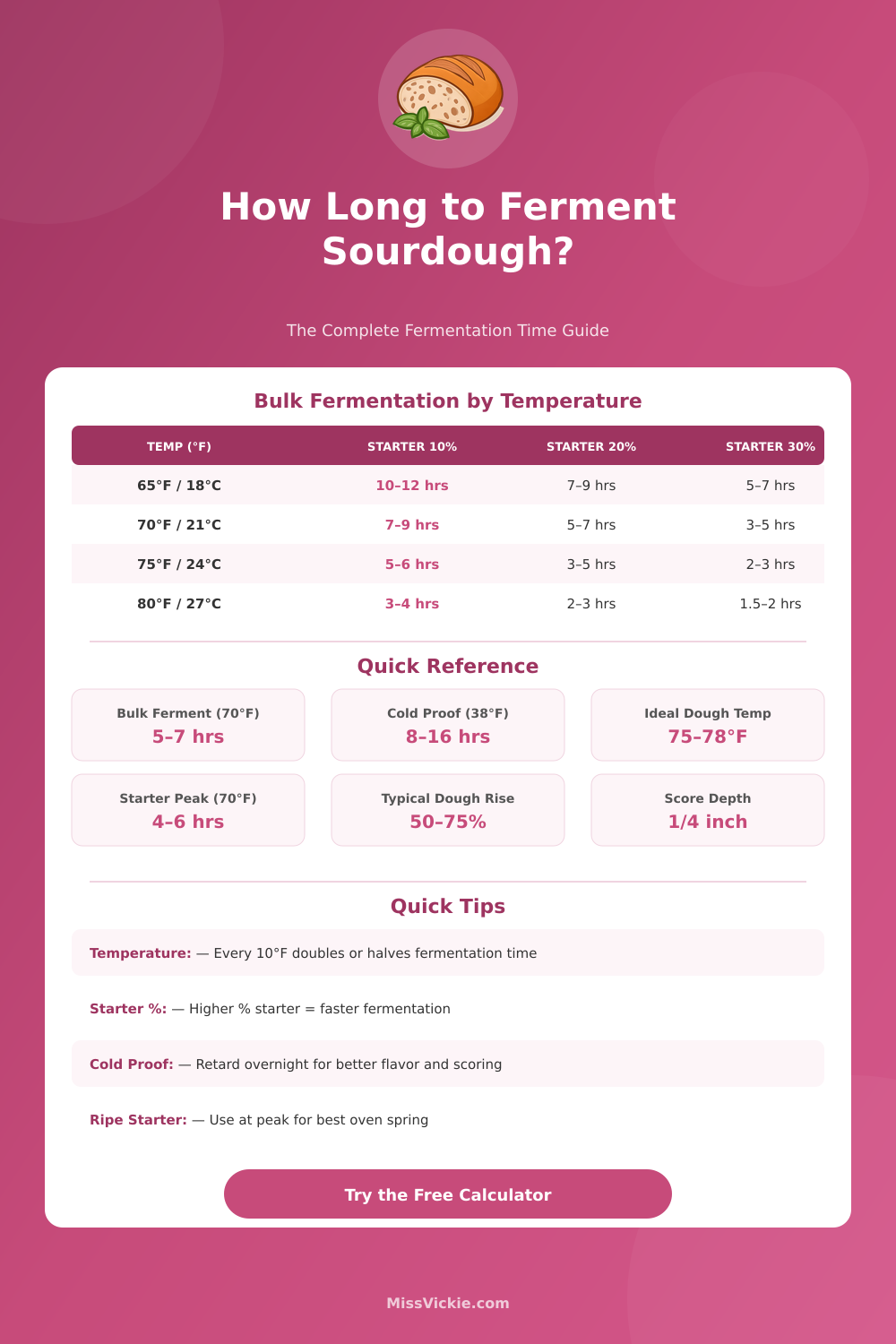
| Temperature | Starter 10% | Starter 20% | Starter 30% |
|---|---|---|---|
| 65°F / 18°C | 10–12 hrs | 7–9 hrs | 5–7 hrs |
| 68°F / 20°C | 8–10 hrs | 6–8 hrs | 4–6 hrs |
| 70°F / 21°C | 7–9 hrs | 5–7 hrs | 3–5 hrs |
| 72°F / 22°C | 6–8 hrs | 4–6 hrs | 3–4 hrs |
| 75°F / 24°C | 5–6 hrs | 3–5 hrs | 2–3 hrs |
| 78°F / 26°C | 3–5 hrs | 2–4 hrs | 1.5–2.5 hrs |
| 80°F / 27°C | 3–4 hrs | 2–3 hrs | 1.5–2 hrs |
| 85°F / 29°C | 2–3 hrs | 1.5–2 hrs | 1–1.5 hrs |
| Hydration % | Dough Feel | Crumb Structure | Best For |
|---|---|---|---|
| 60–65% | Stiff, easy to handle | Tight, chewy | Bagels, sandwich loaf |
| 70–75% | Moderate, slightly tacky | Open, airy | Classic sourdough boule |
| 78–82% | Soft, sticky | Very open, holes | Artisan batard, ciabatta |
| 85–100% | Very wet, shaggy | Large irregular holes | Ciabatta, focaccia |
| Starter % | Ferment Speed | Flavor Profile | Best Use |
|---|---|---|---|
| 5–10% | Very slow (8–14 hrs) | Very sour, complex | Overnight / retard bakes |
| 15–20% | Moderate (4–8 hrs) | Balanced tang | Standard home bakes |
| 25–30% | Fast (2–5 hrs) | Mild, less sour | Same-day bakes |
| 35–50% | Very fast (1–3 hrs) | Mild, yeasty | Quick loaves, pizza dough |
| Cold Proof Duration | Fridge Temp | Flavor Impact | Notes |
|---|---|---|---|
| 4–6 hours | 38–40°F / 3–4°C | Mild tang added | Short retard, easier scoring |
| 8–12 hours | 38–40°F / 3–4°C | Good sour flavor | Overnight — most popular |
| 12–18 hours | 38–40°F / 3–4°C | Full tang, complex | Excellent oven spring |
| 24–36 hours | 38–40°F / 3–4°C | Very sour, deeply complex | For experienced bakers |
| 48–72 hours | 38–40°F / 3–4°C | Extremely sour | Use 10% starter to avoid over-proof |
Sourdough bread is bread that ferments naturally using a sourdough starter instead of commercial yeast or chemical agents like baking powder or baking soda. A live culture of flour and water forms the starter, that naturally raises the dough. You can make it, buy it or receive it from another baker
Naturally occurring yeast and lactobacillus in sourdough raise the dough. They produce lactic acid, that gives a special taste to the bread. To make a starter, you need both yeast and bacteria.
What Is Sourdough Bread?
Yeast are fungi, not bacteria. The culture grows thanks to yeast and bacteria, that fly in the air of the kitchen.
The starter gives a slightly bitter, tangy taste, that simply sticks. Proteins in sourdough bread are more easily digestible for the body. The culture breaks glutenin and gliadin, so the bread becomes more digestible.
It also destroys phytates, that stop the absorb of minerals.
For beginners, strong white bread flour is a good answer. A popular way to make a starter is to mix whole grain flour, for instance rye or wheat, with unsweetened pineapple juice or orange juice, then cover and leave it at room temperture for 24 hours. Some starters are hard to keep alive, especially in cold kitchens.
The simple 1:2:3 method gives a reliable sourdough recipe. It uses one part starter, two parts water and three parts flour, all by weight. Salt goes in at two percent of the flour weight.
For instance: 100 g starter, 200 g water, 300 g flour and 6 g salt.
There are very easy recipes for sourdough. One method entirely skips kneading and shaping. Just mix, wait, pour the wet dough in a pan, wait more and bake.
The result is a wonderful tangy sandwich roll. Another classic recipe gives an oval pain au levain, that is quite tart and rich in taste.
Good sourdough is light inside with a crisp brown crust outside. Before the 19th century it was almost the only leavening. You believe, that it dates from approx. 10 000 BC.
If there is no oven, you can bake in a frying pan. Starter is used not only for bread; think about muffins, pancakes and cakes.
One slice of sourdough bread has around 180 to 200 calories and a lot of carbs. A big slice of French or Vienna style carries about 261 calories. Consume it in moderation, especially if you control bloodsugar.