🍯 Mead Backsweetening Calculator
Calculate exactly how much honey (or sugar) to add to hit your target sweetness level
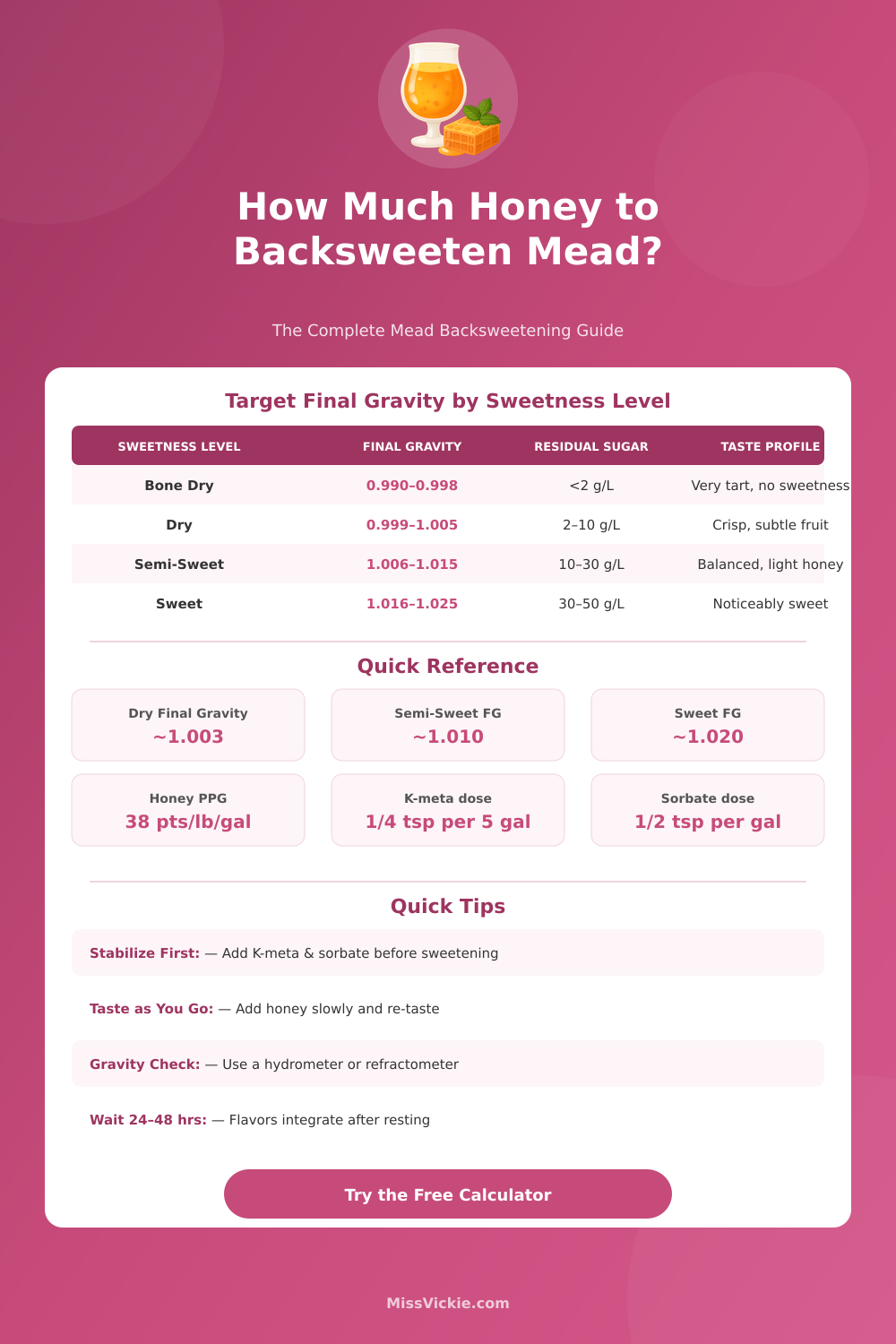
| Sweetness Level | Final Gravity | Residual Sugar | Taste Profile |
|---|---|---|---|
| Bone Dry | 0.990 – 0.998 | <2 g/L | Very tart, no detectable sweetness |
| Dry | 0.999 – 1.005 | 2–10 g/L | Crisp, clean, subtle fruit |
| Semi-Sweet | 1.006 – 1.015 | 10–30 g/L | Balanced honey notes, light sweetness |
| Sweet | 1.016 – 1.025 | 30–50 g/L | Noticeably sweet, rich honey flavor |
| Dessert | 1.026 – 1.040 | 50–80 g/L | Very sweet, syrupy, full honey body |
| Gravity Points Needed | Honey (lbs/gal) | Honey (oz/gal) | Example Use |
|---|---|---|---|
| 5 points (e.g. 1.000 → 1.005) | 0.13 lb | 2.1 oz | Light dry finish |
| 10 points (e.g. 1.000 → 1.010) | 0.26 lb | 4.2 oz | Semi-sweet traditional |
| 15 points (e.g. 1.000 → 1.015) | 0.39 lb | 6.3 oz | Medium-sweet melomel |
| 20 points (e.g. 1.000 → 1.020) | 0.53 lb | 8.4 oz | Sweet holiday mead |
| 30 points (e.g. 1.000 → 1.030) | 0.79 lb | 12.6 oz | Dessert / sack mead |
- 1Confirm Fermentation is Complete — Take gravity readings 3 days apart. If the gravity is stable, fermentation has stopped.
- 2Stabilize the Mead — Add potassium metabisulfite (1/4 tsp per 5 gallons) and potassium sorbate (1/2 tsp per gallon). Stir gently and wait 24–48 hours. This prevents re-fermentation after sweetening.
- 3Calculate the Honey Needed — Use the calculator above to determine how many pounds of honey to reach your target gravity.
- 4Add Honey Slowly — Warm honey slightly to make it pour easily. Add it in small increments, stirring gently between each addition. Taste as you go.
- 5Check Gravity — After adding the calculated amount, take a gravity reading with your hydrometer to verify you hit your target.
- 6Rest and Taste — Allow 24–48 hours for the sweetener to fully integrate. Flavors will mellow and round out after resting.
- 7Bottle or Serve — Once satisfied with the sweetness, bottle your mead. Use wine bottles with corks, or swing-top bottles for short-term storage.
Mead, called honey wine, is alcoholic drink from fermented mix of honey and water. You occasionally add other ingredients, like fruits, spices, grains or hops. The alcohol levels range between around 3.5 % and more than 18 % It probably belongs to the most ancient known alcoholic drinks.
Archaeological digs show mead-like drink in burial rooms, also one linked to King Midas, and traces date until 8,000 years back.
Mead: What It Is and How It Is Made
Mead seems simple to prepare: honey, water and yeast. You ferment the mix, and result is golden. It can be still, carbonated or sparkling.
Also it happens dry, half sweet or sweet. Although like wine, mead differs, because it comes from honey mixed with water, called “must“. Undiluted honey is too rich in sugar to ferment.
Mead you make from honey, beer from malted grain, wine and cider from fruit juice. The mxe is simple.
Although you occasionally call it honey wine, mead is not truly wine. Drinks fermented with honey are not considered meads. Sweetening with honey does not make something mead.
It has its own type.
It is popular to add fruit during the first fermentation. That gives nutrients lacking in honey and helps the process. Some producers make more than ten kinds, which shows the variety.
Before the fermented honey drink showed only at medieval fairs, but now it attracts drinkers, who want to change their routne. Meaderies, big and small, appear across the country during the last years.
Mead does not tolerate mistakes in the preparation. Messes result in truly bad taste. Precise amount of honey is important.
Little sugar is easy to fix. One pound per gallon gives clear mead, two pounds per gallon makes it strong.
Serving sizes depend on the alcohol strength. Gentle meads, like beer in ABV, work in 12-ounce glasses. Intermediate, between 8 and 15 % ABV, taste well from wine or whiskey glasses, with around four ounces.
Standard portion is about five liquid ounces in 12 % ABV. Sparkling meads taste best at around 45 degrees. Clear, fresh meads go with salty snacks like olives, roasted nuts, seafood, smoked salmon or goat cheese.
You use mead also for cooking, for instance mussels for pasta instead of white wine. Somepeople use it.