🍺 Homebrew Refractometer Calculator
Convert Brix readings to OG, FG, and ABV — with fermentation wort correction
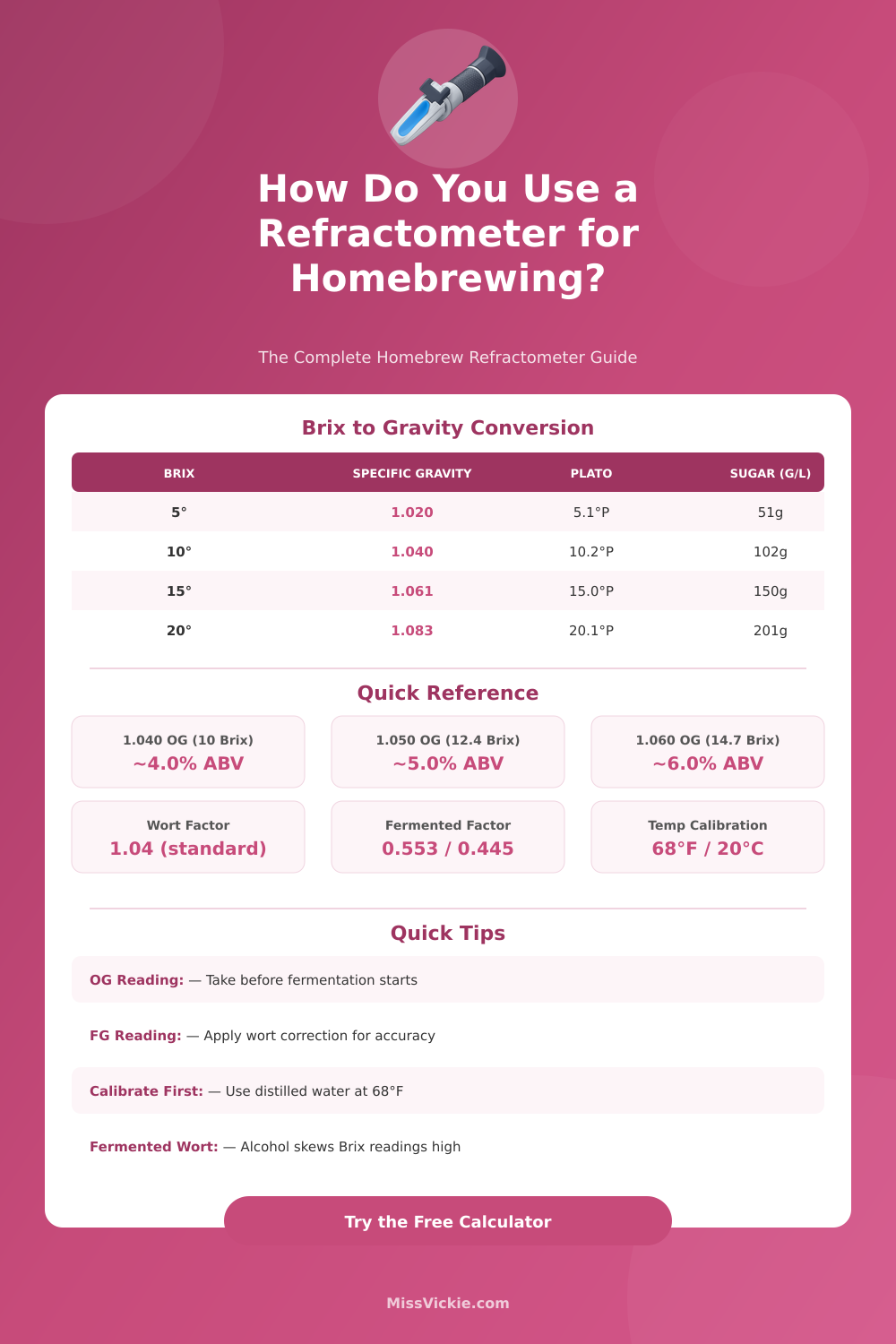
| Brix (°Bx) | Specific Gravity | Plato (°P) | Sugar (g/L) | Potential ABV |
|---|---|---|---|---|
| 4 | 1.016 | 4.1 | 41 | 2.1% |
| 6 | 1.023 | 6.0 | 60 | 3.1% |
| 8 | 1.031 | 8.1 | 81 | 4.1% |
| 10 | 1.040 | 10.2 | 102 | 5.2% |
| 12 | 1.048 | 12.0 | 120 | 6.2% |
| 14 | 1.057 | 14.0 | 140 | 7.3% |
| 16 | 1.065 | 16.0 | 160 | 8.4% |
| 18 | 1.074 | 18.1 | 181 | 9.6% |
| 20 | 1.083 | 20.1 | 201 | 10.8% |
| 22 | 1.092 | 22.1 | 221 | 12.0% |
| 25 | 1.105 | 25.0 | 250 | 13.7% |
| 30 | 1.127 | 30.0 | 300 | 16.6% |
| OG Brix | FG Brix (apparent) | True FG (SG) | ABV | Attenuation |
|---|---|---|---|---|
| 10.0 | 5.0 | 1.008 | 3.9% | 80% |
| 10.0 | 6.0 | 1.010 | 3.4% | 75% |
| 12.4 | 6.0 | 1.009 | 4.9% | 81% |
| 12.4 | 6.5 | 1.010 | 4.6% | 79% |
| 14.7 | 7.5 | 1.011 | 5.8% | 80% |
| 14.7 | 8.0 | 1.013 | 5.5% | 78% |
| 17.0 | 8.5 | 1.013 | 7.0% | 82% |
| 17.0 | 9.0 | 1.014 | 6.7% | 80% |
| 20.0 | 10.0 | 1.015 | 8.5% | 82% |
| Sample Temp (°F) | Sample Temp (°C) | Brix Correction | Notes |
|---|---|---|---|
| 50°F | 10°C | −0.5 Brix | Subtract from reading |
| 59°F | 15°C | −0.25 Brix | Slight subtraction |
| 68°F | 20°C | 0 Brix | Calibration standard |
| 77°F | 25°C | +0.3 Brix | Add to reading |
| 86°F | 30°C | +0.8 Brix | Add to reading |
| 95°F | 35°C | +1.5 Brix | Significant correction |
| 104°F | 40°C | +2.3 Brix | Large correction needed |
Refractometers are one of those tools that simplify homebrewing. It measures sugar in liquid with only some drops, really useful, because hydrometers need much more liquid. This way you save amount during the process and do not lose product to check values at various moments
Most home brewers choose refractometers with double scale for Brix and specific gravity. They work well to track measures during the whole fermentation and brewing. It does not matter whether you use wort, fruit or juice, a refractometer helps to estimate also the ABV.
How to Use a Refractometer in Home Brewing
Especially for all-grain brewing shine refractometers for fast gravity control on mash runoff or while boiling. Good 0… 30 Brix models reach accuracy of 0.2 or 0.3 Brix; not as tight as a hydrometer, but that does not matter.
The advatnage is the speed. When cooling wort for a hydrometer test kills the rhythm, a refractometer gives immediately the result.
Here it gets hard. Refractometers work well for original gravity values, but fail after fermentation starts and alcohol appears. Alcohol bends light different than sugar, so the numbers get messed up.
Here help calculators for corrections, they convert pre-fermentation Brix to gravity, adapt middle and final readings, estimate ABV and find original gravity from current data. Different tools give a bit different results, so averaging some smooths the results.
Even so a hydrometer wins in reliability and general accuracy. Most brewers use a float hydrometer as their main tool, because refractometers shine on brew day, but hydrometers handle final gravity measures better. Use both for original control gives the most trust in your data.
Here people often err: if your refractometer was not calibrated for beer wort or grape juices, it only gives a rough guess of original gravity. Calibration really matters. Test it with distilled or RO water, and if it shows some points too low, then adjust.
Wort correction factors play a role. Adjusting start and final gravity with that help to clear the whole picture.
Most refractometers have ATC, automatic temperature compensation… A standard feature now. Also exist digital versions if you prefer.
They are not difficult, but spend a minute to check features before you buy. In the 18, 30 dollar range most perform similarly and work well enough for homebrewing.