🍺 Homebrew Yeast Calculator
Calculate pitching rate, cell count, starter size, and viability for your homebrew
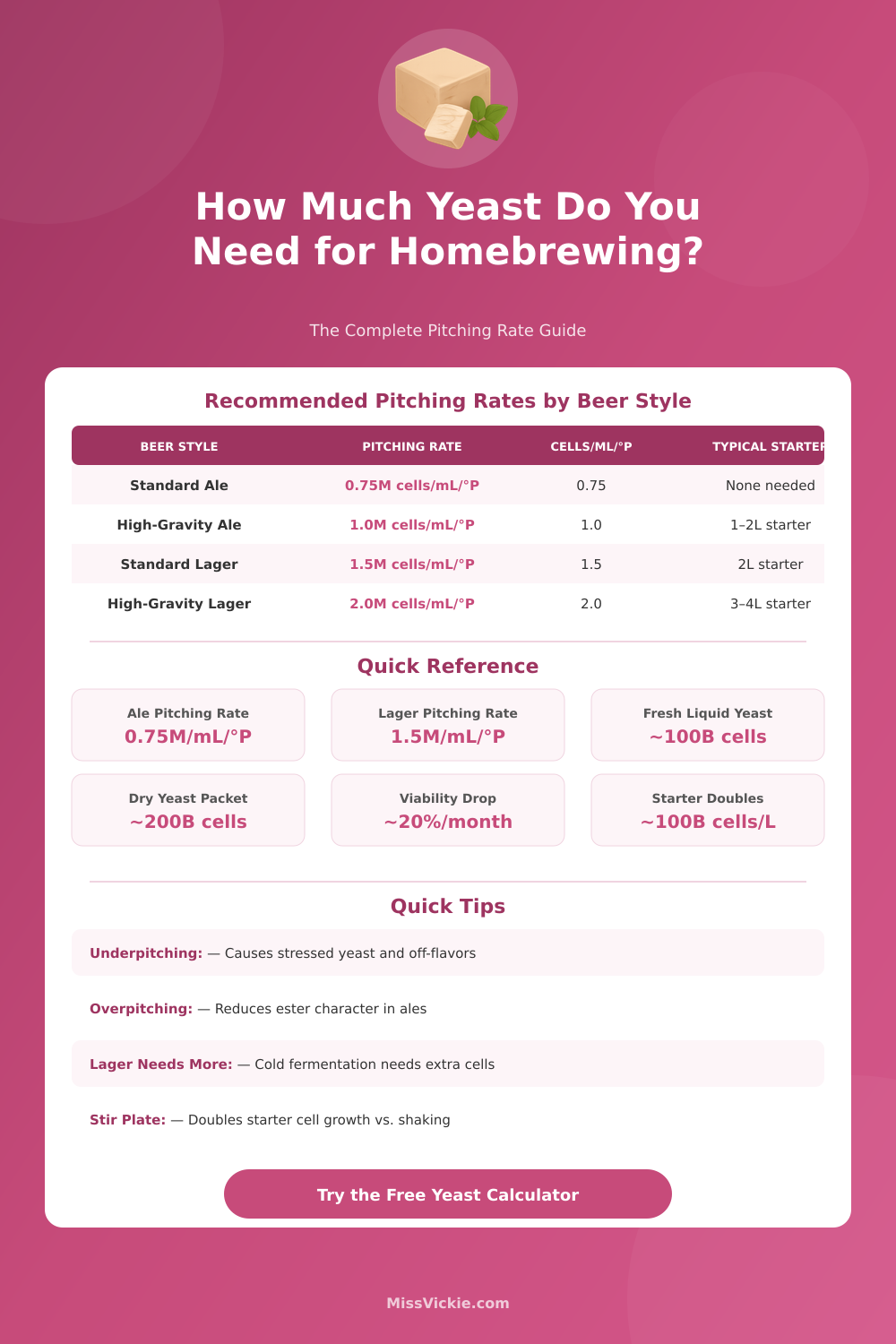
| Beer Style | OG Range | Rate (M/mL/°P) | 5G @ 1.050 Needs |
|---|---|---|---|
| Standard Ale | 1.030 – 1.075 | 0.75 | ~175B cells |
| High-Gravity Ale | > 1.075 | 1.00 | ~233B cells |
| Wheat Beer | 1.040 – 1.060 | 0.75 | ~175B cells |
| Standard Lager | 1.030 – 1.060 | 1.50 | ~350B cells |
| High-Gravity Lager | > 1.060 | 2.00 | ~466B cells |
| Months Old | Liquid Yeast Viability | Cells in 1 Pack (~100B) | Action Needed |
|---|---|---|---|
| 0 – 1 month | ~97% | ~97B | Likely no starter |
| 2 months | ~79% | ~79B | Consider starter for lagers |
| 3 months | ~61% | ~61B | Starter recommended |
| 4 months | ~43% | ~43B | Starter required |
| 5 months | ~26% | ~26B | Large starter required |
| 6 months | ~9% | ~9B | Consider fresh yeast |
| Starter Volume | Cells Added (No Stir) | Cells Added (Stir Plate) | Total from 100B Pack |
|---|---|---|---|
| 0.5L | +25B | +50B | 125–150B |
| 1.0L | +50B | +100B | 150–200B |
| 1.5L | +75B | +150B | 175–250B |
| 2.0L | +100B | +200B | 200–300B |
| 3.0L | +150B | +300B | 250–400B |
| 4.0L | +200B | +400B | 300–500B |
| Original Gravity (OG) | Degrees Plato (°P) | Style Example | Ale Cells Needed (5G) |
|---|---|---|---|
| 1.030 | 7.6°P | Session Ale / Light Lager | ~107B |
| 1.040 | 10.0°P | Wheat Beer / Kolsch | ~140B |
| 1.050 | 12.4°P | Pale Ale / Amber Ale | ~174B |
| 1.060 | 14.7°P | IPA / Porter | ~206B |
| 1.075 | 18.2°P | Double IPA / Strong Ale | ~255B |
| 1.090 | 21.6°P | Imperial Stout / Barleywine | ~605B (high-grav) |
| 1.100 | 23.8°P | Russian Imperial Stout | ~666B (high-grav) |
Brewing yeast is the most important of the four main ingredients: hops, malt, water and yeast. Without it you only get bitter grain water that never fermented. Grain, water and hops all matter, but yeast genuinely decides if the beer succeeds or fails
Homebrewers can use many kinds of yeast strains. Some of them occasionally simply are not available. For the quality of the finished beer it matters to choose the right yeast strain.
Yeast Is the Most Important Ingredient in Beer
Homebrewers find yeast in two forms: liquid and dry. Both work well and give good beer if you care for them and use them correctly. More strains are liquid than dry, but dry yeast is a good and viable altrenative for liquid yeast during homebrewing.
More than 50 dry yeast strains can compete with liquid options.
Ale and lager yeasts are the two most common kinds. One packet of dry yeast suffices for most ale beers of middle density. Liquid packets have different amounts and commonly require two for some ale.
Lager beers require double because they ferment cold. The official advice is use two packets of dry yeast for lager because of the low temperature. One packet weigths around 11 grams.
US-05 is dry yeast that each homebrewer should have. It works well for IPAs when you want simple fermentation character. Wyeast 1056 and WLP001 are liquid matches.
All of them give alike taste, but US-05 attenuates more strongly on average. S-04 works also well, but the esters and taste it creates do not please everyone. It distinctly separates itself and forms firm yeast cakes after fermentation, which is a bonus.
The best way to ensure active and ready yeast is to prepare a yeast starter. Every yeast strain, including lager, you incubate at 70°F for fast growth. Starter cultures can seem less active than a full batch.
The most reliable sign of activity is the density reading. Starters look commonly milky or cloudy during fermentation and clear with white sediment ultimately.
Yeast nutrient is made up of a complex mix of useful things for yeast. One of them is FAN, that yeast uses for good activity. You say that fruits like raisins give it well, but that is not genuinely true.
More yeast helps to close more quickly and shorten lag time. One of the main secrets for good beer is a healthy, unstressed yeastpopulation.