🍺 Homebrew Carbonation Calculator
Calculate priming sugar, CO2 volumes, and bottle counts for perfect carbonation every time
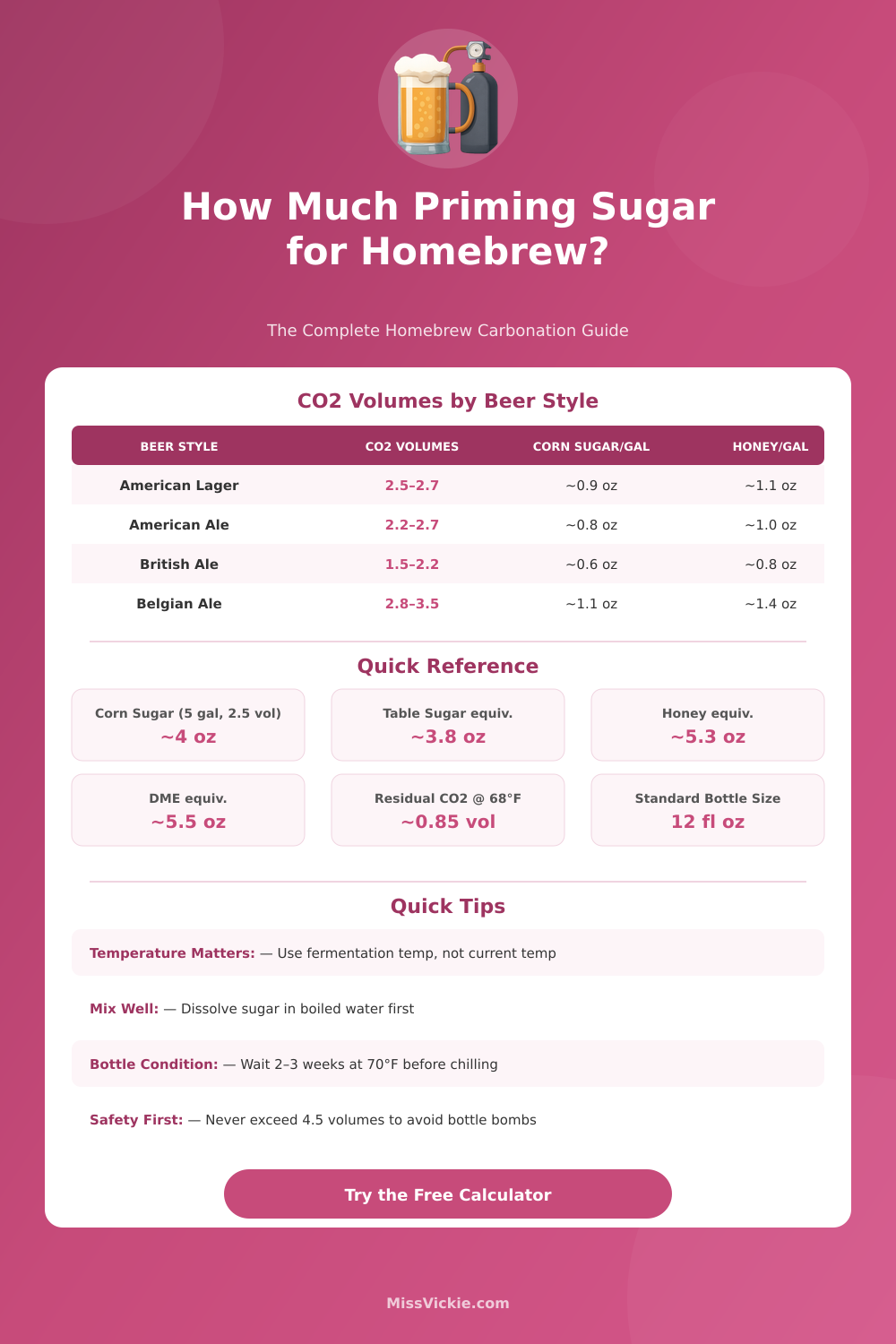
| Sugar Type | Amount (oz) | Amount (g) | Notes |
|---|---|---|---|
| Corn Sugar (Dextrose) | 4.0 oz | 113 g | Most common, reliable, clean flavor |
| Table Sugar (Sucrose) | 3.8 oz | 108 g | Slightly cidery at high amounts |
| Honey | 5.3 oz | 150 g | Adds subtle honey character |
| Dry Malt Extract (DME) | 5.5 oz | 156 g | Adds malty body; light DME preferred |
| Brown Sugar | 4.0 oz | 113 g | Adds molasses notes; great for stouts |
| Beer Temp (°F) | Beer Temp (°C) | Residual CO2 (vol) | Common Use |
|---|---|---|---|
| 32°F | 0°C | 1.65 vol | Lagering temperature |
| 40°F | 4°C | 1.46 vol | Cold crashing / refrigerator |
| 50°F | 10°C | 1.22 vol | Cold ale fermentation |
| 60°F | 16°C | 0.99 vol | Cool basement fermentation |
| 65°F | 18°C | 0.90 vol | Typical ale fermentation |
| 68°F | 20°C | 0.85 vol | Standard room temperature |
| 72°F | 22°C | 0.79 vol | Warm ale / Belgian fermentation |
| 75°F | 24°C | 0.74 vol | Saison / summer fermentation |
| Container Size | Volume | Bottles Needed | Notes |
|---|---|---|---|
| 12 fl oz bottle | 355 ml | ~53 bottles | Standard beer bottle |
| 16 fl oz pint | 473 ml | ~40 bottles | Pint swing-top or screw-top |
| 22 fl oz bomber | 650 ml | ~29 bottles | Large sharing bottle |
| 64 fl oz growler | 1.89 L | ~10 growlers | Reusable jug; less ideal for bottle conditioning |
| 750 ml Belgian | 750 ml | ~25 bottles | Champagne-style; good for high-carb styles |
Homebrew of beer, wine, cider and mead happens at home. This hobby attracts brewers, mazers, vintners and cider makers equally. The community of homebrewers wants that every neighbourhood have its homebrewer and every community its club.
We celebrate the art, science and joy of fermentation while we build expert folks for today and tomorrow
Homebrewing for Beginners
Homebrew of beer was not legal according to federal law until 1978. Before ban it indeed already was allowed, and even George Washington himself did beer home. That bit of history surprises many foks.
The usual size of batch for homebrew recipes is 19 liters, or 5 American gallons. Many homebrewers like to put the beer in Cornelius kegs, that takes exactly that much. For beginners, sets for 2.5-gallon brew-in-a-bag can be good start for all-grain brewing.
Some reckon that it is the best size.
Entering the hobby is simple with starter kits for home brewing or with recipes. Stores sell ingredients for home brewing and wine making of good quality, occasionally with free shipping for big orders. In the community folks commonly discuss yeast, grain, kits and other materials.
There are also programs for design homebrew recipes with calculators, planners for brew days and journals, that help to produce the best beer always.
Online forums form a big part of the homebrew world. They cover general topics, all-grain brewing, change of recipes, as well as wine and mead making. Some forums are friendly groups from United Kingdom and other lands, that address recipes for beer, wine, cider and mead together with kits for home brewing.
The method “try and adjust” works well, and there is always a place to ask.
One interesting fact is that a nearby homebrew store commonly has a wide range of barley malts and less usual types as wheat, rye and spelt. Bakers occasionally go over there for those ingredients. Some bakers even tried making bread from their homebrew mash, although the bread commonly turns out too soft and the interior is not fully cooked.
Cooking with beer is another side of the hobby. The notion of Homebrew Chef consists in sharing tips for using beer in everyday and festive foods. From mustard seeds and a food processor you can make homemade beer mustard.
Recipes for mayonnaise and aioli also match with the homebrew life. Multi-course dinners with beer happen with owners of pubs and craft brewers, using recipes that can scale with beer as an ingredient.