🍺 Homebrew Gravity Calculator
Calculate OG, FG, ABV, attenuation, and Brix conversions for beer, wine & mead
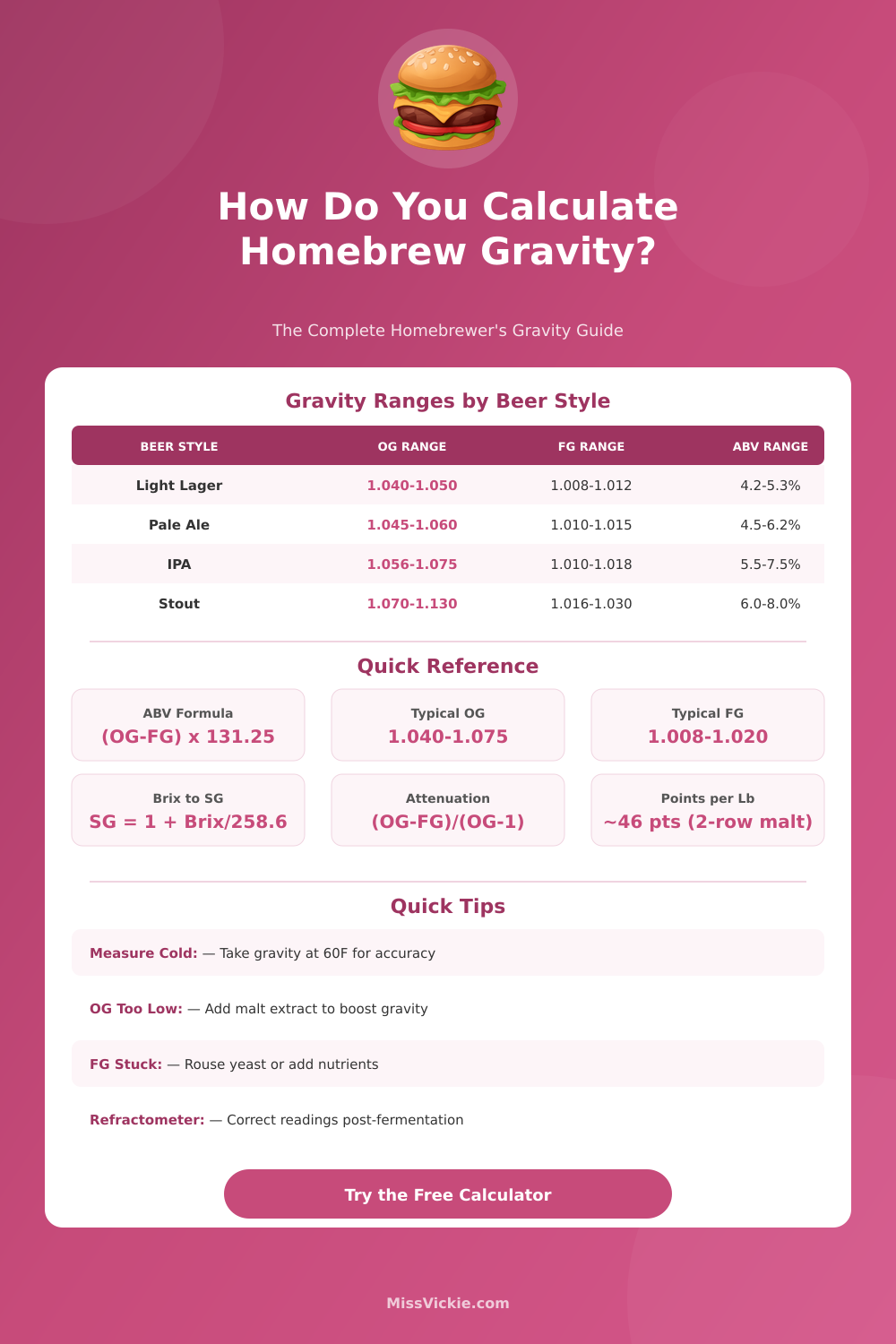
| Beer Style | OG Range | FG Range | ABV Range | Attenuation |
|---|---|---|---|---|
| American Light Lager | 1.026-1.040 | 1.006-1.010 | 3.2-4.2% | 75-80% |
| American Lager | 1.040-1.050 | 1.008-1.012 | 4.2-5.3% | 75-80% |
| American Pale Ale | 1.045-1.060 | 1.010-1.015 | 4.5-6.2% | 73-80% |
| India Pale Ale (IPA) | 1.056-1.075 | 1.010-1.018 | 5.5-7.5% | 73-80% |
| Double / Imperial IPA | 1.075-1.100 | 1.012-1.020 | 7.5-10.0% | 75-82% |
| American Amber Ale | 1.045-1.060 | 1.010-1.015 | 4.5-6.2% | 70-76% |
| American Stout | 1.050-1.075 | 1.010-1.022 | 5.0-7.0% | 70-76% |
| Russian Imperial Stout | 1.075-1.130 | 1.018-1.030 | 8.0-12.0% | 72-78% |
| Belgian Witbier | 1.044-1.052 | 1.008-1.012 | 4.5-5.5% | 75-82% |
| Belgian Tripel | 1.075-1.085 | 1.008-1.014 | 7.5-9.5% | 80-85% |
| Hefeweizen | 1.044-1.052 | 1.010-1.014 | 4.9-5.6% | 73-80% |
| Saison | 1.048-1.065 | 1.006-1.010 | 5.0-7.0% | 80-88% |
| English Barleywine | 1.080-1.120 | 1.018-1.030 | 8.0-12.0% | 68-72% |
| Style | Starting OG | Finishing FG | ABV | Sweetness |
|---|---|---|---|---|
| Dry Table Wine | 1.070-1.085 | 0.990-1.000 | 10.0-12.0% | Dry |
| Semi-Dry Wine | 1.080-1.095 | 1.002-1.010 | 10.0-13.0% | Off-Dry |
| Semi-Sweet Wine | 1.085-1.105 | 1.010-1.020 | 10.0-13.0% | Semi-Sweet |
| Sweet Dessert Wine | 1.100-1.130 | 1.020-1.040 | 10.0-14.0% | Sweet |
| Traditional Mead (Dry) | 1.080-1.120 | 0.998-1.010 | 10.0-14.0% | Dry |
| Sweet Mead | 1.100-1.130 | 1.020-1.040 | 10.0-14.0% | Sweet |
| Cyser (Apple Mead) | 1.080-1.120 | 1.005-1.020 | 10.0-14.0% | Varies |
| Fermentable | PPG (Points/Lb/Gal) | Max Yield | Notes |
|---|---|---|---|
| Dry Malt Extract (DME) | 46 | 1.046 | Most consistent, easiest |
| Corn Sugar / Dextrose | 46 | 1.046 | Highly fermentable |
| Liquid Malt Extract (LME) | 37 | 1.037 | Fresh = best results |
| Pilsner Malt | 37 | 1.037 | 75-80% efficiency typical |
| Wheat Malt | 37 | 1.037 | Hazy beers, wheat ales |
| 2-Row Base Malt | 36 | 1.036 | Most common base malt |
| Munich Malt | 35 | 1.035 | Rich malty flavor |
| 6-Row Base Malt | 35 | 1.035 | More husk, more tannins |
| Crystal 60L | 34 | 1.034 | Caramel flavor, body |
| Honey | 35 | 1.035 | Highly fermentable |
| Chocolate Malt | 28 | 1.028 | Roasty, low fermentable |
| Brix / Plato | Specific Gravity | Gravity Points | Est. Max ABV |
|---|---|---|---|
| 5 Brix | 1.020 | 20 | 2.6% |
| 8 Brix | 1.032 | 32 | 4.2% |
| 10 Brix | 1.040 | 40 | 5.2% |
| 12 Brix | 1.048 | 48 | 6.3% |
| 14 Brix | 1.057 | 57 | 7.5% |
| 16 Brix | 1.065 | 65 | 8.5% |
| 18 Brix | 1.074 | 74 | 9.7% |
| 20 Brix | 1.083 | 83 | 10.9% |
| 22 Brix | 1.092 | 92 | 12.1% |
| 24 Brix | 1.100 | 100 | 13.1% |
| 26 Brix | 1.109 | 109 | 14.3% |
Homebrewing includes everything from making beer and wine to making cider and mead in your own kitchen. It is a hobby that brings together brewers, mazers, vintners and cider makers from all walks of life. The whole community works on an inspiring vision homebrewer in every neighborhood and club in every city.
All moves the same: celebrate and promote fermentation as art and science, while you build a strong community of homebrewers today and pave the way for tomorrow.
Homebrewing Basics and Community
When you choose sizes, 19 liters, around 5 US gallons… Stay the most popular. That comes from Cornelius kegs, that exactly store that amount.
For beginners 2.5-gallon brew-in-a-bag batches could be the best entry to all-grain brewing. Honest folks reckno that it is ideal regardless of your experience.
Here is an interesting history fact: homebrewing was not legal federally until 1978. Well, not entirely. It was allowed before Prohibition.
Even George Washington himself did it.
Local homebrew shops usually sell a crowd of different malts, plus less common grains as wheat, rye and spelt. Many enthusiasts go to stores to discuss fermentation, grains, kits and supplies. Tools as Brewer’s Friend became almost necessary…
They offer a complete beer recipe designer, brewing software, calculators, a brew day planner and a journal for notes to help perfect the next beer.
In the homebrewing world plenty of dogmas circulate about the “right” way to do things. Really works only trying and adjusting according to results. Many browse forums and recipe swaps, then create their own recipes from what sounds attractive and what they learned.
Here you find discussions about everything from general homebrewing and all-grain to recipe swaps, wine making and mead.
Cooking with beer opens a whole new side of the hobby. Sean Paxton, known as the Homebrew Chef, shares his knowledge about food and beer with the community through an online cookbook full of scalable recipes that use beer as a main ingredient. He works with pub owners and craft brewers across the country to arrange exclusive multi-course dinners with beer.
Making homemade beer mustard is extremely easy, you simply mix beer, mustard seeds and use a food processor or mortar.
Some bakers make bread from homebrew mash, although it commonly comes out too wet. The inside no really cooks. A homebrew store can advise about malted wheat flakes or other special grains that work well in baking.
Starting is easy thanks to well rated starter kits and reliable beer recipes. Today you find supplies and great ingredients for brewing and winemaking easy, with free shipping for big orders commonly.