🥃 Moonshine Proof Calculator
Convert proof to ABV, calculate dilution water, and check final volume for any batch
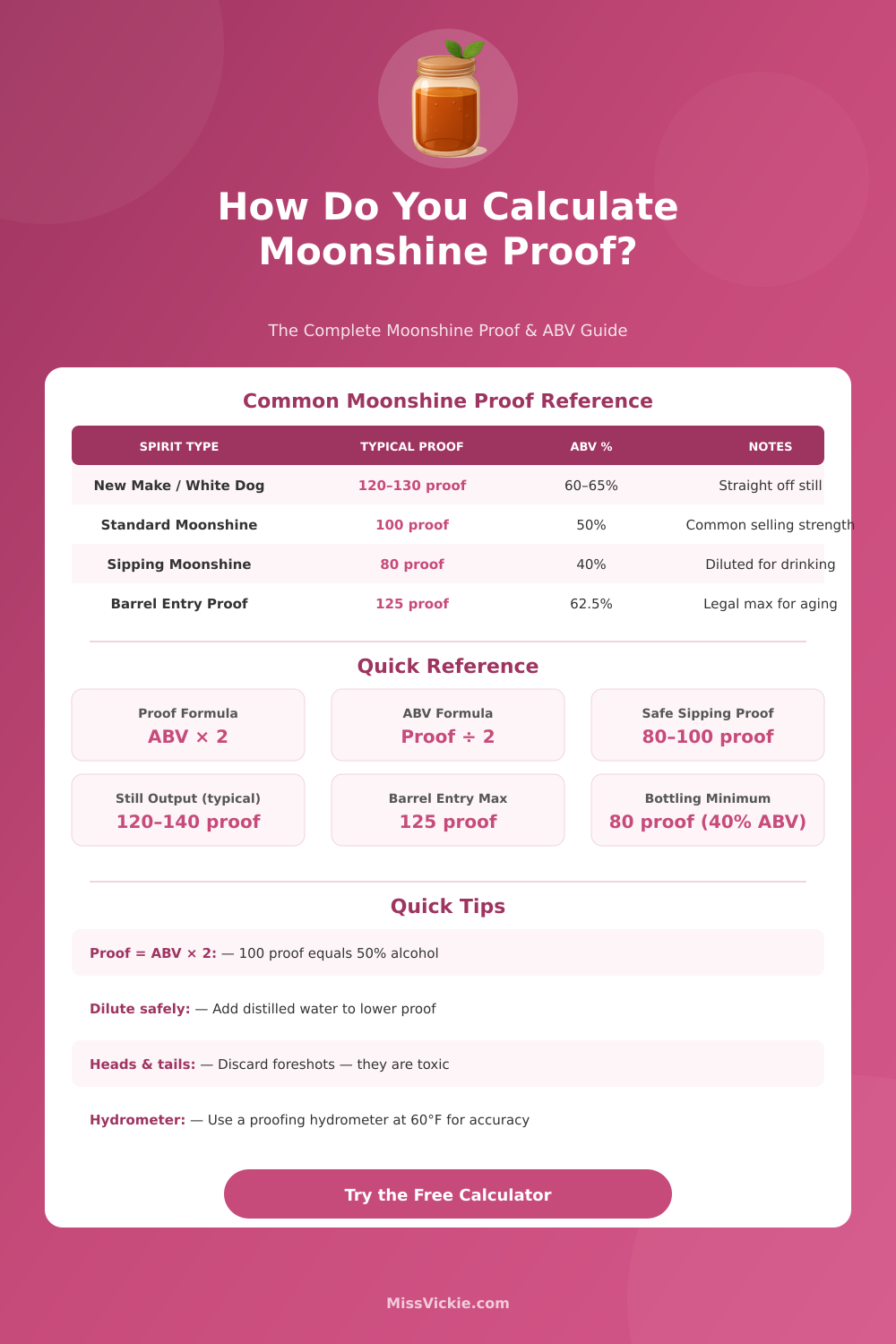
| Proof (US) | ABV % | Spirit Category | Notes |
|---|---|---|---|
| 80 proof | 40% | Standard spirits | Legal minimum for whiskey/vodka |
| 90 proof | 45% | Strong spirits | Common for some bourbons |
| 100 proof | 50% | Bottled-in-bond | US legal standard for BIB |
| 110 proof | 55% | Cask strength | Higher-end bottlings |
| 120 proof | 60% | Moonshine / new make | Common still output |
| 125 proof | 62.5% | Barrel entry max | Legal max for bourbon entry |
| 130 proof | 65% | Moonshine | Typical pot still heart cut |
| 140 proof | 70% | High-proof moonshine | Needs dilution before drinking |
| 160 proof | 80% | Overproof | Often column still output |
| 190 proof | 95% | Neutral spirit | Near maximum distillation |
| Starting Proof | Starting ABV | Water to Add | Final Volume |
|---|---|---|---|
| 90 proof | 45% | 0.125 gal (0.47 L) | 1.125 gal |
| 100 proof | 50% | 0.25 gal (0.95 L) | 1.25 gal |
| 110 proof | 55% | 0.375 gal (1.42 L) | 1.375 gal |
| 120 proof | 60% | 0.50 gal (1.89 L) | 1.50 gal |
| 130 proof | 65% | 0.625 gal (2.37 L) | 1.625 gal |
| 140 proof | 70% | 0.75 gal (2.84 L) | 1.75 gal |
| 160 proof | 80% | 1.00 gal (3.79 L) | 2.00 gal |
| Unit | Gallons (US) | Liters | Fluid Oz |
|---|---|---|---|
| 1 US Gallon | 1.000 | 3.785 | 128 |
| 1 Quart | 0.250 | 0.946 | 32 |
| 1 Liter | 0.264 | 1.000 | 33.8 |
| 750 ml (bottle) | 0.198 | 0.750 | 25.4 |
| 500 ml | 0.132 | 0.500 | 16.9 |
| 1 Fluid Oz | 0.0078 | 0.0296 | 1.000 |
Moonshine is strong liquor that was traditionally made or sold illegally. It is called this because of the custom to distill it at night when the moon shined to not be caught. Distillers that wanted to produce the spirit worked in forests during the night to escape the attention of the police.
They received the name “moonshiner” because they made that liquid under the moon. Also in Scotland people say that folks distilled whiskey during a full moon to work without lamps and not be seen by English tax men from afar
What Is Moonshine?
Purists of moonshine call it homemade unaged corn whiskey with a clear color, base from corn and high alcohol grade. Usually you made it in a home still and put it in mason jars. It has many nicknames like white lightning, corn liquor, stump water, skullcracker, wildcat or ruckus juice.
In the United States “Corn Whiskey” is the official name most alike to classical moonshne.
Some moonshine is made of 80% corn and 20% malted barley. White whiskey is what most distillers call the most difficult task and real sign of skill because you can improve any spirit with barrel aging. For instance, Colorado Clear Mountain Moonshine uses only corn, which gives it a sweet and comfortable taste.
Moonshine itself is not a separate kind of spirit. It simply means that you made it illegally. Many believe that it is unaged corn whiskey and the makers of such whiskey do not stop that thought.
During the first decades of the 21st century, commercial distilleries started to use the word for there own products.
Moonshine reached England through smugglers that moved the liquid along the coast in the late 1700s. Some years after American independence, the idea grew in Pennsylvania because of hate for a liquor tax. Moonshiners wanted to keep their whole profit without paying taxes, so they simply did not tell the government about their production.
Fresh from the still moonshine burns like fire. It has a few tastes, but not many want to drink it a lot. If you put it with charred oak, peach or apple wood for a while, it becomes genuinely good liquor.
It is important to know the alcohol content because it changes the strength and safety. The proof depends on the distiller and varies a lot. One fancy version has 128 proof, clear and pure, exactly what real moonshine should be.
Also you can cook with it, adding it creatively to ingredients.