🍯 Mead Specific Gravity Calculator
Calculate ABV, fermentation progress, sugar content, and mead style from your hydrometer readings
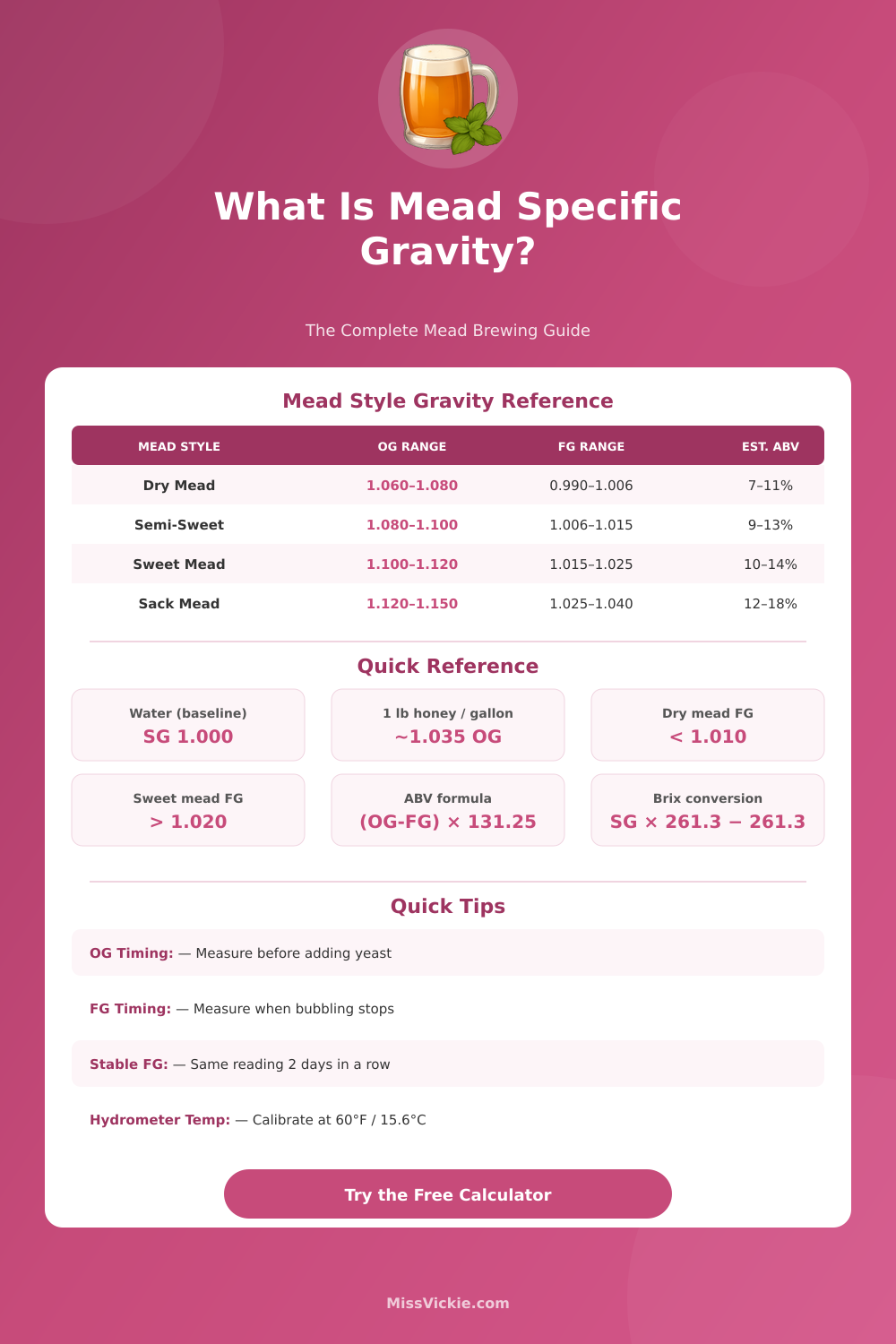
| Mead Style | OG Range | FG Range | Est. ABV | Sweetness |
|---|---|---|---|---|
| Session / Hydromel | 1.040–1.060 | 0.998–1.004 | 5–8% | Very Dry |
| Dry Mead | 1.060–1.080 | 0.990–1.006 | 7–11% | Dry |
| Semi-Sweet Mead | 1.080–1.100 | 1.006–1.015 | 9–13% | Medium |
| Sweet Mead | 1.100–1.120 | 1.015–1.025 | 10–14% | Sweet |
| Sack Mead | 1.120–1.150 | 1.025–1.040 | 12–18% | Very Sweet |
| Great Mead | 1.150+ | 1.040+ | 15–20%+ | Dessert-like |
| Honey Amount | Approx OG | Est. Max ABV | Typical Style |
|---|---|---|---|
| 1.5 lb (680g) | ~1.052 | ~6.8% | Hydromel / Session |
| 2 lb (907g) | ~1.070 | ~9.2% | Dry Mead |
| 2.5 lb (1134g) | ~1.087 | ~11.4% | Semi-Sweet |
| 3 lb (1361g) | ~1.105 | ~13.8% | Sweet Mead |
| 3.5 lb (1588g) | ~1.122 | ~16.1% | Sack Mead |
| 4 lb (1814g) | ~1.140 | ~18.4% | Great Mead |
| Specific Gravity | Brix (°Bx) | Plato (°P) | Sugar / Gallon (approx) |
|---|---|---|---|
| 1.040 | 10.0 | 9.99 | ~5.3 oz (150g) |
| 1.060 | 14.7 | 14.7 | ~8.0 oz (227g) |
| 1.080 | 19.3 | 19.3 | ~10.7 oz (303g) |
| 1.100 | 23.8 | 23.8 | ~13.3 oz (377g) |
| 1.120 | 28.2 | 28.2 | ~15.9 oz (451g) |
| 1.140 | 32.5 | 32.5 | ~18.5 oz (525g) |
| Reading Temp | Correction | Example: Reads 1.060 | True SG |
|---|---|---|---|
| 50°F (10°C) | −0.001 | 1.060 | 1.059 |
| 60°F (15.6°C) | 0 (calibration) | 1.060 | 1.060 |
| 70°F (21°C) | +0.001 | 1.060 | 1.061 |
| 80°F (27°C) | +0.002 | 1.060 | 1.062 |
| 90°F (32°C) | +0.003 | 1.060 | 1.063 |
| 100°F (38°C) | +0.005 | 1.060 | 1.065 |
Mead, also known as honey wine, is an alcoholic drink made by fermentation of honey and water. You commonly mix in fruits, spices, grains or hops. The alcoholic grade ranges between around 3.5% and more than 18% ABV Yeast is added to the mix of honey and water.
Without water, honey is too dense because of sugar and will not ferment alone, hence water is needed.
What Is Mead?
Maybe mead is one of the oldest alcoholic drinks. Archaeological finds showed mead-like drinks in graves, also one linked to King Midas, with traces dating back 8,000 years. Currently it is coming back.
Before you saw the drink only in medieval fairs, but last years brought many meaderies big and small, because folks like to diversify thier habits.
Mead is different from wine and beer. It ferments due to honey sugar, rather than wine from fruit juice and beer from malted grains. Although you call it occasionally honey wine, really it is not wine.
Even honey wines do not count as mead. Because of how it is made and alcohol strength, it is similar to wine more than to beer.
Mead can be still, carbonated or sparkling. It can also be dry, half sweet or sweet. Adding fruit during first fermentation helps to create fruit meads.
Such additions bring nutrients lacking in honey and ease the process. You rule the sugar simply: just pour honey per galon.
Portion size depends on the grade. In light meads in beer-like ABV, you must serve 12 ounces. For medium meads of 8 to 15% ABV use a wine or whisky glass with around four ounces.
Standard ration matches around five liquid ounces at 12% ABV. Heavy mead has 177.5 calories for six-ounce ration, while light base has only 100 calories for six ounces.
Sparkling meads taste best at around 45 degrees. Above 8% ABV you use a wineglass. Mead goes well with salty snacks as olives, roasted nuts, seafood, smoked salmon and goat cheese.
You can even use it in the kitchen, as a replacement for white wine for dishes like mussels with pasta.