🍯 Mead Calculator
Calculate ABV, honey amount, original gravity, and estimated fermentation time for your mead batch
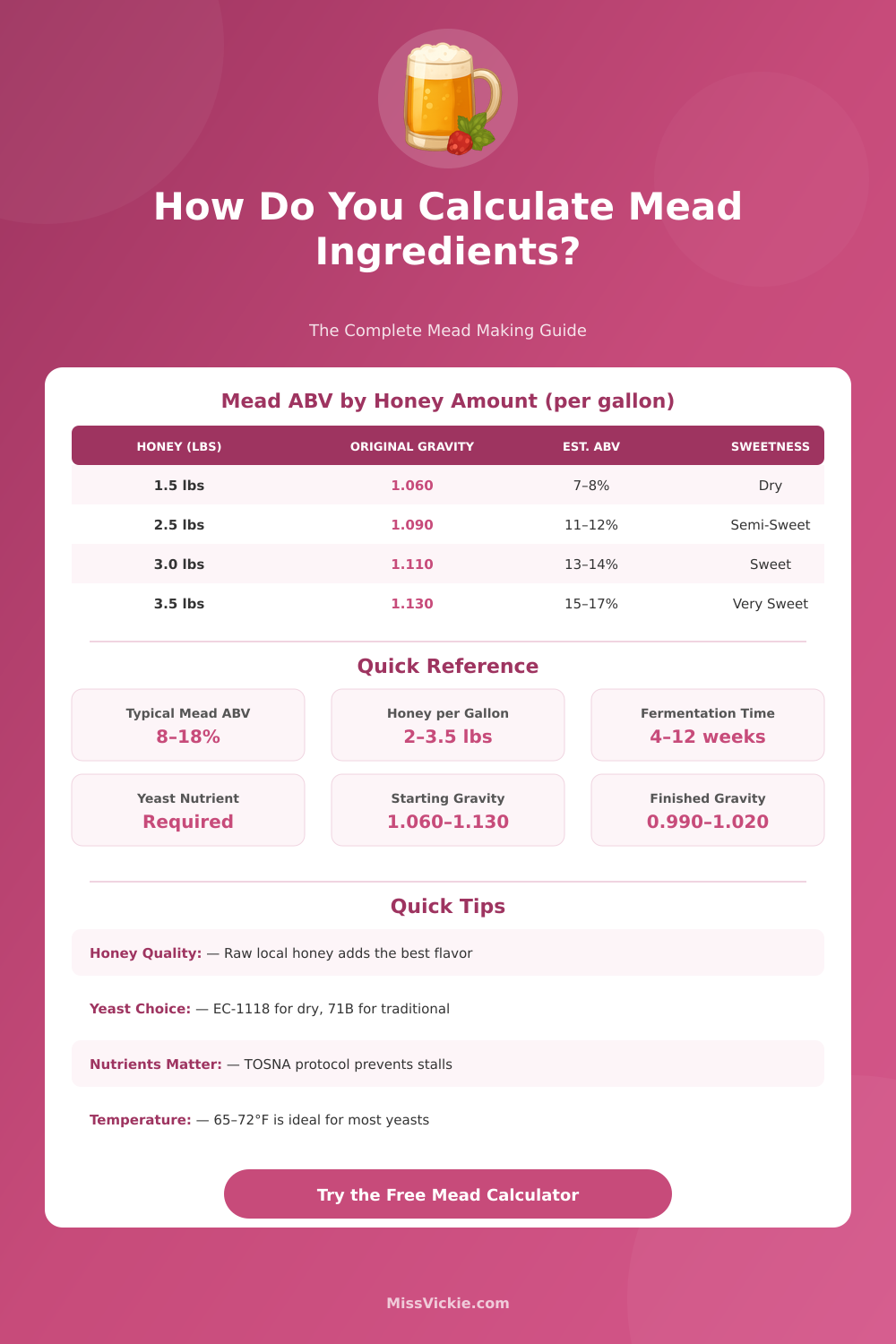
| Honey (lbs/gal) | Honey (kg/3.8L) | Original Gravity | Est. ABV | Sweetness Profile |
|---|---|---|---|---|
| 1.0 lb | 0.45 kg | 1.035–1.040 | 4–5% | Very Dry / Session |
| 1.5 lbs | 0.68 kg | 1.055–1.065 | 7–8% | Dry |
| 2.0 lbs | 0.91 kg | 1.070–1.080 | 9–10% | Dry to Semi-Dry |
| 2.5 lbs | 1.13 kg | 1.090–1.100 | 11–12% | Semi-Sweet |
| 3.0 lbs | 1.36 kg | 1.105–1.115 | 13–14% | Sweet |
| 3.5 lbs | 1.59 kg | 1.125–1.135 | 15–17% | Very Sweet |
| 4.0 lbs | 1.81 kg | 1.140–1.150 | 16–18% | Sack / Dessert |
| Yeast Strain | ABV Tolerance | Ferment Temp | Flavor Notes | Best For |
|---|---|---|---|---|
| Lalvin 71B | 14% | 59–86°F | Fruity, smooth | Traditional, melomel |
| Lalvin D47 | 14% | 50–65°F | Full-bodied, floral | Traditional, cyser |
| EC-1118 Champagne | 18% | 50–86°F | Neutral, clean | Dry, sack, bochet |
| K1-V1116 | 18% | 50–95°F | Fruity, fresh | Melomels, light meads |
| Lalvin D21 | 16% | 59–86°F | Complex, spicy | Bochet, spiced meads |
| RC212 | 13% | 59–86°F | Rich, structured | Traditional, pyment |
| Stage | Timeframe | What to Expect |
|---|---|---|
| Primary Fermentation | Week 1–2 | Active bubbling, cloudy must |
| Secondary Fermentation | Week 2–4 | Slowing activity, yeast settling |
| Clearing / Racking | Week 4–8 | Rack off lees, mead starts clearing |
| Conditioning | Week 8–16 | Flavors mellow and develop |
| Bulk Aging (optional) | 3–12 months | Complex flavor development |
| Bottling | After clear & stable | Gravity stable for 2+ weeks |
| Mead Style | Base Ingredients | Typical ABV | Notes |
|---|---|---|---|
| Traditional | Honey + water | 8–18% | Classic, pure honey flavor |
| Melomel | Honey + fruit | 8–14% | Fruit adds flavor & sugar |
| Cyser | Honey + apple cider | 8–12% | Apple-forward, great for fall |
| Bochet | Caramelized honey | 10–16% | Toasty, caramel, dark flavor |
| Pyment | Honey + grape juice | 10–14% | Wine-mead hybrid |
| Metheglin | Honey + spices/herbs | 8–14% | Spiced or herbed mead |
| Sack Mead | High honey ratio | 14–18% | Very sweet, dessert style |
Mead. Sometimes called honey wine… Is made of fermented honey with water.
Here is the basic simple version. Folks then get creative: mix in fruits, spices, grains or hops and you get something entirely new. The alcohol level changes a lot according to the way it is made, from around 3.5% until more than 18% ABV It can be still, carbonated or sparkling.
Mead — A Very Old Honey Drink
About taste, expect dry, semi-sweet or sweet kinds.
Here is the thing about mead: it is genuinely ancient. Archaeologists found traces of mead-like drinks in graves dating back thousands of years, including one linked to King Midas that dates back around 8,000 years. Today it is having a renaisance.
For a long time it lived in a niche. Something you find at medieval fairs or history events. Now everything changes.
More and more drinkers try it, especially those that want something different than beer or seltzer. Meaderies, big and small, appear everywhere in the land.
Mead seems simple: honey, water, yeast, and leave it ferment. But reality is less soft than the recipe promises. When something fails, it flops badly.
The reason? Pure honey is extremely dense in sugar, so heavy that it will not ferment. Hence diluting it with water is necessary.
Mead belongs to its own kind, not wine nor beer. It uses honey for fermentable sugars, while wine depends on fruits and beer on malts from grains. Although you call it „honey wine“, it is not genuinely wine.
If you add fruit to honey, that is no longer purely mead. It is more like wine in terms of how it is made and strength, but with beer? No comparison.
One commonly mixes fruit during the first fermentation. That adds nutrients that honey alone lacks, boosts the process and ensures a smooth result. Moreover, adjusting the sweetness is easy (just add more or less honey per gallon).
The amount depends on the kind. For gentle mead in beer strength? Twelve ounces work perfectly.
For 8 to 15%, take wine or whisky glasses, around four ounces per serving. In 12% ABV, a standard serving is seven liquid ounces. If sparkling, cool it to around 45 degrees.
A tested main version had in six ounces around 177.5 calories, while a light base had only 100 in the same amount.
Mead goes surprisingly well with salty foods, olives, roasted nuts, seafood, smoked salmon, raspberry and white chocolate cake or goat cheese work well. You can also cook with it. Substitute mead for white wine in mussels for pasta?
It genuinely works well.