☕ French Press Coffee Calculator
Get the perfect coffee-to-water ratio by cup size, strength, and number of servings
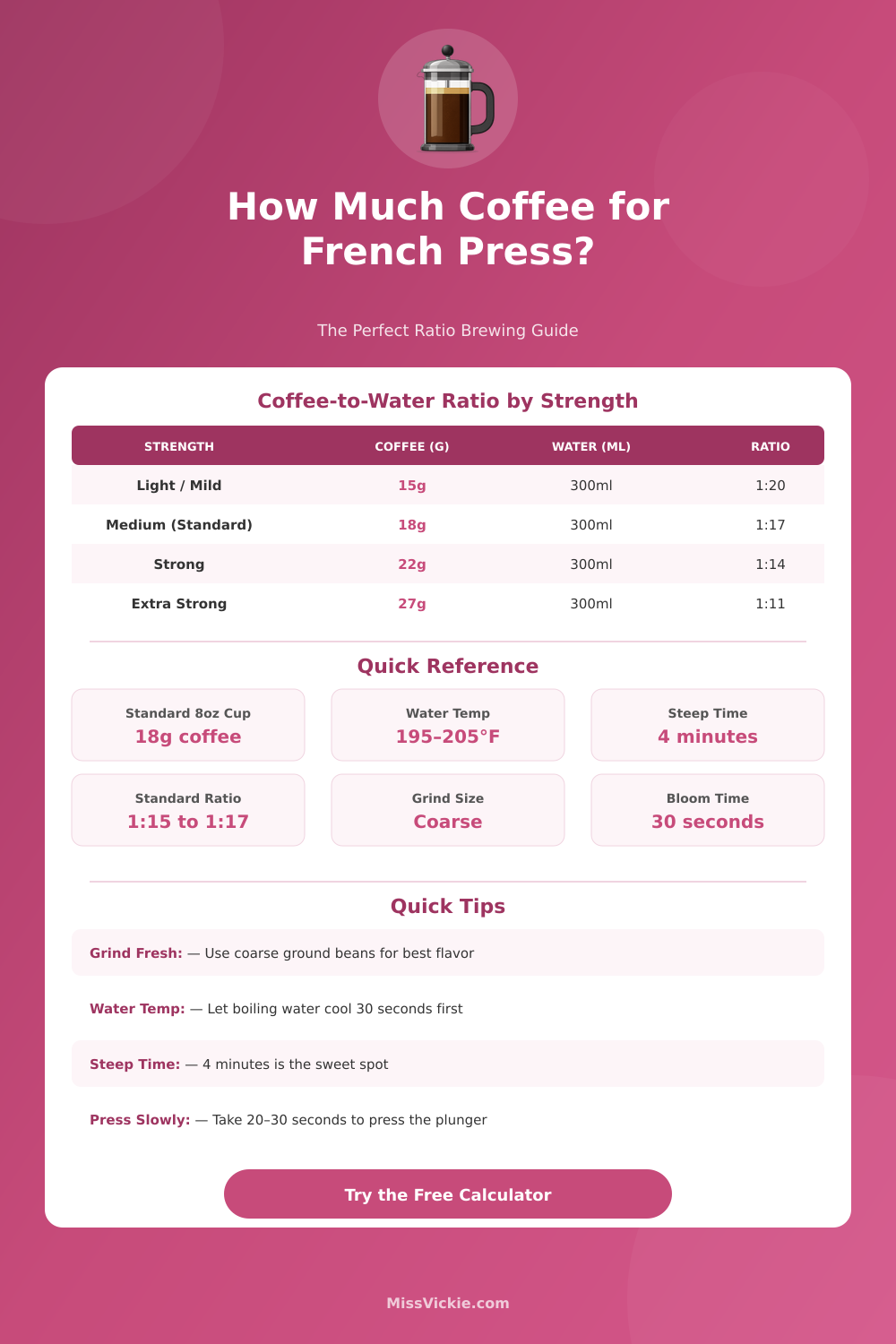
| Water Volume | Light (1:20) | Medium (1:17) | Strong (1:14) | Extra Strong (1:11) |
|---|---|---|---|---|
| 200 ml (6.8 oz) | 10g | 12g | 14g | 18g |
| 300 ml (10 oz) | 15g | 18g | 21g | 27g |
| 350 ml (12 oz) | 18g | 21g | 25g | 32g |
| 500 ml (17 oz) | 25g | 29g | 36g | 45g |
| 750 ml (25 oz) | 38g | 44g | 54g | 68g |
| 1000 ml (34 oz) | 50g | 59g | 71g | 91g |
| Grams of Coffee | Approximate Tablespoons | Teaspoons | Notes |
|---|---|---|---|
| 10g | 2 tbsp | 6 tsp | 1 small cup (light) |
| 15g | 3 tbsp | 9 tsp | 1 standard cup (light) |
| 18g | 3.5 tbsp | ~10.5 tsp | 1 standard cup (medium) |
| 21g | 4 tbsp | 12 tsp | 1 standard cup (strong) |
| 27g | 5.5 tbsp | ~16 tsp | 1 standard cup (extra) |
| 36g | 7 tbsp | 21 tsp | 2 cups (medium) |
French press coffee is one of the simplest ways to enjoy the rich, roasted aromas of coffee. Pour hot water on coarse ground coffee beans, leave it to steep to bring out the tastes, then press. That brew method is much easier than many other ways to brew coffee
A French press is also called a cafetière, press pot, coffee press or coffee plunger. It serves as a coffee brewing device that you can use for various tasks. The device is made of one piece with a glass cylinder and a plunger that has a fine mesh screen.
How to Use a French Press
It comes apart for easy cleaning.
French press coffee is known for its dense, heavy body and strong taste. Because the grains soak entirely in the water and filter through metal mesh instead of paper, more oils and small particles stay in the cup. That gives it a more packed, more robust structure.
Paper filters remove almost all oils and deposits, so filtered coffee has a clear, purer feel. French press coffee should have a richer taste.
All coffee you best grind fresh from whole grains and use immediately. French press gives the best result with coarse ground coffee, because the grounds sit in hot water for around five minutes. If you grind too fine, particles slip through the screen and the cup becomes mduy.
Moreover, pressure can build when you push the plunger down, which makes the process slow and hard.
A good starting amount is two spoons of grounds for one cup water. Heat the water to around 205 degrees, boil it and let it rest 30 seconds. Long brew time gives a stronger taste, but too long a dip brings out bitter notes.
Leaving the coffee in the press is a big mistake, because it causes bitterness.
French presses come in different materials. Glass models allow you to see the brew, but one blow to the edge can break it. Stainless steel is very strong and keeps the heat, something glass cannot do.
Double-walled steel presses keep the coffee close to the brew temperature during the process, while glass commonly cools quickly. Steel however can slightly change the taste.
There is no real difference in taste between a cheap and expensive French press, if you use the same brew method. The press itself matters less than the quality of the coffee in it. Great coffee always will be better, regardless of the method.
French press does not limit the strength of the coffee. Fresh grounds in five minutes simply cannotfail.