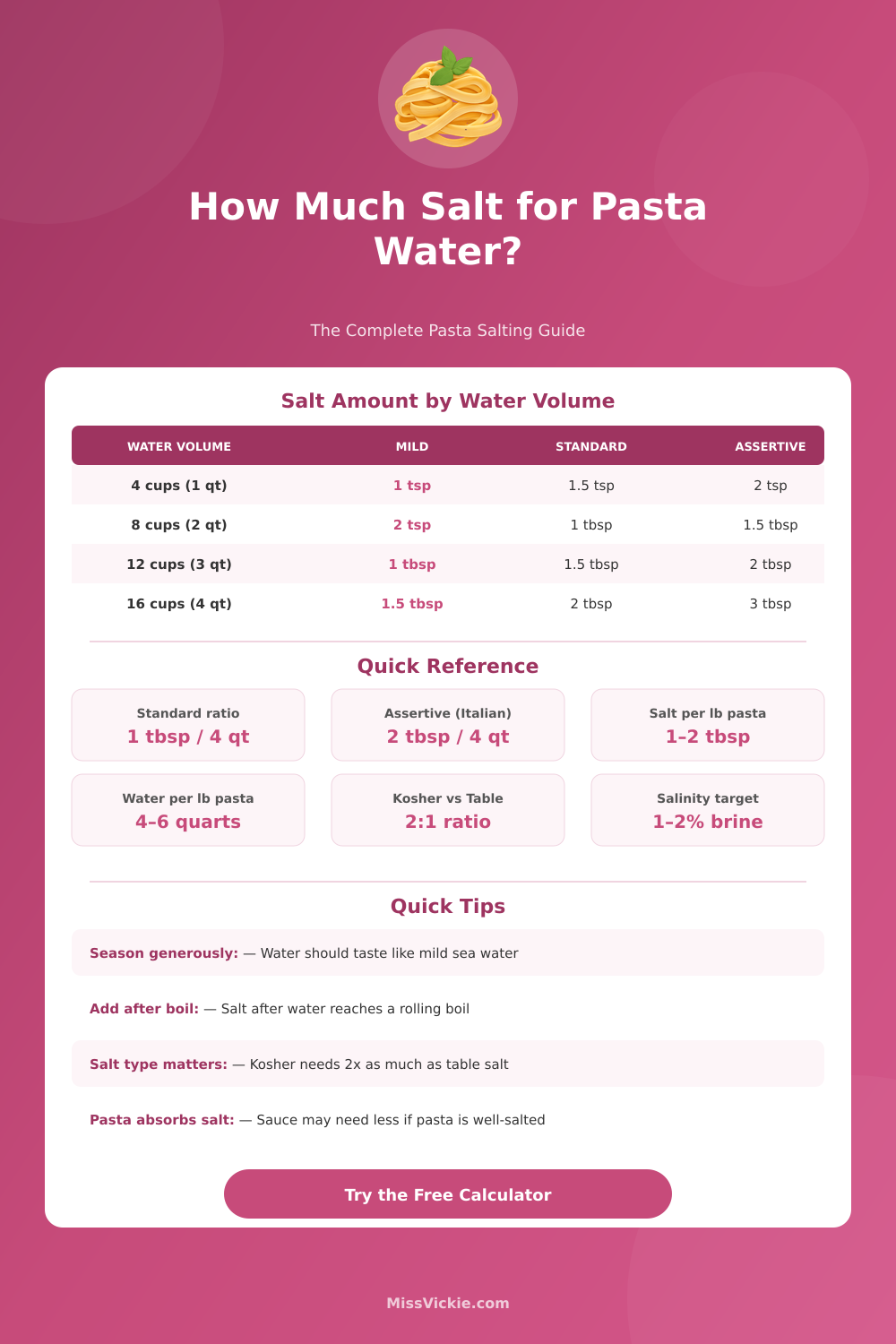
🧂 Pasta Salt Calculator
Find the perfect amount of salt for your pasta water by volume, pasta type, and preferred saltiness
| Water Volume | Mild | Standard | Assertive |
|---|---|---|---|
| 2 quarts (8 cups) | 1.5 tsp | 1.5 tbsp | 1 tbsp |
| 3 quarts (12 cups) | 2 tsp | 2.5 tsp | 1.5 tbsp |
| 4 quarts (16 cups) | 1 tbsp | 1.5 tbsp | 2 tbsp |
| 5 quarts (20 cups) | 1.5 tbsp | 2 tbsp | 2.5 tbsp |
| 6 quarts (24 cups) | 2 tbsp | 2.5 tbsp | 3 tbsp |
| Salt Type | Equivalent to 1 tsp Table Salt | Sodium per tsp | Notes |
|---|---|---|---|
| Table Salt (fine) | 1 tsp | 2,325 mg | Baseline reference |
| Morton Kosher Salt | 1.5 tsp | 1,560 mg | Coarser crystal |
| Diamond Crystal Kosher | 2 tsp | 1,120 mg | Lightest flake |
| Fine Sea Salt | 1 tsp | 2,200 mg | Similar to table |
| Coarse Sea Salt | 1.5 tsp | 1,800 mg | Slightly less dense |
| Pasta Amount | Water (quarts) | Table Salt (standard) | Kosher Salt (standard) |
|---|---|---|---|
| 4 oz (1 serving) | 2 qt | 1.5 tsp | 1 tbsp |
| 8 oz (2 servings) | 3 qt | 2 tsp | 1.5 tbsp |
| 12 oz (3 servings) | 4 qt | 1 tbsp | 2 tbsp |
| 1 lb (4 servings) | 4–5 qt | 1.5 tbsp | 2.5 tbsp |
| 1.5 lbs (6 servings) | 5–6 qt | 2 tbsp | 3 tbsp |
| 2 lbs (8 servings) | 6–8 qt | 2.5 tbsp | 4 tbsp |
Pasta is made from unleavened dough from wheat flour, mixed with water or eggs. You form it in sheets or various shapes, later boil or bake. Before you used only durum wheat for pasta.
It comes in many kinds, for instance spaghetti, penne, fusilli and others Spaghetti is like long noodles.
How to Make and Cook Pasta
For one person enough around 2 ounces of dry pasta. Cooked it is a cup. The amount depends on the form.
Small shapes, as rigatoni or macaroni, weigh more. Cooked pasta almost double its volume, so the eventual amounts range. In Italy you commonly ask, how many grams you want to eat.
Usually you serve it as first plate, after that come second with meat, seafood or vegetables.
At home you prepare fresh pasta from flour, eggs, olive oil and salt. There are also dried, that you buy in stores. Fresh is evident because of its freshness and cook more quickly.
Expensive dried pasta pass through bronze, no teflon, for good surfcae. More slow drying give rich texture after cook.
Cook pasta in big pot with a lot of boiling water. No simmer, but genuinely boil. Water must be salty.
Salt in pasta water matters. Even something simple, as too long cook or late adding of pasta, can identify wonderful Italian meal of bad meal.
Summer recipe includes to cut cherry tomatoes in halves and marinate them with olive oil, basil, garlic, salt and pepper during two hours. Later boil pasta and mix everything with grated parmesan. Other mode is cook noodles directly in pan with tomato juice and a bit of water, similarly to risotto.
If leave them in pan without move, they scorch and form crisp bits at the edges, as if in lasagna.
Light pasta with caramelized fennel and juicy tomatoes already please alone, but you can add seafood. Zucchini and shrimps form delicious pair. Even tricolora spirala pasta becomes favorite because of its colours and enclosed vegetables.
Home pasta-preparation commonly is household festival. Decades you used knives on cutting tables, later machine, now blender with tools. It is a labor, that attaches children.
Home extruders lack reliability, so home extruded pasta have inferior texture than factory dried. But roller gives excellent fresh pasta.