🍞 Aliquot Method Sourdough Calculator
Track your bulk fermentation rise percentage for perfectly timed sourdough every time
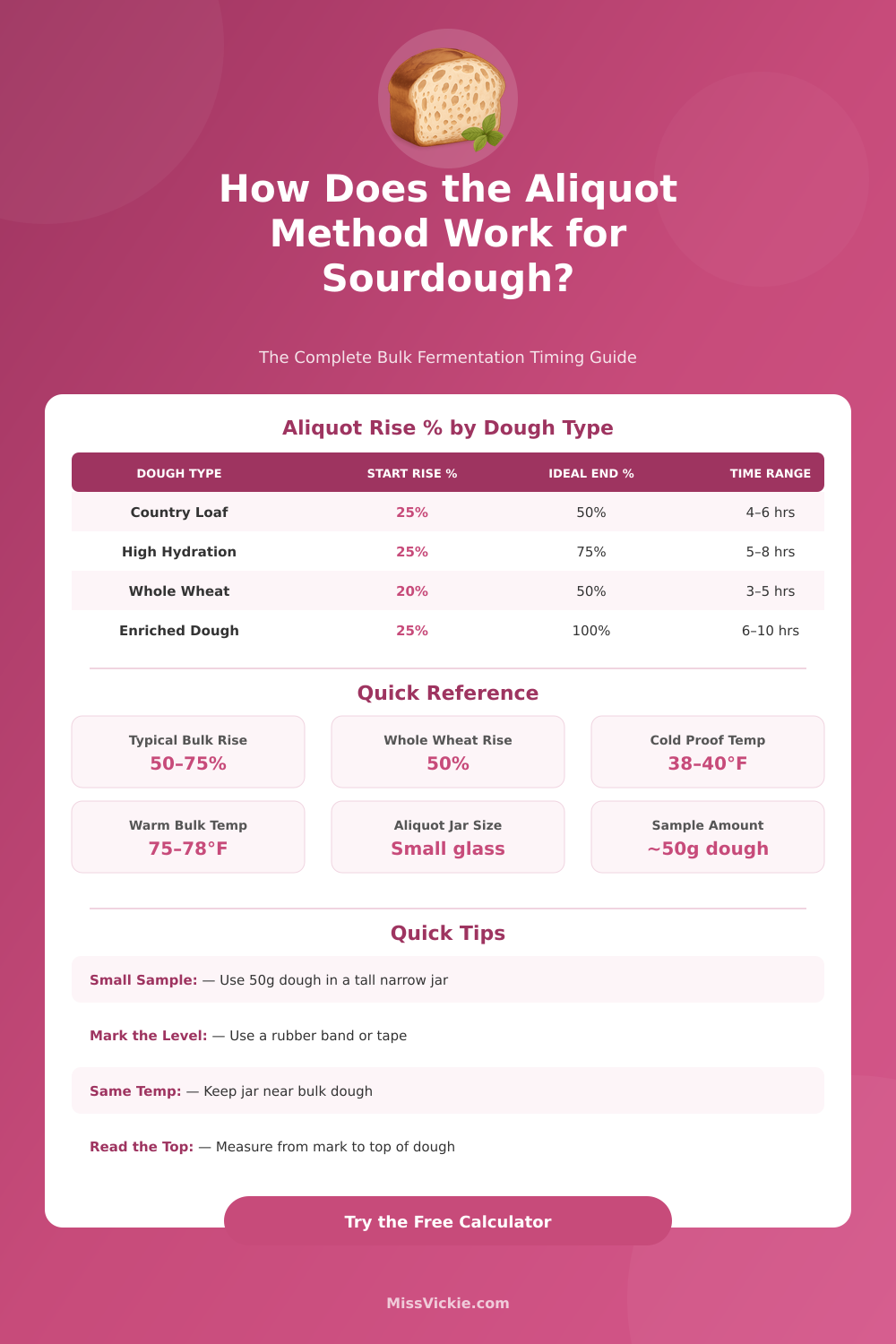
| Dough Type | Recommended Rise % | Approx Bulk Time (76°F) | Crumb Result |
|---|---|---|---|
| Country Loaf (70% hydration) | 50–60% | 4–6 hours | Medium-open, chewy |
| High Hydration (80%+) | 60–75% | 5–8 hours | Open, lacy crumb |
| Whole Wheat Blend (20–30% WW) | 40–50% | 3–5 hours | Moderate crumb |
| 100% Whole Wheat | 30–40% | 2–4 hours | Dense, moist |
| Rye Blend (20–30% Rye) | 35–50% | 3–4 hours | Tight, earthy |
| Enriched (butter/eggs) | 75–100% | 6–10 hours | Soft, fine crumb |
| Baguette Dough | 50% | 3–5 hours | Light, thin crust |
| Focaccia | 75–100% | 4–8 hours | Airy, bubbly |
| Dough Temp | Bulk Fermentation Time | Aliquot Check Interval | Notes |
|---|---|---|---|
| 65°F (18°C) | 8–12 hours | Every 2 hours | Slow, complex flavor |
| 70°F (21°C) | 6–10 hours | Every 90 min | Good for overnight |
| 74°F (23°C) | 5–8 hours | Every 60 min | Standard home bake |
| 76°F (24°C) | 4–6 hours | Every 45 min | Ideal sweet spot |
| 78°F (26°C) | 3–5 hours | Every 30 min | Warmer kitchen |
| 80°F (27°C) | 2–4 hours | Every 20 min | Watch closely |
| 85°F (29°C) | 1.5–3 hours | Every 15 min | Risk of overproof |
| Problem | Likely Cause | Solution |
|---|---|---|
| Dough not rising after 2+ hours | Weak starter, too cold | Move to warmer spot; check starter activity |
| Rising too fast (<2 hrs to 50%) | Too warm, too much starter | Reduce starter % or move to cooler location |
| Aliquot jar shows bubbles but dough flat | Dough too stiff or cold | Increase hydration or dough temp |
| Overproofed (dough slack, sticky) | Left too long past target | Shape quickly, cold retard immediately |
| Dense crumb after baking | Underproofed bulk | Extend bulk until aliquot hits target % |
| Huge holes, gummy center | Overproofed bulk | Reduce target rise % by 10–15% |
| Inconsistent results batch to batch | Aliquot jar not matching bulk temp | Keep jar directly next to bulk dough |
| Step | Action | Details |
|---|---|---|
| 1 | Choose your jar | Tall, straight-sided glass jar (mason jar, deli container, or pill bottle) |
| 2 | Weigh dough sample | Take ~50g of dough right after mixing / first stretch & fold |
| 3 | Place and smooth | Press dough gently into jar, remove large air pockets |
| 4 | Mark the starting level | Use a rubber band, tape, or dry-erase marker at top of dough |
| 5 | Place near bulk dough | Same temperature environment is critical for accuracy |
| 6 | Monitor regularly | Check every 30–60 minutes and measure current height |
| 7 | Calculate rise % | Use this calculator: ((Current - Initial) / Initial) x 100 |
| Starter % | Typical Bulk Time (76°F) | Flavor Development | Best For |
|---|---|---|---|
| 5% | 10–14 hours | Most complex, sour | Overnight bakes |
| 10% | 7–10 hours | Good complexity | Same-day (early start) |
| 15% | 5–8 hours | Mild tang | Standard home bake |
| 20% | 4–6 hours | Mild, slightly sweet | Faster schedule |
| 25–30% | 2–4 hours | Very mild | Same-day quick bake |
Sourdough bread is bread that ferments naturally by sourdough starter instead of commercial yeast or chemicals like baking powder or baking soda Sourdough starter is a live culture of flour and water. It naturally raises the dough without any commercial help. You can make it home, buy it or receive it from another baker.
Sourdough bread raises naturally with yeast and lactobacillus bacteria. The fermentation produces lactic acid, that gives the bread its taste. That a bit acidic, tangy aroma of the starter simply cannot leave us.
What Is Sourdough Bread
To make starter, you need yeast and lactobacilli. Yeast are not bacteria, but fungi.
The sourdough culture breaks glutenin and gliadin, so the bread digests easily. It also destroys phytates, that block the absorb of minerals. Proteins in that bread are indeed more well handled by the body.
The same fermentation process, that creates the typical tangy taste, makes the protein more available.
Strong white bread flour of good quality works well for newcomers. Simple proportion 1:2:3 is very popular: one part sourdough starter, two parts water, three parts flour, everything by weight, plus two percent salt of flour. For instance, 100 g sourdough starter, 200 g water, 300 g flour and 6 g salt.
Easy method for sourdough is surprisingly forgivign. You do not require feeding of the sourdough starter, no kneading of dough and no shaping of loaf. Just mix, wait, pour the wet dough in a pan, wait more and bake.
Classic oval sourdough bread or levain loaf has light tangy taste and deep aroma.
Good sourdough has light, airy insides with crisp brown crust outside. Beginners commonly end up with dense bread. Other mistake is crust too thick, while internal taste is excellent, that happens, when dough is too wet because of lack of flour and flattens during second rise.
Sourdough dates even until 10,000 BC. Until the 19th century it was almost the only available lever. Making it is fun, like a kitchen science experiment.
It tastes good, so that already suffices. Standard serving of home sourdough bread is one slice with around 180 to 200 calories. It is rich in carbs, so eat it in moderation, especially if you care about bloodsugar.