🍺 Homebrew Mash Calculator
Calculate strike water temp, mash water volume, grain absorption, sparge water & brew efficiency
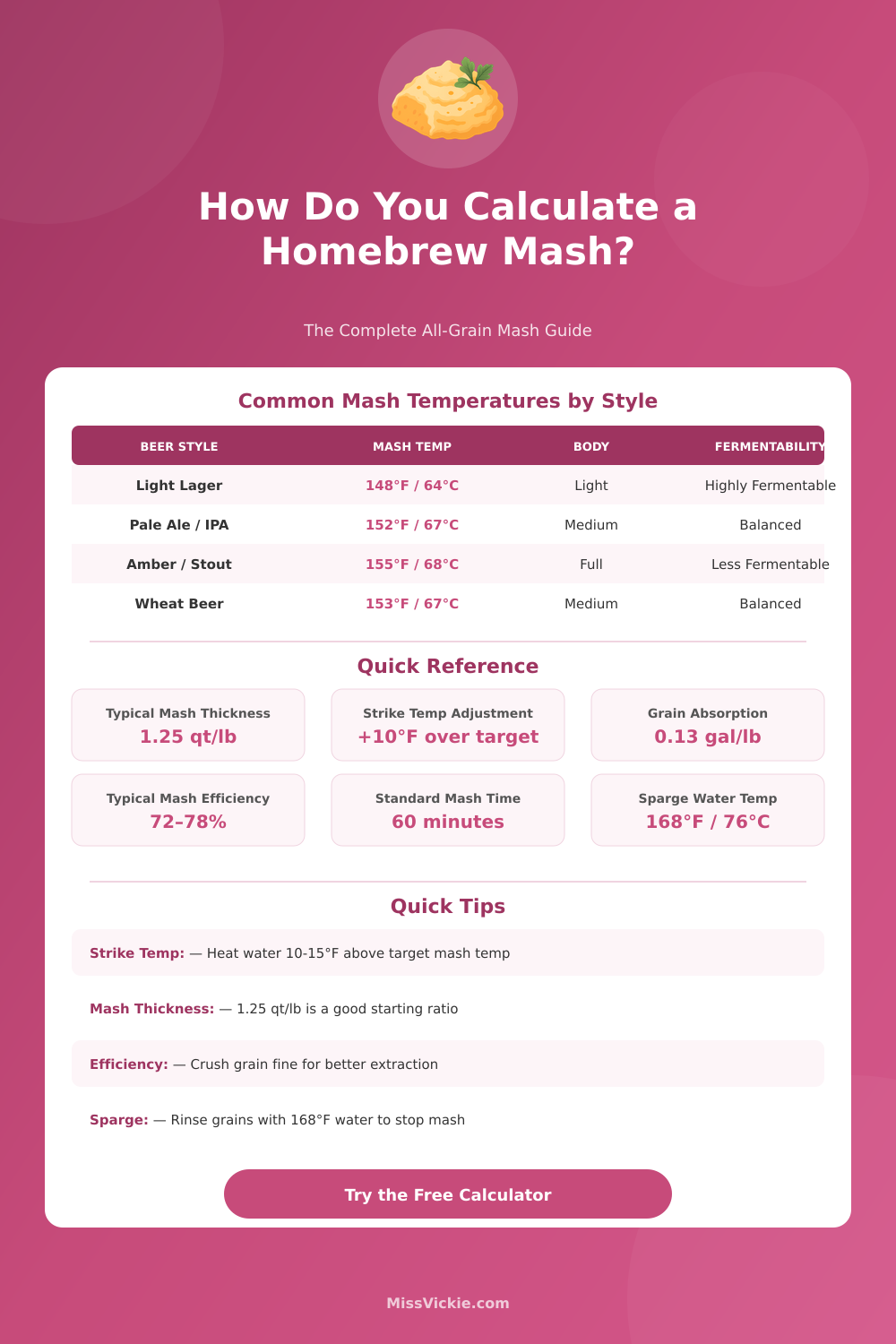
| Beer Style | Mash Temp (°F) | Mash Temp (°C) | Body / Fermentability |
|---|---|---|---|
| Light Lager | 147–149°F | 64–65°C | Very dry, highly fermentable |
| Saison / Belgian | 148–150°F | 64–65°C | Dry, spicy, effervescent |
| Session Ale | 149–151°F | 65–66°C | Light, crisp |
| American Pale Ale | 150–153°F | 66–67°C | Medium, balanced |
| IPA | 150–153°F | 66–67°C | Medium, hop-forward |
| Wheat Beer | 152–154°F | 67–68°C | Medium body, hazy |
| Amber / Red Ale | 153–156°F | 67–69°C | Full, malty |
| Stout / Porter | 153–157°F | 67–69°C | Full, roasty, chewy |
| Barleywine | 154–158°F | 68–70°C | Very full, sweet, rich |
| Oatmeal Stout | 154–156°F | 68–69°C | Silky, full body |
| Mash Ratio (qt/lb) | Water per lb | 10 lb Grain | 15 lb Grain |
|---|---|---|---|
| 1.0 qt/lb (thin) | 0.25 gal | 2.5 gal | 3.75 gal |
| 1.25 qt/lb (standard) | 0.3125 gal | 3.13 gal | 4.69 gal |
| 1.33 qt/lb | 0.3325 gal | 3.33 gal | 4.99 gal |
| 1.5 qt/lb | 0.375 gal | 3.75 gal | 5.63 gal |
| 2.0 qt/lb (very thin) | 0.5 gal | 5.0 gal | 7.5 gal |
| Grain / Malt | PPG (Potential) | Typical Use | Notes |
|---|---|---|---|
| 2-Row Pale Malt | 37 | Base malt | Most common base |
| 6-Row Pale Malt | 35 | Base malt / adjuncts | Higher enzyme content |
| Pilsner Malt | 37 | Lagers, Belgian ales | Light color, clean |
| Maris Otter | 38 | British ales | Rich biscuit flavor |
| Munich Malt | 37 | Bocks, Octoberfest | Malty, bread-like |
| Vienna Malt | 36 | Vienna lager, amber | Slightly toasted |
| Crystal / Caramel 40L | 34 | Specialty, steeping | Adds sweetness & color |
| Wheat Malt | 37 | Wheat beers, haze | Increases head retention |
| Flaked Oats | 33 | Stouts, NEIPAs | Silky mouthfeel |
| Roasted Barley | 25 | Stouts | Coffee, dark color |
Mashing is one of the most important steps in making beer at home. It is made up of simply soaking crushed grains in hot water. During the grains soak here, the water dissolves the starch from them.
It really is as simple as that. The basic idea is heating malted grains in water between 140 and 160 degrees Fahrenheit for around 60 minutes.
Mashing: Soaking Grains to Make Sugar for Beer
Malting starts the process of changing complex carbohydrates in grains to a form that you can break to simple sugars during mashing. It also creates the important enzymes that break those carbohydrates during the mash. The hot water gives the right temperature for those enzymes and also serves as medium for keeping the sugars.
Mashing activates enzymes that naturally exist in malts. A wide range of them and each handles a different chemical task. For home brewers the most useful are those that break complex carbohydrates into sugars for yeast.
The most important of them are alpha amylase and beta amylase. Once the enzymes have finished their work usually after 60 minutes, extending the time does not make the wort more fermentable.
Mash temperature matters a lot. A lower mash around 148 degrees Fahrenheit gives wort that ferments to lower final gravity, while a higher mash around 154 degrees results in higher gravity. The best range is between 144 and 156 degrees Fahrenheit.
Higher temperatures help make flavorful beer with less alcohol.
Mash tun is vessel for mashing that also eases lautering, the separation of liquid wort from grain solids. Raising temperature with mash out increases viscosity of the mash and frees everything up. Stepped mashing requires usually tun with direct heat or similar vessel to raise mash temperature through steps.
There are three basic types: infusion mashing, decoction mashing and temperature-controlled infusion mashing.
Water to grain ratio also matters. Around 1.25 quarts per pound is minimum for mash that can be stirred easy. At 1.5 quarts per pound stirring becomes even easier.
Ratio of 2.0 quarts per pound makes more soup in the tun which helps break dough balls. In thinner mash enzymes work better to turn starch into sugar.
Overnight mashing is another method where grains sit in mash much longer than usual. Critics say it gives wort of lower quality because of natural cooling that can lead to over conversion and thinner beer. Temperature drops 2 to 8 degrees Fahrenheit during an hour in typical cooler or kettle setup.