
A portion is the amount of food that you choose to eat once whether in a restaurant, from a package or at home. The serving size on the Nutrition Facts label of a product points the listed amount. These two things are no longer the same, especially for restaurants and packaged food.
You decide if the portion will be big or small. It entirely depends on your own control
How to Measure and Control Portions
Many products that seem like a single portion indeed carry several servings. Some portion sizes depend on the package size. A package with 5 servings sounds good, until you find out that one serving is 4 spoons of food, 5 crackers or one cookie.
The serving size is shown by common measures as cup, spoon, piece, slice or jar, plus the weight in grams.
Labels commonly suggest serving sizes smaller than the usual amount in restaurants. Although 76% of cooks thought that they served standard portions, the reported amounts of steak and pasta were 2 to 4 times bigger than the U.S. Government recmmendation. Cooks said that too big portions complicate weight control.
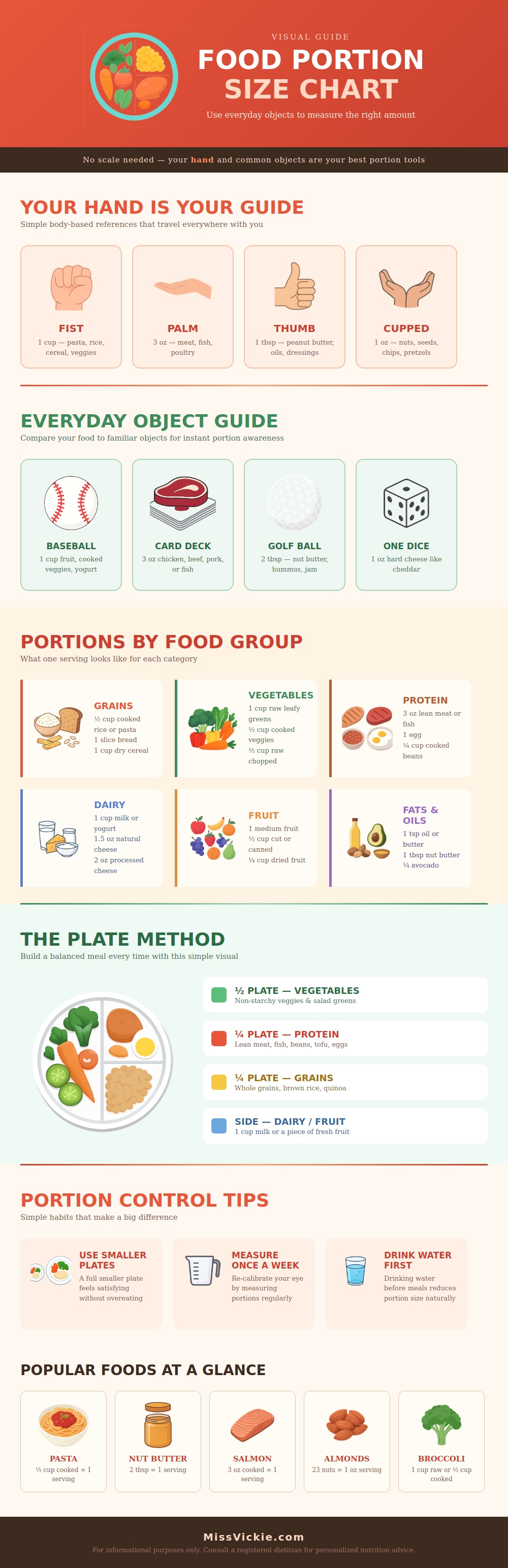
Using hands you can easily estimate portions. An advantage is that human hands are usually proportional with the body and its food needs. A portion of meat or fish matches the palm, included thickness.
Other visual aids work well: a deck of cards is like 3 ounces of meat or fish, a pair of dice matches two 1-ounce pieces of cheese, a hockey puck is half a cup of pasta or half a bagel.
For vegetables it is fine, even good, to eat more than the serving size on the package. But for calorie- or fat-rich foods it warns about excessive health risks. Avoiding dense calories helps with reasonable portions.
Huge packages or food from big tins urge you to overeat and ignore good portions. Most quickly you will limit them by means of small plates. Eating without distractions and slowly you win better control.
Around a third of household waste comes from too much cooking, that ultimately stays uneaten. Too much food leads to overeating, waste of foodand money.