
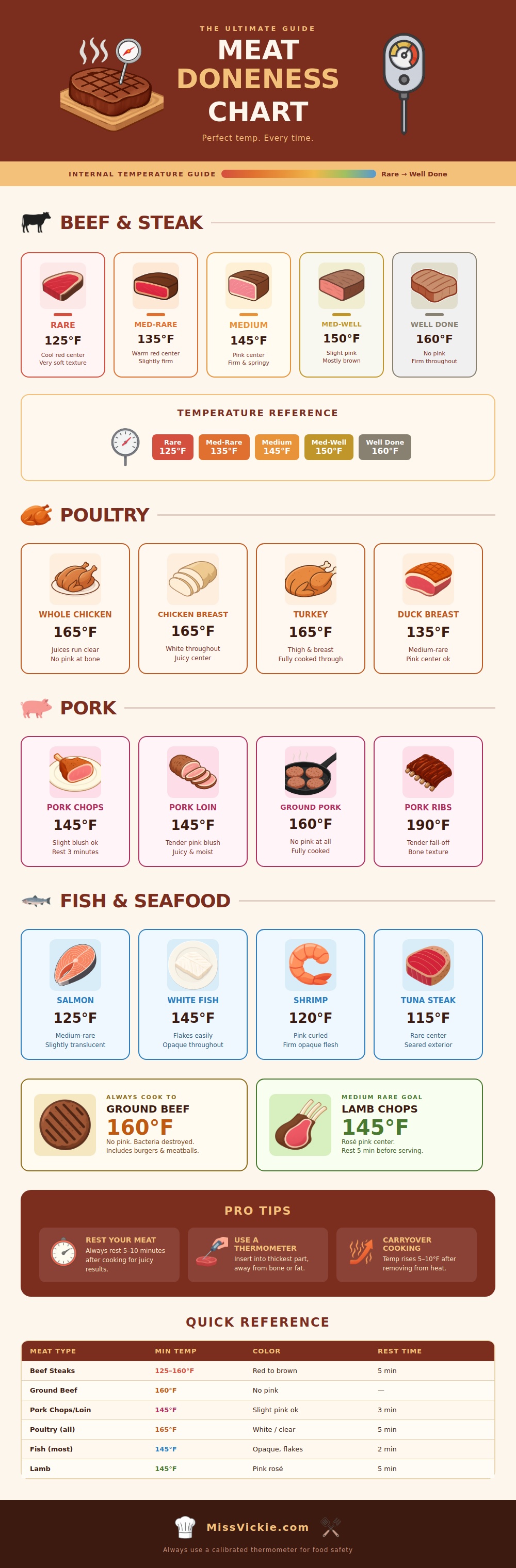
Kuirgrado is a rating of how fully meat is cooked based on its colour, juice and internal temperature. Simply said, it describes the grade of cook. Some meats, like chicken, always must be well cooked while others, like venison meat, are more delicious when they are poorly cooked
In United States, Canada and many European lands you recognise six levels of kuirgrado. Those are: blue, rare, meze-rare, intermediate, meze-good and well cooked. The corresponding internal temperatures are 115, 125, 135, 145, 150 and 160 gradi Fahrenheit.
Meat Cooking Levels and Temperatures
When foods cook, they experience a process that scientists call denaturigo. That means that the meat adjusts from its raw state to a new form with different taste, texture and colour. Rarely cooked steak has a red centre, that maybe is a bit bloody.
Meze-rare meat has a dark pink centre. This grade gives to the meat soft texture, that is not too elastika, and it yet reserves juices. Intermediate kuirgrado are ideal for jucega and gustuma steak, that has warm rozan centre and a bit firmer texture.
Ultimately, meze-good steak is mostly brown in the centre and quite a lot firm.
Reason for choosing a particular grade? That depends on your preferences and the part of the meat. For sirloin or porterhouse, meze-rare cook is best, because that allows the fat to melt into the rest of the meat.
The suggested temperature always depends on the animal, the part of the meat and how you preapre it.
The USDA advocates to cook steaks and roasts until 145 gradi Fahrenheit and later leave them rest for at least three minutes. Ground beef must reach at least 160 grades. Chicken and turkey also require 160 gradiojn, because they can have salmonelaj bacteria, that do not die at lower temperature.
Even so, dark meat yet can look a bit roze at that temperature.
The most precise and easy way to control the kuirgradojn is to use a meat thermometer for measure the internal temperature. Because each bit of meat has a different size, trust only in the time per pound could easily too cook or under cook the meat. The internal temperature is the most important thing, not the method of cook.
The times range depend on the pan, the heat of the grill, the caliber of the oven, the thickness of the meat and its initial temperature.
The temperature continuously rises five to fifteen grades after you remove the meat from the oven. Hence, big bits you should remove around ten grades before the target, and little bits five grades before. If you cut the meat before it rests, you will lose the juices and the protein will become dry.
Recall that different light can alter the look of the steak, so kuirgrado is a matter of temperature, not only of colour.