🍺 Homebrew Calculator
Calculate ABV, priming sugar, original gravity, and batch size for beer, wine & mead
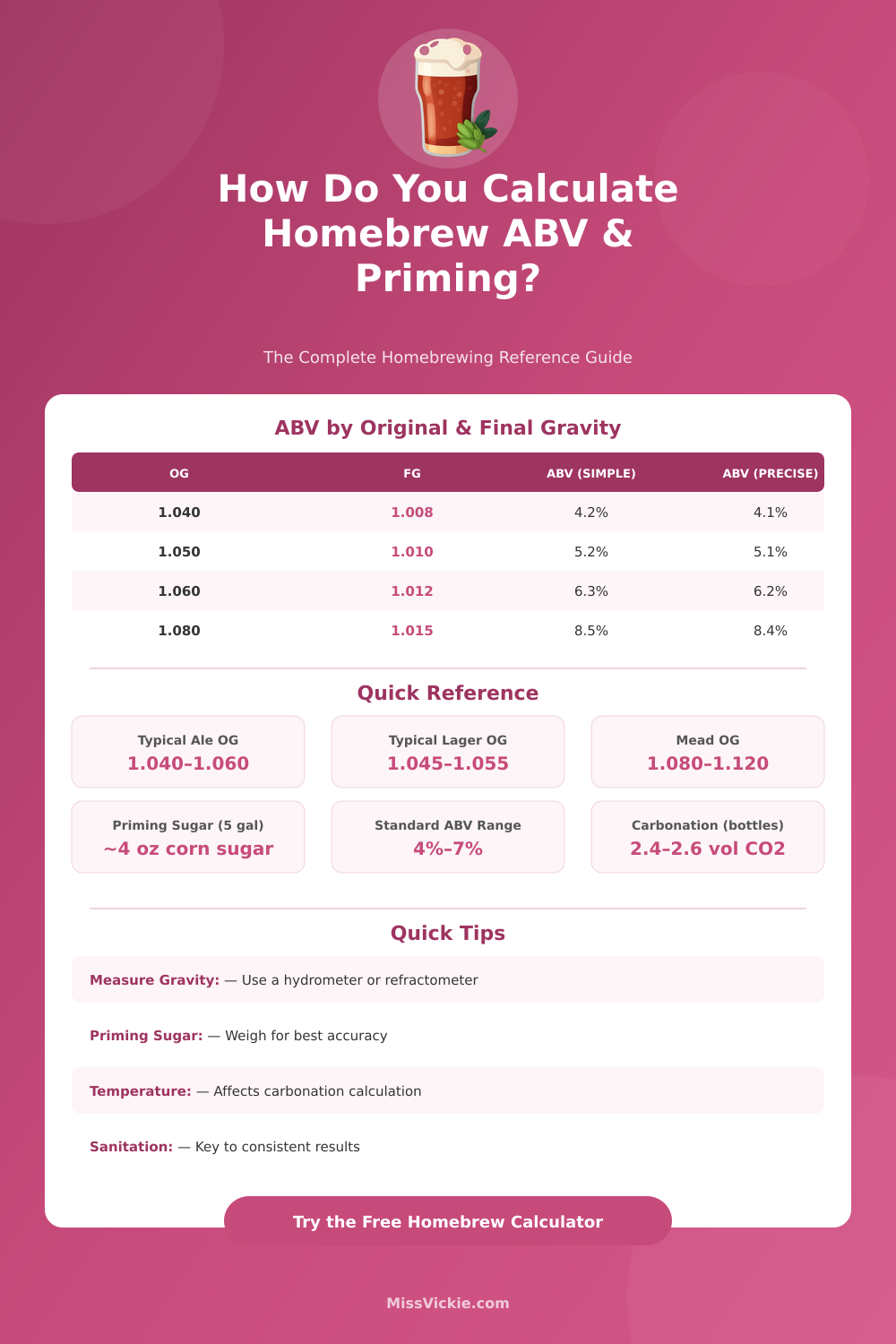
| Beer Style | Typical OG | Typical FG | ABV Range |
|---|---|---|---|
| Session Ale | 1.038–1.044 | 1.006–1.010 | 3.5–4.5% |
| American Pale Ale | 1.045–1.060 | 1.010–1.015 | 4.5–6.2% |
| American IPA | 1.056–1.075 | 1.008–1.014 | 5.5–7.5% |
| Stout / Porter | 1.048–1.065 | 1.010–1.018 | 4.0–6.5% |
| Belgian Tripel | 1.075–1.085 | 1.008–1.014 | 7.5–9.5% |
| Barleywine | 1.090–1.120 | 1.016–1.030 | 8.0–12.0% |
| Dry Mead | 1.080–1.110 | 0.995–1.010 | 9.0–14.0% |
| Sweet Mead | 1.100–1.130 | 1.020–1.040 | 9.0–12.0% |
| Beer Style | CO2 Volumes | Corn Sugar (oz) | Corn Sugar (g) |
|---|---|---|---|
| British Ales | 1.5–2.0 | 2.5–3.0 | 71–85 |
| American Ales | 2.2–2.5 | 3.5–4.0 | 99–113 |
| Wheat Beer | 3.3–4.5 | 5.0–6.5 | 142–184 |
| Lager | 2.4–2.6 | 3.8–4.2 | 108–119 |
| Belgian Ales | 2.0–3.0 | 3.2–4.8 | 91–136 |
| Champagne / Cider | 5.0–6.0 | 7.5–9.0 | 213–255 |
| SG (Specific Gravity) | Plato (°P) | Brix | Notes |
|---|---|---|---|
| 1.040 | 10.0°P | 10.0 | Session ale OG |
| 1.050 | 12.4°P | 12.4 | Standard ale OG |
| 1.060 | 14.7°P | 14.7 | IPA / porter OG |
| 1.080 | 19.3°P | 19.3 | Strong ale / mead OG |
| 1.010 | 2.6°P | 2.6 | Typical dry FG |
| 1.020 | 5.1°P | 5.1 | Typical sweet FG |
The term “homebrew” means various things depending on the context. It commonly relates to the making of beer, wine, cider or mead at home. Also it can mean a tool for programs used on Mac and Linux computers.
In the world of video games it stores fresh games created for old consoles. Each of those meanings forms its own group of fans with separate tradition.
Homebrew: Beer, Software and Games
In the software world, Homebrew works as a free and open-source manager for packages. It makes the installation of programs on macOS and Linux simpler. The name itself hints at the idea of building software to fit the needs of the user on Mac.
It basically adds what Apple or the Linux system does not provide itself. Think of it as a store for programs that developers and experts use.
Homebrew stands on a base of Git and Ruby. It places everything in a standard place, similar to a Git folder. When one clones the homebrew/core folder, the system points to around 82 MB of space.
Without installed programs, it takes less than 100 MB on Mac. The whole project depends on volunteers without salary, as a not-for-profit project. It requires moeny for buying programs, servers and support of ongoing work for future changes.
Using it on Mac, Homebrew stays safe. It does not require big permissions for changes, so it acts like average programs. Those that only use the graphical screen and store of apps probably do not need it.
Even so for folks that work in the terminal, start services in background or involve themselves with programming, it will be very helpful. Between popular packages available threw it are awscli, bash-completion, calc, ccrypt, dos2unix and geoip. An alternative is MacPorts, although Homebrew always stays the more popular.
Now about the brewing part. Homebrewing covers the making of beer, wine, cider and mead. In United States, home brewing was not allowed by federal law until 1978.
Before the ban period it already was legal, and even George Washington himself was a home brewer. To start in that hobby, one can spend less than 100 dollars. Rising cost of hops and brewing barley deters some, but the whole process commonly gives big savings.
For getting into all-grain brewing, a 2.5-gallon set with the method of bags of grains could be a good starting point.
Online groups form the core of the homebrewing culture. Forums discuss general themes about home brewing, all-grain method, sharing of recipes, wine and mead. The goal of groups for homebrewing is to have a brewer in every neighbourhood and a club in every town.
Also it has a creative cooking side. Sean Paxton, known as the Homebrew Chef, shares recipes with beer as an ingredient and runs events withprofessional brewers across the country.
In the video game world, homebrew relates to the idea of enjoying fresh games on old consoles. That covers alpha versions, ROM files and physical cartridges. Also in board gaming, homebrew means home-made elements like backgrounds, magic objects, monsters and spells for Dungeons & Dragons.