🍓 Fresh Preserving Pectin Calculator
Calculate how much pectin you need for jams, jellies, and preserves by batch size and fruit type
| Fruit | Powdered Pectin | Liquid Pectin | Sugar (cups) | Yield (jars) |
|---|---|---|---|---|
| Strawberry | 1 pkg (1.75oz) | 1 pouch (3oz) | 5 cups | 6-7 half-pints |
| Blueberry | 1 pkg (1.75oz) | 1 pouch (3oz) | 4.5 cups | 5-6 half-pints |
| Raspberry | 1 pkg (1.75oz) | 1 pouch (3oz) | 7 cups | 8 half-pints |
| Peach | 1 pkg (1.75oz) | 1 pouch (3oz) | 6 cups | 6-7 half-pints |
| Grape | 1 pkg (1.75oz) | 1 pouch (3oz) | 5 cups | 6 half-pints |
| Apple / Crabapple | 1 pkg (1.75oz) | 1 pouch (3oz) | 5 cups | 5-6 half-pints |
| Cherry | 1 pkg (1.75oz) | 1 pouch (3oz) | 4 cups | 5 half-pints |
| Citrus / Marmalade | 1 pkg (1.75oz) | Not recommended | 4 cups | 4-5 half-pints |
| Powdered Pectin | Equivalent Liquid Pectin | Notes |
|---|---|---|
| 1 pkg (1.75oz / 49g) | 1 pouch (3 fl oz / 85ml) | Not directly interchangeable — method differs |
| 2 pkgs (3.5oz) | 2 pouches (6 fl oz) | Liquid added after boiling; powder before |
| 3 pkgs (5.25oz) | 3 pouches (9 fl oz) | Adjust sugar slightly for liquid |
| 4 pkgs (7oz) | 4 pouches (12 fl oz) | Large batch — work in separate pots |
| Recipe Type | Pectin Brand Example | Sugar Reduction | Notes |
|---|---|---|---|
| Standard | Sure-Jell (yellow box) | None | Best texture and shelf stability |
| Low-Sugar | Sure-Jell Light (pink box) | 25-50% less | Add calcium water if required |
| No-Sugar / Splenda | Sure-Jell for Less or No Sugar | Up to 100% less | Use approved sugar substitutes only |
| Freezer Jam | Ball Instant Pectin | Varies | No cooking required; shorter shelf life |
| Low-Methoxyl | Pomona's Universal Pectin | Up to 100% less | Requires calcium water; very flexible |
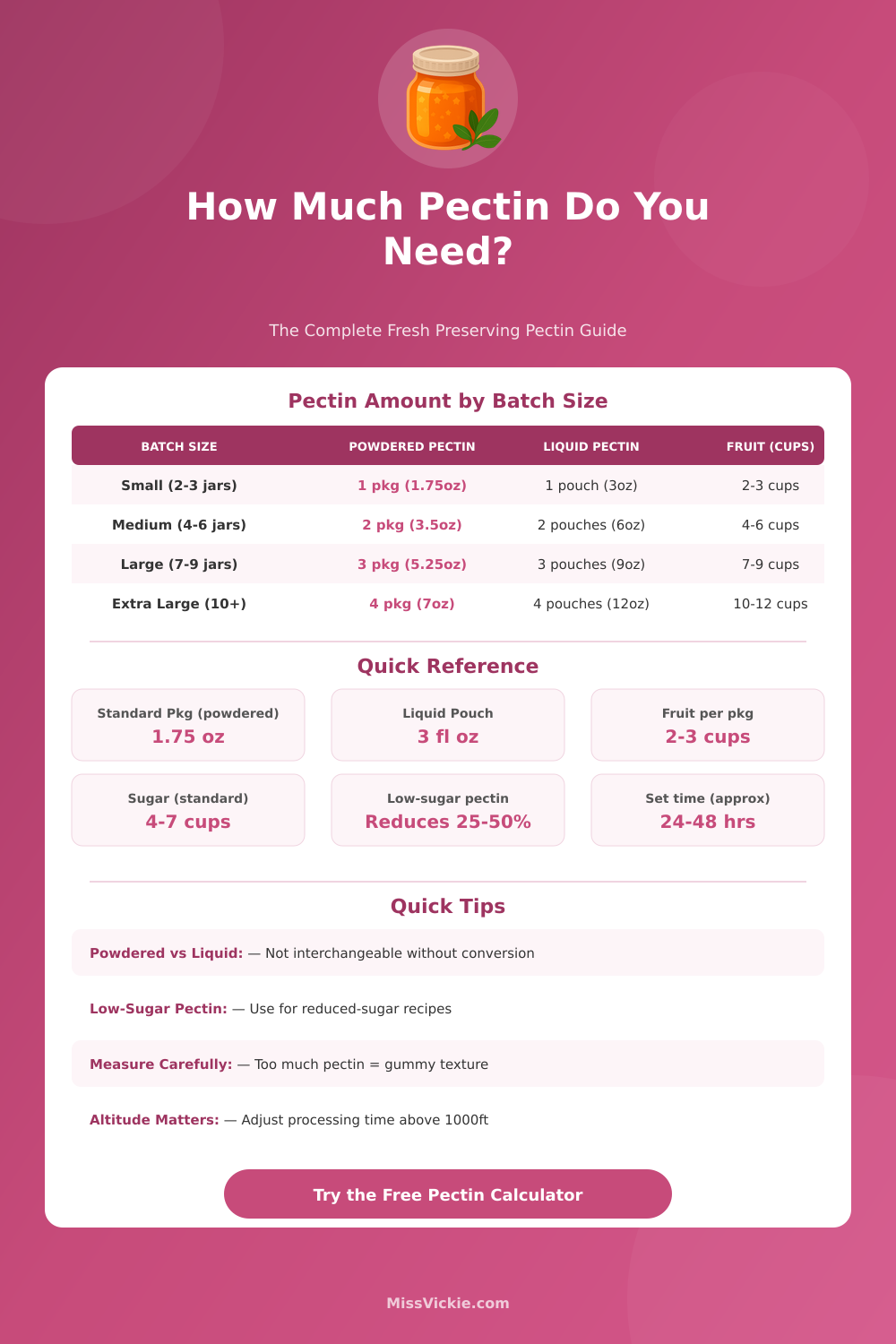
| Jars Desired | Pkgs Powdered Pectin | Pouches Liquid Pectin | Approx Fruit (cups) | Approx Sugar (cups) |
|---|---|---|---|---|
| 2-3 jars | 1 pkg | 1 pouch | 2-3 cups | 3-4 cups |
| 4-6 jars | 1-2 pkgs | 1-2 pouches | 4-5 cups | 4-7 cups |
| 7-9 jars | 2-3 pkgs | 2-3 pouches | 6-8 cups | 8-12 cups |
| 10-12 jars | 3-4 pkgs | 3-4 pouches | 9-11 cups | 12-16 cups |
| 13-16 jars | 4-5 pkgs | 4-5 pouches | 12-14 cups | 16-20 cups |
Pectin are natural substances that present in the cell walls of many fruits and vegetables. It works like glue, which helps to bind those walls together. Scientists say Pectin belong to the complex sugars, so it is a kind of soluble fiber.
The main chemical base of it is galacturonic acid a kind of sugar acid from galactose.
What is pectin and how it helps make jam
Quinces, plums and apples store especially a lot of Pectin. Also the peels and the pulp of citrus fruits has it in big amounts. Cranberries naturally own enough of it, and hence their sauce becomes this dense.
Peppers, although one commonly thinks otherwise, carry Pectin because they are fruits according to scientific definition. All fruits have a bit of Pectin, even so in some it presents in much more high levels than in the rest.
During cooking Pectin help thicken and gel. When one mixes it with sugar, acid and heat, it clots and hardens the liquids. Because of that it matters for preparing preserves, jellies and fruit jams.
Reaching the ideal set without it can be difficult. Preserves with extra Pectin cook more quickly and preserve more well the fresh taste of the fruit. When one does not add Pectin, one needs to cook the preserve more long.
In some recipes for fruit jams cooked poorly, one commonly skips adding Pectin, relying on teh natural Pectin from the fruit itself.
Pectin are entirely natural. The most common commercial Pectin comes from apple peels or citrus leftovers after juice making. Using such scraps means that one does not waste them.
Such wet apple peels and citrus bits quickly break down, hence one washes and dries them soon, before sending to the Pectin plant.
Various kinds of Pectin exist. Some of them come from apples, while others from citrus fruits or seeds. Unripe apples store Pectin, but those ripe ones no any more.
In some stores one offers Pectin with mixed sugar, that one commonly calls jelly sugar or marmalade sugar. One can use Pectin instead of sugar or thickener to create recipes with fewer calories, which is a useful affect.
Except in the kitchen, Pectin has some uses for health. It settles in the intestines, binding substances there and bulking the stools. It served to control looseness and once was a main part in certain old medicines against diarrhea.
But in 2003 the FDA found that the existing proof does not back such use. Apple Pectin helps to lower the cholesterol and back the digestion. It is widely good to eat a lot of fiber foods, because fibers slow the taking in of glucose.
The size of the batch matters during preserve making. One batch should use around five to eight cups of ready fruit. Passing eight cups means that the heat does not spread fast enough, and the preserve will not set right.
Donot advise doubling the batch size.