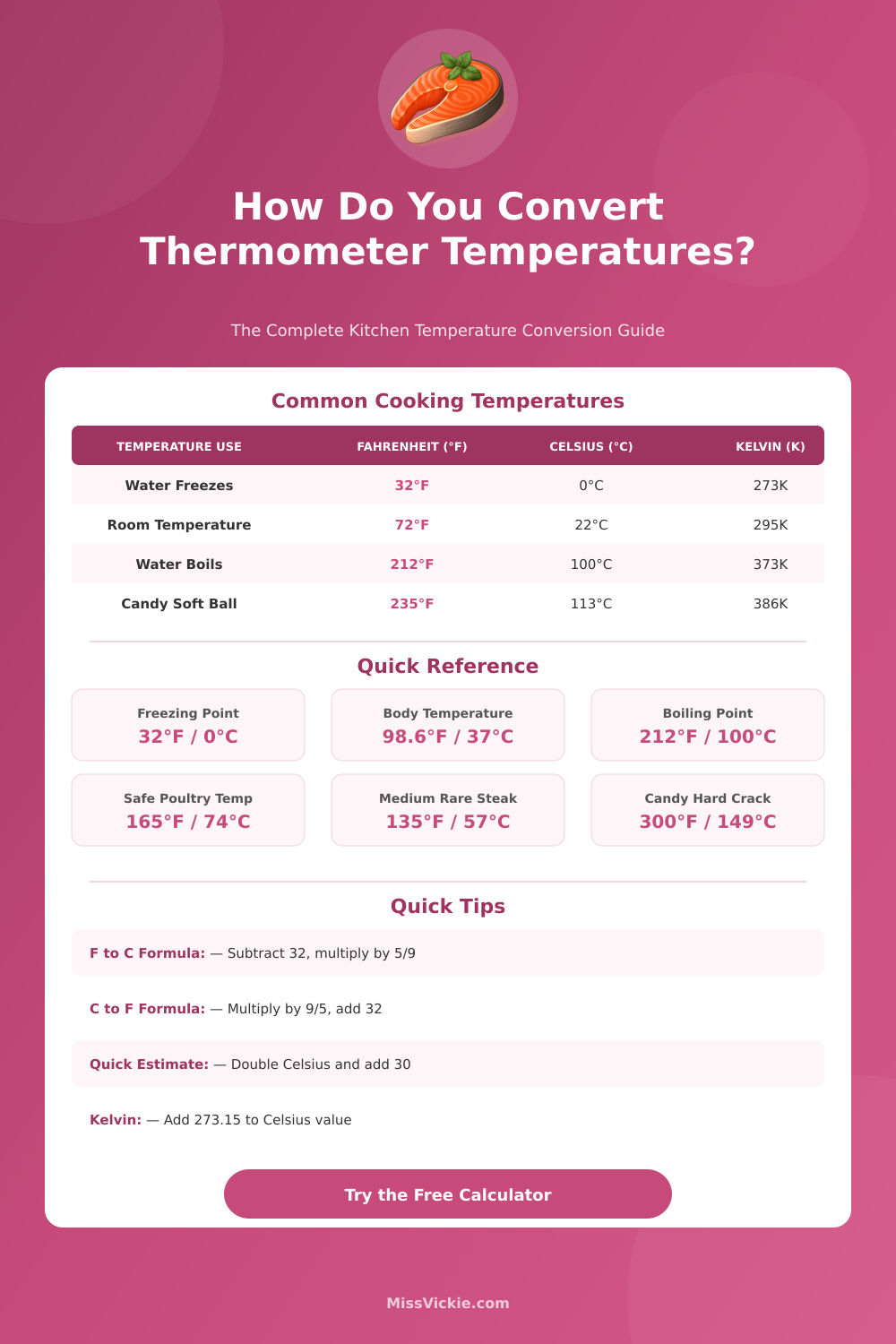
🌡 Thermometer Conversion Calculator
Convert between Fahrenheit, Celsius, and Kelvin for cooking, baking, candy making, and meat temperatures
| Doneness | Fahrenheit (°F) | Celsius (°C) | Description |
|---|---|---|---|
| Rare | 120–125°F | 49–52°C | Bright red, very soft center |
| Medium Rare | 130–135°F | 54–57°C | Pink, warm center — most popular |
| Medium | 140–145°F | 60–63°C | Light pink center |
| Medium Well | 150–155°F | 66–68°C | Slightly pink, firmer |
| Well Done | 160°F+ | 71°C+ | No pink, fully cooked through |
| Stage | Fahrenheit (°F) | Celsius (°C) | Use |
|---|---|---|---|
| Thread Stage | 230–235°F | 110–113°C | Syrups, glazes |
| Soft Ball | 235–240°F | 113–116°C | Fudge, fondant, pralines |
| Firm Ball | 245–250°F | 118–121°C | Caramels |
| Hard Ball | 250–265°F | 121–129°C | Divinity, marshmallows |
| Soft Crack | 270–290°F | 132–143°C | Taffy, butterscotch |
| Hard Crack | 300–310°F | 149–154°C | Toffee, lollipops, brittle |
| Caramel | 320–350°F | 160–177°C | Caramel color and flavor |
| Oven Heat Level | Fahrenheit (°F) | Celsius (°C) | Common Uses |
|---|---|---|---|
| Very Low / Warm | 200–250°F | 93–121°C | Meringues, dehydrating |
| Low / Slow | 275–325°F | 135–163°C | Casseroles, slow roasting |
| Moderate | 350–375°F | 177–191°C | Cakes, cookies, breads |
| Moderately Hot | 400–425°F | 204–218°C | Muffins, quick breads |
| Hot | 450–475°F | 232–246°C | Pizza, puff pastry |
| Very Hot / Broil | 500°F+ | 260°C+ | Broiling, high-heat searing |
| Reference Point | Fahrenheit (°F) | Celsius (°C) | Kelvin (K) |
|---|---|---|---|
| Absolute Zero | -459.67°F | -273.15°C | 0 K |
| Freezing (Water) | 32°F | 0°C | 273.15 K |
| Refrigerator Safe | 35–40°F | 2–4°C | 275–277 K |
| Room Temperature | 68–72°F | 20–22°C | 293–295 K |
| Body Temperature | 98.6°F | 37°C | 310.15 K |
| Boiling (Water) | 212°F | 100°C | 373.15 K |
| Deep Fry Oil | 350–375°F | 177–191°C | 450–464 K |
A thermometer is a tool that measures the level of heat so the warmth or coolness of some stuff. It fits to measure heat of weight as food, of liquid as water or of steam as air. Each of them is made up of two main parts: sensor for heat and way to show the result.
Between the two most used scales for heat stand Celsius and Fahrenheit, that both rest on the boiling and freezing points of water at sea level.
Thermometers and How to Use Them
Currently digital thermometers already reach high accuracy and are more simply readable than the old model. They give quick results and offer various options for usage home, in the kitchen or in professional tasks. A good digital thermometer owns an LCD-screen, that one can set to show either Fahrenheit or Celsius.
When the screen does not work, one first checks the battery. Sometimes unusual or blinking display simply points, that the batteries need change.
In the kitchen thermometers show up as key aids. Having one of them makes the cooking process simpler and helps to avoid overdoing the foods, what commonly results in tough or too dry foods. Two main types of thermometers for meat exist.
One puts an instant-read thermometer in the meat during some seconds, to receive immediate result. Leave-in probes stay inside during the whole cook, with cable bound to a clock or alarm outside of the oven, that warns, when the wanted heat is reached.
Thermometers based on thermocouples give the fastest results between all. They point the target heat after only seconds and have very little tips, so they work for slim bits of food. Digital thermistor tools enjoy popularity thanks too their little format and quiet response.
They measure the heat by means of calculation of the electrical resistance.
Size of the sensor matters during choice of the right model. For roasts or big bits of meat well works a metal thermometer with piercing peak. When dealing about slim foods, one puts the tool through the side until the centre.
Always one measures every part separate, because size and position affects, that bits reach safe heats in various moments.
Some thermometers serve also to measure bread. One can put a probe in the loaf, to check its readiness. Infrared thermometers show up as practical.
They measure the heat at the surface of foods before, during and after the cook. Thermometers for ovens help to ensure, that the device genuinely reaches the needed heat.
Metal thermometers for industry are built for rough conditions in areas as HVAC, oil and gas or medicine. Different materials hand over heat differently, hence one must check the range of the thermometer, because oil and sugar can reach much more high heat than water or meat. When several digitalthermometers stand at every spot, they sometimes disagree about the heat, what can be annoying.