🔥 Oven BTU Calculator
Calculate BTU output, energy cost, and heat-up time for gas and electric ovens
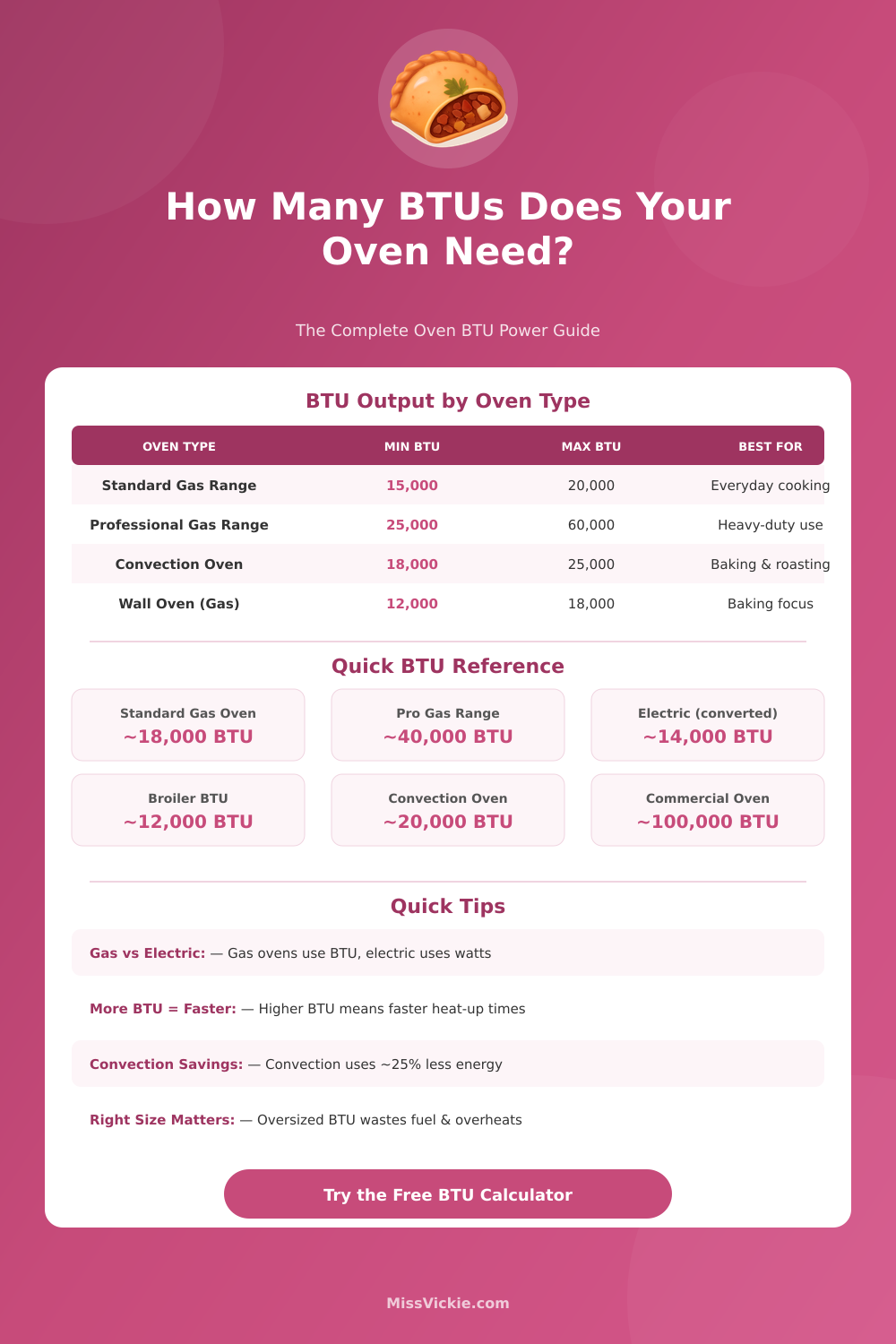
| Oven Type | BTU/hr Range | Typical Use | Efficiency |
|---|---|---|---|
| Standard Gas Range/Oven | 15,000 – 20,000 | Everyday home cooking | 70–80% |
| Professional Gas Range | 25,000 – 60,000 | Avid cooks & caterers | 72–82% |
| Gas Wall Oven | 12,000 – 18,000 | Baking & roasting | 68–78% |
| Gas Convection Oven | 18,000 – 25,000 | Even baking, faster cook | 75–85% |
| Electric Oven (equiv.) | 12,000 – 16,000 | Baking, precise temp | 88–95% |
| Commercial Gas Oven | 50,000 – 150,000 | Restaurant, bakery use | 65–75% |
| Oven Temp (°F) | Oven Temp (°C) | Relative BTU Demand | Common Use |
|---|---|---|---|
| 250°F | 121°C | Low | Slow roasting, warming |
| 325°F | 163°C | Low–Medium | Casseroles, moist cakes |
| 350°F | 177°C | Medium | Standard baking |
| 375°F | 191°C | Medium | Cookies, quick breads |
| 400°F | 204°C | Medium–High | Roasting vegetables |
| 425°F | 218°C | High | Pizza, crispy foods |
| 450°F | 232°C | High | Bread, high-heat roasting |
| 500°F+ | 260°C+ | Very High | Pizza stone, broiling |
| BTU Rating | To 350°F | To 400°F | To 450°F |
|---|---|---|---|
| 12,000 BTU | 18–22 min | 22–27 min | 27–33 min |
| 15,000 BTU | 14–18 min | 18–22 min | 22–27 min |
| 18,000 BTU | 10–15 min | 14–18 min | 18–22 min |
| 25,000 BTU | 7–10 min | 9–13 min | 12–16 min |
| 40,000 BTU | 5–7 min | 6–9 min | 8–11 min |
An oven is a device that one uses to keep materials in a warm space. It has an empty room and gives the chance to warm it regularly. The earliest known use of oven goes back before the 12th century and since then one used them for many different jobs.
At the base, an oven simply is a closed space that stays at a temperature higher than the surrounding air. The most usual home ovens work between 150°F and 550°F.
Ovens: Types, Uses and Care
Two main kinds of home ovens exist: those with gas and those with electric. In gas ovens one burns gas to warm a heat element or directly the cooking space from metal. Also hybrid types exist.
Besides average cooking and roasting, some models fit to dry fruits and meats at low grades, fry foods by means of air, launch a cycle for high-heat cleaning and also smoke meats. Small fryers are simply little fan ovens. Fan ovens move hot air and they greatly crisp foods, rather than average, that only warms the inside for baking.
Ovens use more energy during one hour than almost every other device in the house. Choosing the most energy-saving model helps to spare a lot of money on bills for electric ore gas during the time.
To choose an oven, many spots deserve to mind. Kind of connection, needs for cooking, size and price all matter. One finds ranges with built-in panels and free styles, fitting the cabinets in the kitchen.
Double-oven models are available for gas, electric and induction types. A typical 36-inch range has six burners with a 26-inch wide standard oven, what makes it the most popular size for mid-sized kitchens. In business kitchens, an easy way to find the right size of oven is to watch how many meals one serves daily.
A highly priced oven arrives with real benefits. Good insulation ensures more stable heat. More rugged racks, that do not bend under heavy tools for cooking, and rails, that slide easily, make a big difference.
Fan cooking works well without blowing foods around. Among other features are doors, that close tightly and softly, timers for baking and delayed starting, a mode for smoothing, a setting for warming, a probe for temperature reading during roasting of meats, better light inside, a stronger grill and a hidden element for baking, what eases the cleaning.
Modern ovens depend on hard to fix complex electronics, rather than the simple circuits in old models. Old devices usually last more long, because they do not have the new parts, that easily break. Keeping an oven clean is key work, that helps the kitchen run well and foods have better taste.
Removing stuck food and fat best happens, when the oven cooled to around 122°F, instead of waiting until it is fully cold. Opening the door of an oven during cooking can drop theinternal temperature by 30°F or even more.