🍜 Sodium in Ramen Calculator
Calculate sodium content by ramen type, broth consumption, and number of servings
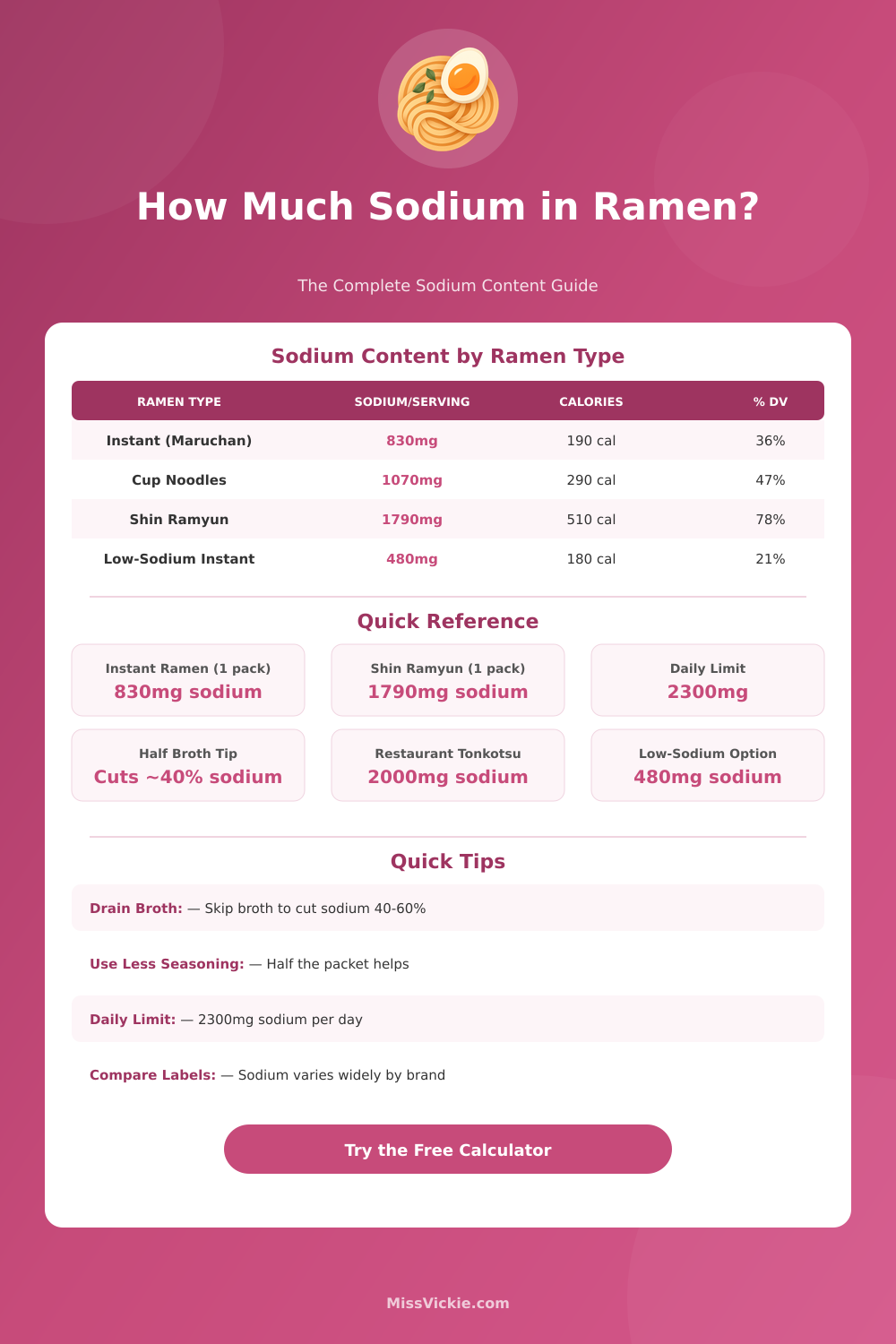
| Ramen Type | Sodium (mg) | Calories | Serving Size |
|---|---|---|---|
| Instant (Maruchan / Top Ramen) | 830mg | 190 | 1 packet (85g) |
| Cup Noodles | 1070mg | 290 | 1 cup (64g) |
| Shin Ramyun | 1790mg | 510 | 1 packet (120g) |
| Nissin Raoh | 1100mg | 350 | 1 packet (107g) |
| Restaurant Tonkotsu | 2000mg | 450 | 1 bowl (~550g) |
| Restaurant Shoyu | 1800mg | 400 | 1 bowl (~500g) |
| Restaurant Miso | 1900mg | 430 | 1 bowl (~520g) |
| Low-Sodium Instant | 480mg | 180 | 1 packet (85g) |
| Noodle Soup | Sodium | Calories | Notes |
|---|---|---|---|
| Instant Ramen (Maruchan) | 830mg | 190 | Most common brand |
| Chicken Noodle Soup (canned) | 890mg | 150 | Similar sodium level |
| Pho (restaurant) | 1200mg | 350 | Varies by broth |
| Udon Soup (instant) | 1020mg | 270 | Thick wheat noodles |
| Wonton Soup (restaurant) | 900mg | 280 | Lighter broth |
| Tom Yum (restaurant) | 1100mg | 200 | Spicy Thai broth |
Ramen is a Japanese dish with noodles that has origin in Chinese cooking. It is made up of alkaline wheat noodles in the style of China, served with tasty broth. Before it was simple food for streets, but now ramen became famous everywhere on the globe.
In its center, every bowl stores three basic parts: the broth, the noodles and the toppings. It gives great enjoyment, no matter the way it is prepared.
A Simple Guide to Ramen
Between the most common broths for ramen stand the tonkotsu. It receives its creamy make-up from cooking of pork feet, chicken backs and thick pork parts during hours long. That long time pulls out the collagen, that turns into gelatin and give to the broth that thick, milky quality.
One can serve ramen with toppings as charsiu, spring onions and black mushrooms in spicy miso.
The soft boiled egg on top of ramen call ajitsuke tamago in Japanese, what wants too say marinated egg. They are soft boiled eggs, soaked in soy sauce together with things as mirin, sugar and various spices. To prepare good jammy-egg, one boils the water on the stove, lay the egg directly from the refrigerator and cook it during six minutes.
Later, one soaks it in iced water, remove the shell, cut it in two parts and lay it on top of the ramen.
Homemade ramen-noodles are not that hard to do, although they could seem so. Pasta machine cares about the roll and cutting, and the whole process maybe is even simpler than prepare average wheat dough. Fresh ramen-noodles usually cook during two until four minutes in hot water.
Instant ramen fully differs from the others. It costs little and fills the stomach. Prepare it is easy, without need of special gear.
Every packet commonly stores two servings, not only one. One whole package has around 370 until 380 calories. The noodles have bad reputation mainly because of the flavor packets, that comes with them.
Ramen have high amount of sodium. Second part of packet can store 760 milligrams of salt. However the noodles themselves are not fully unhealthy, and they no much more worse than other wheat noodles.
Nissin and Maruchan are two important brands of instant ramen, that deserve comparison. Nissin Raoh and Shin Ramyun form good choices. Marutai is other good brand, although a bit expensive.
Sold ramen packs come in many different tastes.
Fast ramen-dinner, that becomes with the pantry, can fully skip the salty sharp packet. Use miso and butter to make tasty food in only fifteen minutes. Add fresh or frozen vegetables, one or two eggs or a bit of peanut butter can change everything.
In Japan, slurping ramen indeed is normal. It shows, that thefood is enjoyed.