🧀 Calcium in Cheese Calculator
Calculate calcium content by cheese type, serving size, and number of servings
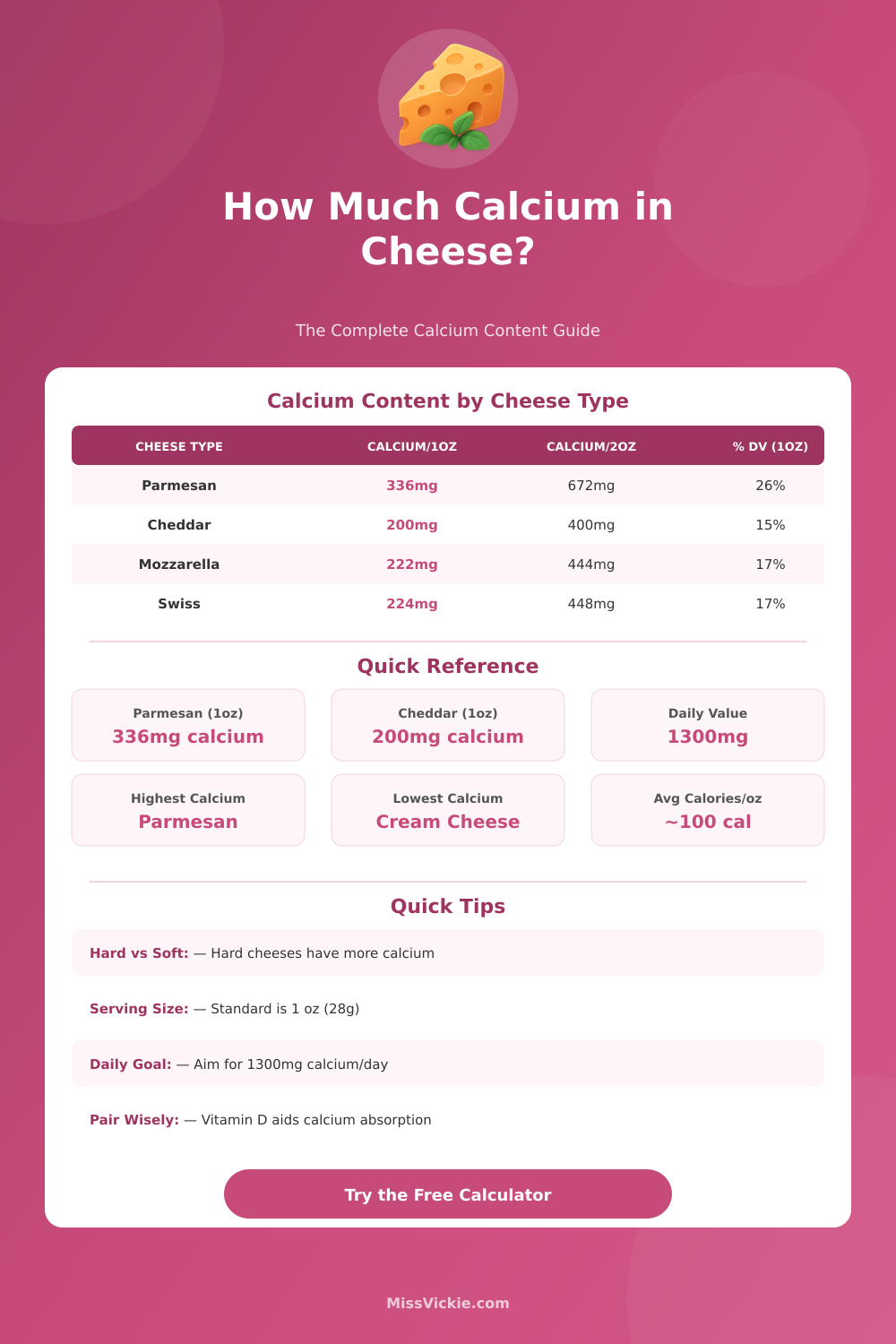
| Cheese Type | 1 oz (28g) | 2 oz (56g) | 3 oz (85g) |
|---|---|---|---|
| Parmesan | 336mg | 672mg | 1008mg |
| Swiss | 224mg | 448mg | 672mg |
| Mozzarella | 222mg | 444mg | 666mg |
| Cheddar | 200mg | 400mg | 600mg |
| American | 175mg | 350mg | 525mg |
| Cottage Cheese | 69mg* | 138mg* | 207mg* |
| Brie | 52mg | 104mg | 156mg |
| Cream Cheese | 28mg | 56mg | 84mg |
| Food Source | Serving | Calcium | Notes |
|---|---|---|---|
| Parmesan Cheese | 1 oz (28g) | 336mg | Highest among cheeses |
| Cheddar Cheese | 1 oz (28g) | 200mg | Popular all-purpose choice |
| Yogurt (plain) | 1 cup (245g) | 296mg | Also contains probiotics |
| Whole Milk | 1 cup (244ml) | 276mg | Vitamin D fortified |
| Sardines (canned) | 3 oz (85g) | 325mg | Edible bones add calcium |
| Kale (cooked) | 1 cup (130g) | 177mg | Plant-based option |
Cheese comes in many different flavors, textures and forms, that you can hardly limit it to one description. At its base, it is made up of clotted milk protein, especially casein, and the main parts are proteins together with fat from milk. Although cow milk leads the world of cheeses there also exist types from milk of goats, sheep, buffalo, reindeer, camels and yaks.
In most cheese making, one sours the milk during some stage of the process. Truly impressive, how rich in nutrients it indeed is.
All About Cheese
Through history, cheese stayed a daily favorite. It attracted folks because of its richness, creaminess and those satisfying filling qualities. Its discovery happened a long time ago in old societies, when folks began herding sheep and goats especially to produce milk.
When the whey drains, only the curds stay, that now must form. The next stages depend entirely on the kind of cheese, that one intends. Some curds recieve salt before one will press them (one does so for Cheddar).
Other times they go directly in molds and later in brine, what happens for Mozzarella and Swiss cheese.
The diversity here is simply surprising. One can sort cheeses according to aging time, texture, making method, fat amount, kind of creature, from whose milk it comes, or land of origin. Combine any of those qualities, and you will have endless groups.
Soft ones like Brie or cream cheese stand at one end of the range, while the hard ones like Cheddar and Parmesan fix the opposite. Truly hear you find something for every food and every occasion.
So here Burrata, a special case. The best samples are so tender and soft with such thin skin, that they nearly expect disaster to happen. One false touch, and the creamy liquid flows over your hands.
That even so is exactly the charm. Those cheeses live and die by freshness; it should taste of tenderness, pure milk with only a trace of brine in the finish.
Here folks commonly err: truly good cheese sauce becomes even better, when one mixes two or more cheeses instead of relying on only one. That approach with alone cheese one should escape, because one loses either the texture or the flavor.
The size of portions matters more, than many know, because cheese is full of fat, calories and sodium. Good portions help to control the eating. If cheese is the main part, between four and six ounces per person reach the right amount.
For a whole cheese board during a meal, expand it to around seven or eight ounces each person. A light cheese course is another option, maybe fifty to seventy-five grams per person, if one chooses three types or less. One ounce almost matches two dice, so one and a half to three or four stacked.
For grated kinds, think about Cheddar, Swiss, Monterey Jack, mozzarella, blue cheese or feta, one loosely filled cup estimates aroundfour ounces.
Cheese goes well with many foods. Fruits, nuts, crackers, honey cakes and bread form natural pairs. Fresh figs with gentle goat cheese form a perfect combination.
Aged Cheddar with spicy apple chutney and crispy oat crackers work equally well.