🍯 Sugar in Honey Calculator
Find out exactly how much sugar, fructose, glucose & calories are in any amount of honey
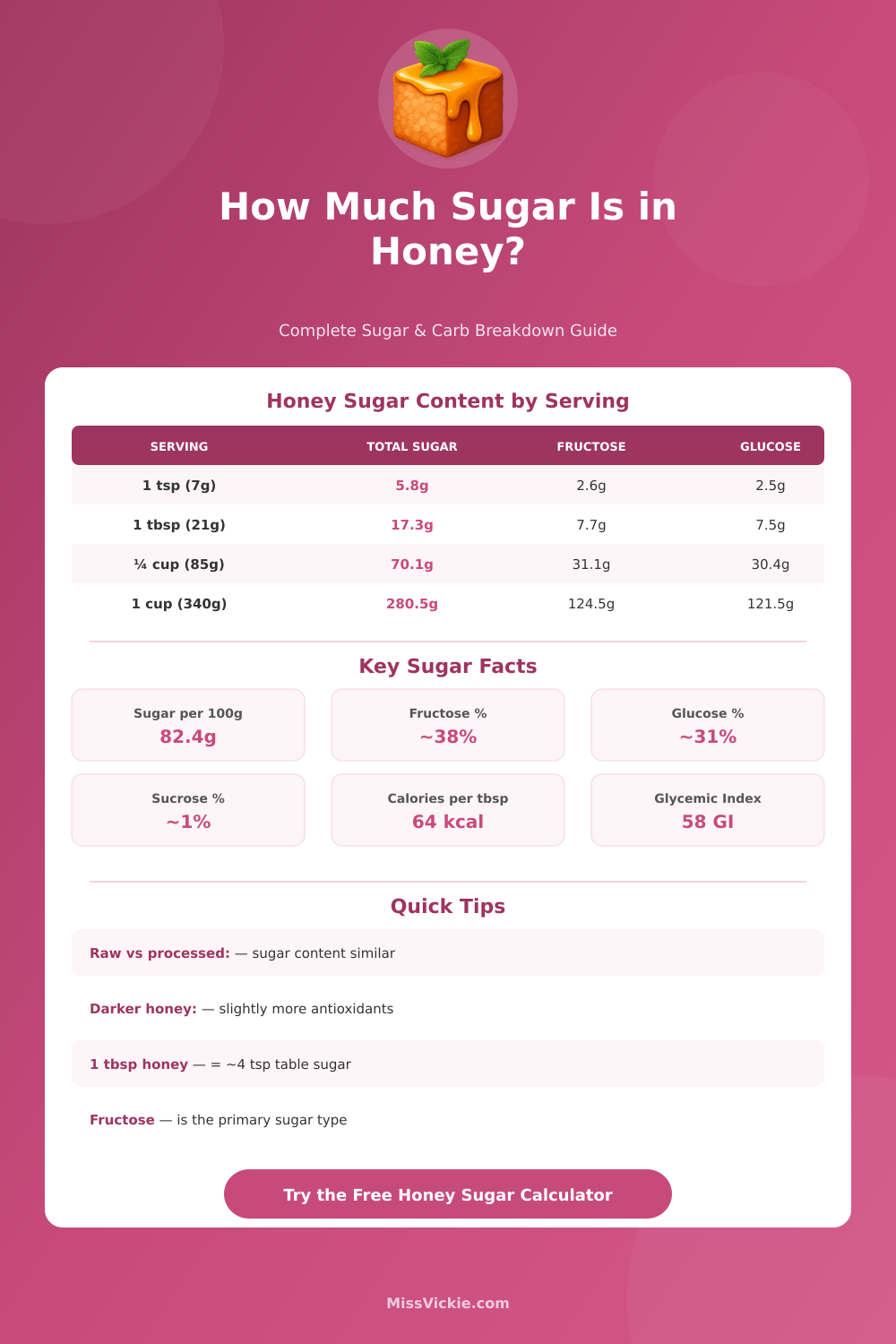
| Serving Size | Weight (g) | Total Sugar (g) | Fructose (g) | Glucose (g) | Calories |
|---|---|---|---|---|---|
| 1 teaspoon | 7g | 5.8g | 2.7g | 2.2g | 21 kcal |
| 1 tablespoon | 21g | 17.3g | 8.1g | 6.5g | 64 kcal |
| 2 tablespoons | 42g | 34.6g | 16.2g | 13.0g | 128 kcal |
| 1 oz (28.3g) | 28.3g | 23.3g | 10.9g | 8.8g | 86 kcal |
| ¼ cup | 85g | 70.0g | 32.7g | 26.4g | 258 kcal |
| ½ cup | 170g | 140.1g | 65.5g | 52.7g | 516 kcal |
| 1 cup | 340g | 280.2g | 130.9g | 105.4g | 1032 kcal |
| 100g (metric) | 100g | 82.4g | 38.5g | 31.0g | 304 kcal |
| Honey Type | Total Sugar | Fructose % | Glucose % | GI (approx.) | Notes |
|---|---|---|---|---|---|
| Raw / Wildflower | 82.4g | 38.5% | 31.0% | 58 | Standard reference |
| Clover | 82.0g | 40.0% | 30.0% | 69 | Most common commercial |
| Manuka | 79.6g | 30.5% | 32.0% | 54 | High glucose relative to fructose |
| Buckwheat | 79.1g | 35.5% | 35.0% | 61 | Darker, stronger flavor |
| Acacia | 83.7g | 43.0% | 24.0% | 32 | Lowest GI, stays liquid longer |
| Sweetener | Weight (g) | Total Sugar (g) | Calories | GI |
|---|---|---|---|---|
| Honey (raw) | 21g | 17.3g | 64 | 58 |
| White table sugar | 12.5g | 12.5g | 48 | 65 |
| Brown sugar | 13.8g | 13.5g | 52 | 64 |
| Maple syrup | 20g | 13.4g | 52 | 54 |
| Agave nectar | 21g | 14.1g | 60 | 15 |
| Corn syrup (light) | 21g | 15.5g | 57 | 73 |
| Sugar Component | % of Total Weight | per 100g | per 1 tbsp (21g) |
|---|---|---|---|
| Fructose | 38.5% | 38.5g | 8.1g |
| Glucose (Dextrose) | 31.0% | 31.0g | 6.5g |
| Sucrose | 0.9% | 0.9g | 0.2g |
| Maltose | 7.2% | 7.2g | 1.5g |
| Other oligosaccharides | 4.7% | 4.7g | 1.0g |
| Water | 17.1% | 17.1g | 3.6g |
| Minerals, enzymes, acids | 0.5% | 0.5g | 0.1g |
Bees make honey gathering nectar from flowers and converting it into that dense, sweet liquid that we know and love. The process is truly wonderful if you look at it: the bees harvest nectar from the flowers, process it by their own magic and later preserve it. Everything depends on one single ingredient that is born from the teamwork between bees, flowers and nature that acts in its best way.
What makes honey so different from one jar to the other depends on where it comes from and the kind of flowers. Where the honey comes from decides everything. Tropical honey is usually more liquid while that from northern areas usually is thicker.
How Bees Make Honey and Why It Is Special
Some rare honeys are not like what one expects from chestnut honey at the store, for example, manuka-honey belongs to the richest and most tasty kinds that one can find.
The chemical make-up of honey is truly amazing. It carries around 17 percent of water, so we can say that. Fructose leads among the sugars with about 38 to 39 percent, followed by glucose at around 31 percent.
Here is what also deserves attention: it naturally does not carry gluten and has a lower blood sugar rating than regular sugar. Also, it does not have fat or cholesterol, which certainly does not hrut.
For thousands of years folks liked honey simply because of its nice taste. It does belong to the most ancient natural products that folks used. Besides sweetening foods, honey plays a role in traditional medical systems everywhere around the world, in Ayurveda, folk medicine, whatever you call it.
Almost every culture on the Earth used it for various goals, weather for preserving foods, calming sore throats or healing wounds. Researchers from Oxford studied fourteen studies and found that honey helps more than many usual cough medicines.
Here is a striking fact: it takes twelve bees working their whole lives to make only one teaspoon.
Raw honey and the regular kind does not differ too much. Many sold in stores were heated so that they flow more easily, but that warming destroys many useful nutrients. Also imported honey sometimes gets mixed with cheaper replacements.
Buying from local beekeepers gives you the real quality, and some folks believe that it helps against seasonal allergies.
honey holds moisture more than sugar, which matters during baking. If you swap sugar for honey, half a cup of honey balances a full cup of sugar. Mixing honey and olive oil in bread from natural grain can boost the rising and help it rise more easily.
The honeycomb itself is fully edible, cut it up and lay it on warm toast or cake, and you will have something tasty with more depth than plain honey. Even fried bananas in warm sauce with a bit of oil, honey and salt tastessurprisingly good.
honey usually hardens in the jar after a month or two, though it does not always happen, even in the same storage conditions.