🍉 Sugar in Watermelon Calculator
Enter your serving size and get exact sugar, carb & nutrition data instantly
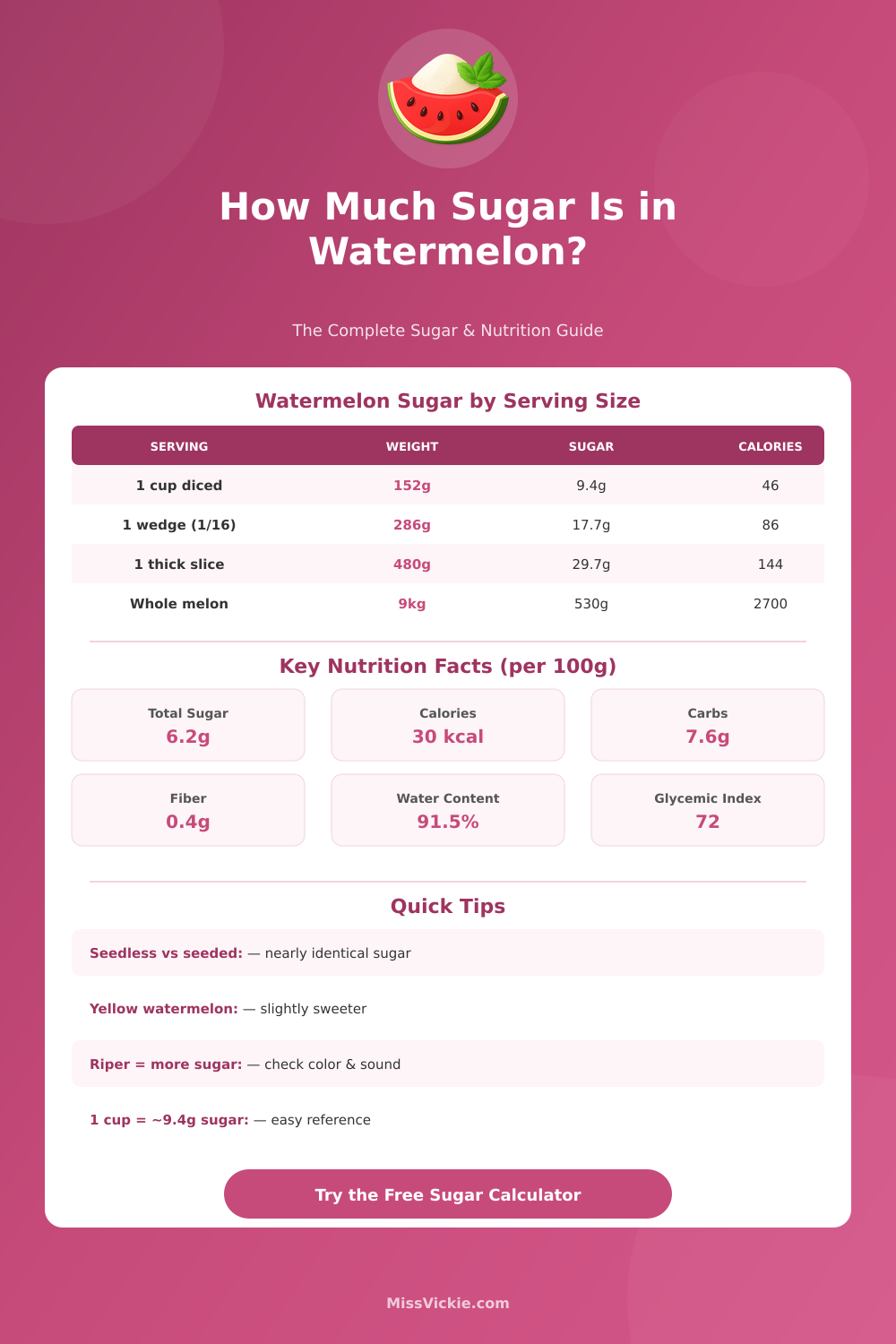
| Serving Description | Weight | Total Sugar | Carbs | Calories |
|---|---|---|---|---|
| 1 cup diced | 152g / 5.4 oz | 9.4g | 11.6g | 46 |
| 1 small wedge (1/16 melon) | 286g / 10 oz | 17.7g | 21.8g | 86 |
| 1 thick wedge (1/8 melon) | 480g / 17 oz | 29.7g | 36.5g | 144 |
| 100g (standard reference) | 100g / 3.5 oz | 6.2g | 7.6g | 30 |
| 50g (kids snack) | 50g / 1.8 oz | 3.1g | 3.8g | 15 |
| 2 cups diced | 304g / 10.7 oz | 18.8g | 23.1g | 92 |
| Half small watermelon (~4.5kg) | 4500g / 9.9 lb | 279g | 342g | 1350 |
| Whole medium watermelon (~9kg) | 9000g / 19.8 lb | 558g | 684g | 2700 |
| Sugar Type | Amount per 100g | % of Total Sugar | Notes |
|---|---|---|---|
| Fructose | 3.36g | 54% | Primary sugar in watermelon |
| Glucose | 2.18g | 35% | Quick energy source |
| Sucrose | 0.19g | 3% | Table sugar equivalent |
| Other sugars | 0.47g | 8% | Trace amounts |
| Total | 6.20g | 100% | Per 100g fresh watermelon |
| Variety | Sugar / 100g | Per Cup (152g) | Relative Sweetness |
|---|---|---|---|
| Standard Seedless | 6.2g | 9.4g | Baseline |
| Yellow / Orange Flesh | 6.5g | 9.9g | Slightly sweeter |
| Seeded Heirloom | 5.9g | 9.0g | Slightly less sweet |
| Mini / Personal Size | 6.3g | 9.6g | Similar to seedless |
| Unripe / Pale Flesh | 5.6g | 8.5g | Noticeably less sweet |
Watermelon is a flowering plant from the family Cucurbitaceae. It climbs and spreads as a vine-like grass that gives large, tasty fruit. Around the globe people grow more than a thousand species.
Those fruits do best in dry and warm places. Rather than one commonly thinks they do not like too wet conditions for growth or heavy rain.
All About Watermelon
Watermelon comes originally from the Kalahari desert in Africa. Today people grow it also in tropical areas everywhere in the world.
The watermelon is made up of 90 percent water. It appears in various shades, like red, pink, orange and yellow. The fruit has few calories, but plenty of antioxidants, electrolytes and water.
It is full of nutrients and truly refreshing. In one cup of plain watermelon bist there are around 46 calories. The main nutrient makeup of watermelon comes roughly 94 percent from carbs, no fat and 6 percent protein.
Also it stores a lot of amino acid called citrulline, that helps the blood flow through the body and can reduce blood pressure. The lycopene in watermelon can help the heart.
To choose a good watermelon takes a bit of experience. Ripe watermelon should show a yellow mark on one side and way a lot for its size. More round ones are better than those oval.
If the watermelon sounds empty, maybe it has a hole inside, where the insides split. Also the state of the skin tells a lot about the fruit inside. Watermelons do not ripen after picking.
Always wash it under running water, to remove any dirt before cutting. If watermelon has a weird smell or a bitter taste, do not eat it.
One can enjoy watermelon in many ways, not only simply eating it fresh. Surprisingly good is watermelon salsa. Watermelon with feta salad mixes well with finely diced jalapeno, dressed with olive oil and balsamic vinegar.
Grilling watermelon is another fun idea, and the secret for extra flavor is in blending of sugar and citrus spice. In salad watermelon goes well with goat cheese, basil and balsamic glaze. Mix watermelon in a blender with simple syrup, juice of lime and a bit of salt to create a lovely summer drink.
Even blended fresh watermelon cubes are useful for baking. Candies and drinks flavored with watermelon rarely taste like the real fruit, because its flavor is hardlyrepeated chemically.
For folks with kidney issues, a typical serving of medium watermelon is about three cups, which can hold too much liquid and potassium for a limited diet.