🟢 Fiber in Green Beans Calculator
Calculate total dietary fiber from green beans by serving size & track your daily fiber goal
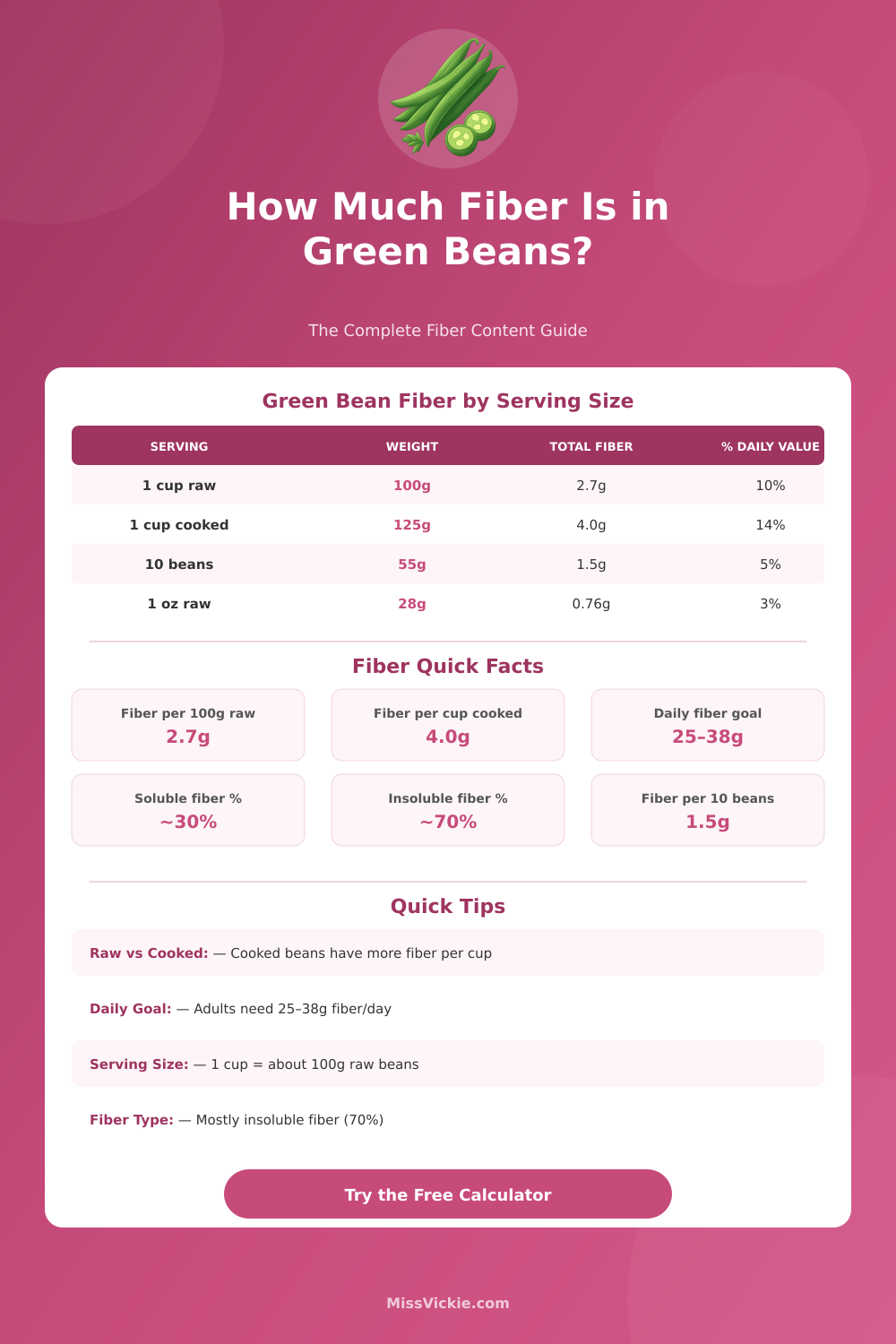
| Serving Size | Weight | Total Fiber | Soluble | Insoluble | % Daily Value* |
|---|---|---|---|---|---|
| 1 cup raw, whole | 100g / 3.5oz | 2.7g | 0.81g | 1.89g | 10% |
| 1 cup cooked, boiled | 125g / 4.4oz | 4.0g | 1.2g | 2.8g | 14% |
| ½ cup cooked | 62.5g / 2.2oz | 2.0g | 0.6g | 1.4g | 7% |
| 10 whole beans (raw) | 55g / 1.9oz | 1.5g | 0.45g | 1.05g | 5% |
| 1 oz raw | 28g | 0.76g | 0.23g | 0.53g | 3% |
| 100g raw | 100g / 3.5oz | 2.7g | 0.81g | 1.89g | 10% |
| 100g canned (drained) | 100g / 3.5oz | 1.8g | 0.54g | 1.26g | 6% |
| 100g frozen (uncooked) | 100g / 3.5oz | 2.5g | 0.75g | 1.75g | 9% |
| Measure | Raw Weight | Cooked Weight | Fiber (Raw) | Fiber (Cooked) |
|---|---|---|---|---|
| 1 cup | 100g / 3.5oz | 125g / 4.4oz | 2.7g | 4.0g |
| ½ cup | 50g / 1.75oz | 62.5g / 2.2oz | 1.35g | 2.0g |
| ¼ cup | 25g / 0.88oz | 31.25g / 1.1oz | 0.68g | 1.0g |
| 1 oz | 28g | — | 0.76g | — |
| 1 whole bean | ~5.5g | ~6.5g | 0.15g | 0.22g |
| 1 lb (raw) | 454g | ~400g cooked | 12.3g | 12.8g |
| Group | Daily Fiber Goal | Cups Needed* | Grams of Beans |
|---|---|---|---|
| Women (19–50) | 25g/day | ~6.25 cups raw | ~925g |
| Men (19–50) | 38g/day | ~9.5 cups raw | ~1,407g |
| Women (51+) | 21g/day | ~5.25 cups raw | ~778g |
| Men (51+) | 30g/day | ~7.5 cups raw | ~1,111g |
| Children (4–8) | 20g/day | ~5 cups raw | ~740g |
| General Adult (FDA) | 28g/day | ~7 cups raw | ~1,037g |
Green beans are made up of young pods of the common bean plant, that scientists call Phaseolus vulgaris. One knows them under different names for instance string beans, snap beans and wax beans. Although many new types truly do not have strings, the old name stays used.
Those vegetables belong to the bean family, but one eats them fresh, so with the whole skin. Unlike many other beans, no need to shell or dry them before putting in the mouth.
How to Choose and Cook Green Beans
Haricots verts is the French name for Green Beans, what simply means “green beans”. Those French types are long, slim and especially crispy. Many folks favour this type.
The plant types can be bushy or climbing, and the best fresh happen especially in summer and autumn, when they naturally grow well.
Freshness really matters. Firm Green Beans should click when one bends them in two parts. Also their colour should stay green.
When they become soft and stringy, then they already taste bad. This simple snap test helps to quickly check whether they are in good state.
Many ways exist for making Green Beans. For instance, one can boil them in water with salt until they become a bit crispy, similar to cooking of pasta tubes. Adding salt too the water is a traditional step, because it improves the taste.
When they boil, quickly putting them in iced water stops the cooking and keeps the bright green colour. Also, roasting them in a pan with olive oil, salt, pepper and juice of lemon is another simple idea.
Cooking in butter also has popularity. First blanch the beans to keep crisp, later put them in a pan with olive oil, cut garlic, butter, salt and pepper results in great taste. Cook them in small batches to avoid crowding the pan, what gives better colour and helps to keep the bright green look.
Even so garlic easily burns, so add it last moment.
Bacon goes surprisingly well with Green Beans. First fry the bacon, later use the fat for cooking garlic, onions and the beans to form a reliable recipe. Adding broth and cooking everything together on weak flame creates thick sauce, especially if one adds a bit of flour to thicken.
Some recipes add potatoes, vinegar and brown sugar for extra flavour.
Green Beans answer well for Italian food. Cooking fresh beans directly in tomato sauce with garlic, cooked onions and olive oil until they soften, one finds that in areas like Tuscany and Naples. In Asian style, soy sauce, sesame seeds and red pepper flakes give rich taste.
Also dry frying in warm wok or iron pan until the beans a bit blister delivers an attractive option.
Canned Green Beans often taste better if one adds broth cubes. Frozen Green Beans work well in pots. Whether fresh, frozen or canned, every cup delivers almost two grams of protein.
Green Beans have anti-aging properties, store antioxidants, are rich in potassium andhave very few calories.