🍚 Protein in Rice Calculator
Find out exactly how much protein is in any serving of rice — by type, weight, or cup size
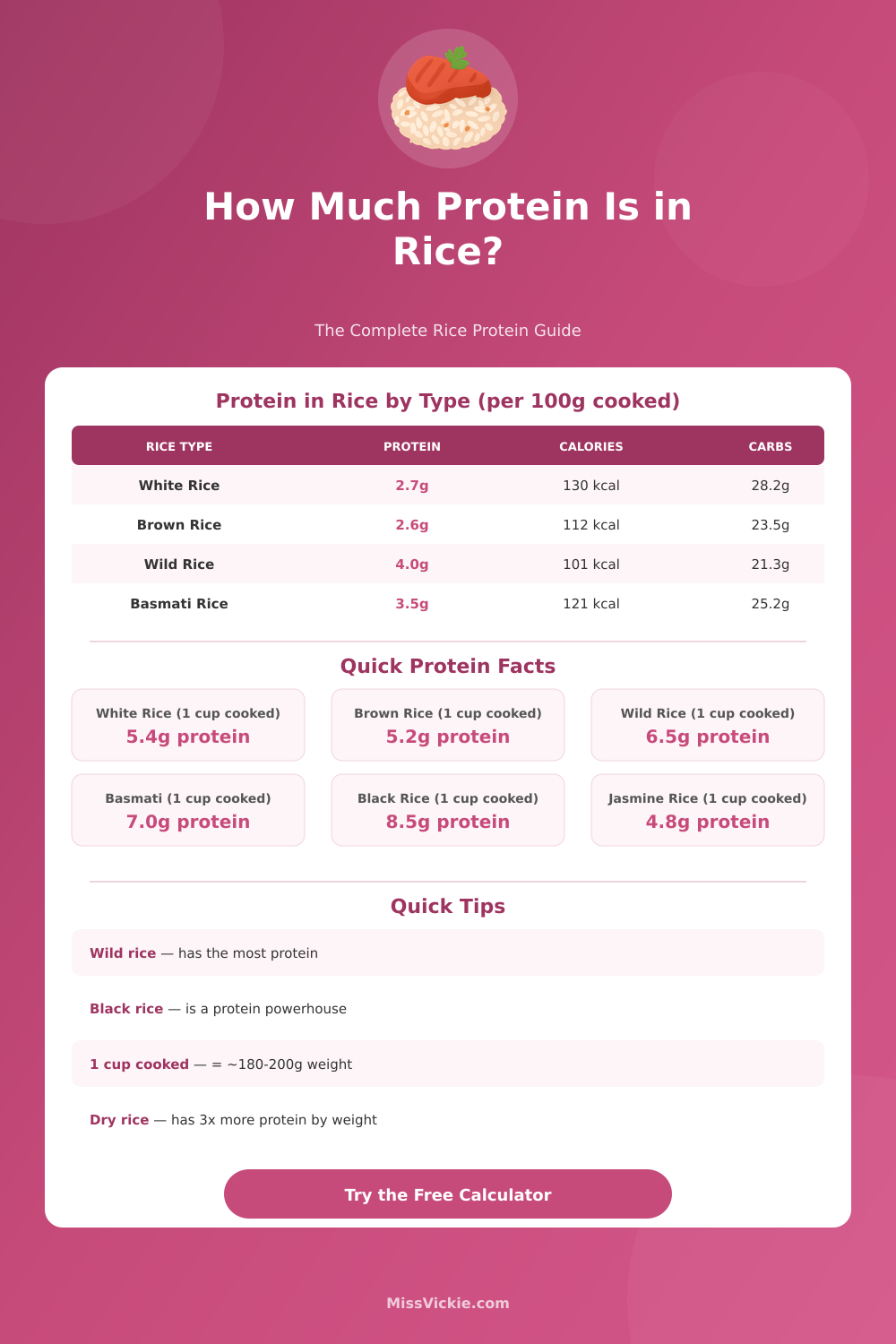
| Rice Type | Protein | Calories | Carbs | Fat |
|---|---|---|---|---|
| White Rice | 2.7g | 130 kcal | 28.2g | 0.3g |
| Brown Rice | 2.6g | 112 kcal | 23.5g | 0.9g |
| Wild Rice | 4.0g | 101 kcal | 21.3g | 0.3g |
| Basmati Rice | 3.5g | 121 kcal | 25.2g | 0.4g |
| Jasmine Rice | 2.4g | 129 kcal | 28.0g | 0.4g |
| Black Rice | 4.2g | 106 kcal | 23.0g | 1.0g |
| Red Rice | 3.8g | 110 kcal | 23.0g | 0.8g |
| Arborio Rice | 2.9g | 140 kcal | 30.0g | 0.2g |
| Rice Type | 1 Cup Cooked | 1/2 Cup Cooked | 2 Cups Cooked |
|---|---|---|---|
| White Rice | 5.0g | 2.5g | 10.0g |
| Brown Rice | 4.8g | 2.4g | 9.6g |
| Wild Rice | 6.5g | 3.3g | 13.0g |
| Basmati Rice | 6.5g | 3.3g | 13.0g |
| Jasmine Rice | 4.5g | 2.3g | 9.0g |
| Black Rice | 7.8g | 3.9g | 15.6g |
| Red Rice | 7.1g | 3.6g | 14.2g |
| Dry Amount | Cooked Weight (approx) | Cooked Cups (approx) | Protein (White) |
|---|---|---|---|
| 1/4 cup dry (46g) | ~130g cooked | ~0.65 cups | ~3.5g |
| 1/2 cup dry (93g) | ~260g cooked | ~1.4 cups | ~7.0g |
| 1 cup dry (185g) | ~520g cooked | ~2.8 cups | ~14.0g |
| 100g dry | ~280g cooked | ~1.5 cups | ~7.6g |
| 200g dry | ~560g cooked | ~3.0 cups | ~15.1g |
rice forms basic food for more than half of the world population, especially in Asia and Africa, because it is grain from cereals. The grassy plant Oryza sativa gives its seeds that we know as Asian rice. There also exists a less common species, called Oryza glaberrima, or African rice.
In more than 100 lands it works as a main food and in many homes it appears in several meals daily. Almost half of the folks on earth, including almost all in East and Southeast Asia, depend fully on rice for their everyday nutrition.
Rice: Types, Uses and How to Cook
The world has more than 120 000 different types of rice. One sorts them by the level of milling, the size of the grain, the amount of starch and the smell. It is grain rich in starch, full in calories and usually cheap.
Whole brown rice gives much more fiber, protein and nutrients than the white type. Brown rice is rich in phenols and flavonoids, which are antioxidants helping protect cells against damage and lower the chance of early aging. Compared with other grains like barley, oats and wheat, rice sotres more starch but fewer proteins.
Basmati rice comes from the Indian region, because it is long-grain and has a pleasant smell. One uses it commonly in the cooking of India, Pakistan, Persia and the Middle East, where it appears in dishes like biryani, kebabs, pilafs and curries.
Cooking rice requires a bit of attention. For cooking in a pot, one well washes the rice in a bucket, lays it in a jar, and then brings it to a boil. Later, cover the tin and lower the flame to minimal strength.
Adding tea during cooking gives tender taste, similar too clear broth. Also rice flour helps in the baking… The dough sticks not at all to it, almost like Teflon.
It works great for cleaning smooth baskets.
For one serving of cooked rice one suggests around 150 to 200 grams. A quarter of a cup of plain rice forms a good start for one person, who can prepare up to three quarters of a cup. Youngsters or very hungry folks usually eat much more than the usual amount.
The serving size adjusts a bit according to the kind of rice that one serves.
In many Asian traditions rice porridge forms comfort food. One can prepare dosa from rice, mixing cooked rice with urad dal and leaving it to ferment a bit. For long-grain white rice only rice and water are needed during cooking.
Some packages suggest adding oil and salt, but that does not always have to be. Letting the rice rest some minutes after cooking, before mixing it, truly changes the finish. The ideal is fluffy andmoist rice always…
Never sticky or raw.