🥛 Protein in Almond Milk Calculator
Calculate total protein intake from almond milk by serving size, brand type & daily consumption
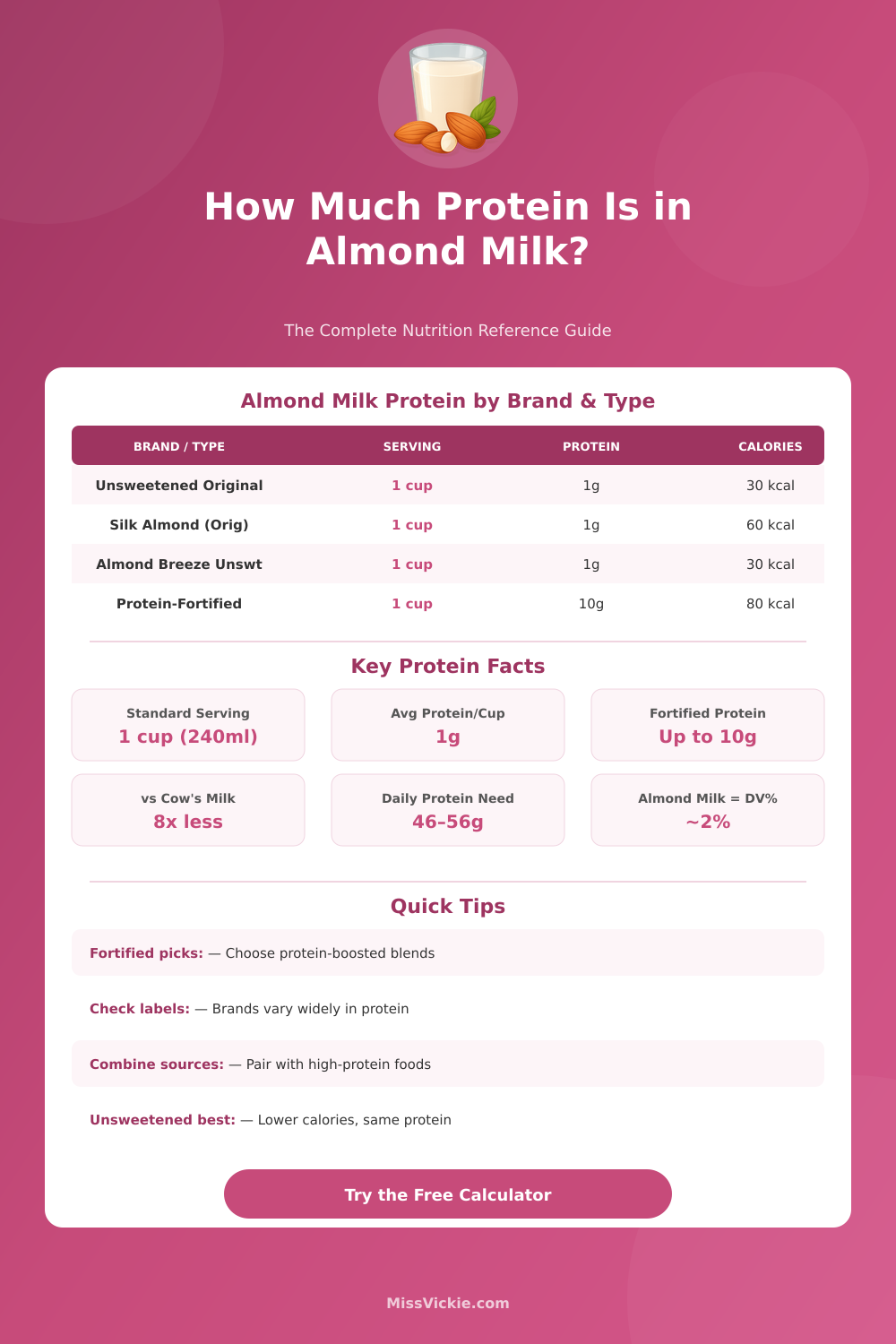
| Type / Brand Style | Serving | Protein | Calories | Fat | Carbs |
|---|---|---|---|---|---|
| Unsweetened Original | 1 cup (240ml) | 1g | 30 kcal | 2.5g | 1g |
| Original (Sweetened) | 1 cup (240ml) | 1g | 60 kcal | 2.5g | 8g |
| Vanilla Unsweetened | 1 cup (240ml) | 1g | 30 kcal | 2.5g | 2g |
| Vanilla (Sweetened) | 1 cup (240ml) | 1g | 80 kcal | 2.5g | 14g |
| Chocolate Almond Milk | 1 cup (240ml) | 1g | 120 kcal | 2.5g | 20g |
| Protein-Fortified | 1 cup (240ml) | 10g | 80 kcal | 2.5g | 6g |
| Barista Edition | 1 cup (240ml) | 1g | 90 kcal | 4g | 10g |
| Homemade Almond Milk | 1 cup (240ml) | 1.5g | 40 kcal | 3g | 1.5g |
| Milk Type | Protein per Cup | Calories | Suitable For |
|---|---|---|---|
| Whole Cow’s Milk | 8g | 149 kcal | Omnivores |
| Skim Cow’s Milk | 8g | 83 kcal | Low-fat diets |
| Soy Milk (unsweetened) | 7g | 80 kcal | Vegans |
| Pea Milk | 8g | 70 kcal | Vegans/Allergy |
| Oat Milk | 3g | 120 kcal | Vegans |
| Almond Milk (standard) | 1g | 30–90 kcal | Low-calorie |
| Almond Milk (protein+) | 10g | 80 kcal | Protein goals |
| Coconut Milk Beverage | 0.5g | 45 kcal | Nut-free alt |
| Activity Level | Protein Need | 150 lbs (68kg) | 180 lbs (82kg) |
|---|---|---|---|
| Sedentary (RDA) | 0.8g / kg | 54g/day | 66g/day |
| Lightly Active | 1.0g / kg | 68g/day | 82g/day |
| Moderately Active | 1.2g / kg | 82g/day | 98g/day |
| Very Active | 1.6g / kg | 109g/day | 131g/day |
| Athlete / Bodybuilder | 2.0g / kg | 136g/day | 164g/day |
| Common Measure | Cups | ml (metric) | fl oz |
|---|---|---|---|
| Splash (coffee) | 0.1 cup | 24 ml | 0.8 fl oz |
| Cereal Serving | 0.5 cup | 120 ml | 4 fl oz |
| Latte / Small Coffee | 0.75 cup | 180 ml | 6 fl oz |
| Standard Serving | 1 cup | 240 ml | 8 fl oz |
| Smoothie Base | 1.5 cups | 360 ml | 12 fl oz |
| Large Smoothie | 2 cups | 480 ml | 16 fl oz |
| Full Pint | 2.1 cups | 500 ml | 16.9 fl oz |
Almond Milk is made as a base to replace real milk, prepared from almonds. The texture is watery while the taste reminds of nuts. In it you do not find cholesterol or lactose, and the amount of packed fat stays low.
If one does not add sugar after it is made then the pure Almond Milk does not store any sugar. It has only very little fat, and it does not match to real milk.
What Is Almond Milk and How to Use It
Some brands keep it simple. They prepare Almond Milk from only two main ingredients: almonds together with water. No extra gums or thickeners.
Using even four times more almonds than competitors, one gets naturally smooth and creamy results, without any extra stuffing. Some variants choose organic almond, water from filtering and pink salt from Himalaya. No oils, no stuffings.
About the home making of Almond Milk, it is really simple. It is enough to have regular almond, water and something to sweeten, for instance honey or agave. One soaks the almond, later mixes them with water and then strains through cheese fabric or special nut packet.
The process of blending and straining lasts only some minutes. Home Almond Milk one keeps in the fridge four around four to five days. It has a taste creamy, fresh, as if real almonds.
In Almond Milk there is not a lot of Protein, but the carbs also stay very few, so that it mostly does not affect the level of sugar in blood. The version without sugar stores around 40 calories for one cup, together with almost 1 grams of Protein. Store brands usually include sugar, vanilla or stabilizers, that changes the base of the taste.
Some of them thicken by means of gums.
In cooking and baking it proves useful. One can use Almond Milk to replace water in recipes for bread, and it works well for biscuits, crepes or cakes. When a recipe requires thin or fat free milk, commonly one-for-one change succeeds well.
Even so compared to cow milk, in it is very little Protein. Where dairy Protein helps with structure or with browning, one can see more softness or less colour. From high heats or because of bitter elements, Almond Milk risks to split.
Stir or shake it in the mixture helps to avoidthat.
Also in coffee one uses Almond Milk, although it can a bit weaken the taste and give a more watery feeling. For warm chocolate, it serves as good option to those that avoid dairy. Even frozen desserts work with flavored forms of Almond Milk.
Almonds can cause allergies. Around one to two percent of folks across the world suffer from food allergies, and nuts cause commonly serious reactions. Also, eating whole almond does feed more than drinking their milk.
The most of store Almond Milks show weaker nutritious value than soy milk or oat milk, and prices of them usually rise also.