🐐 Protein in Goat Milk Calculator
Calculate protein content from any goat milk serving size & track your daily intake
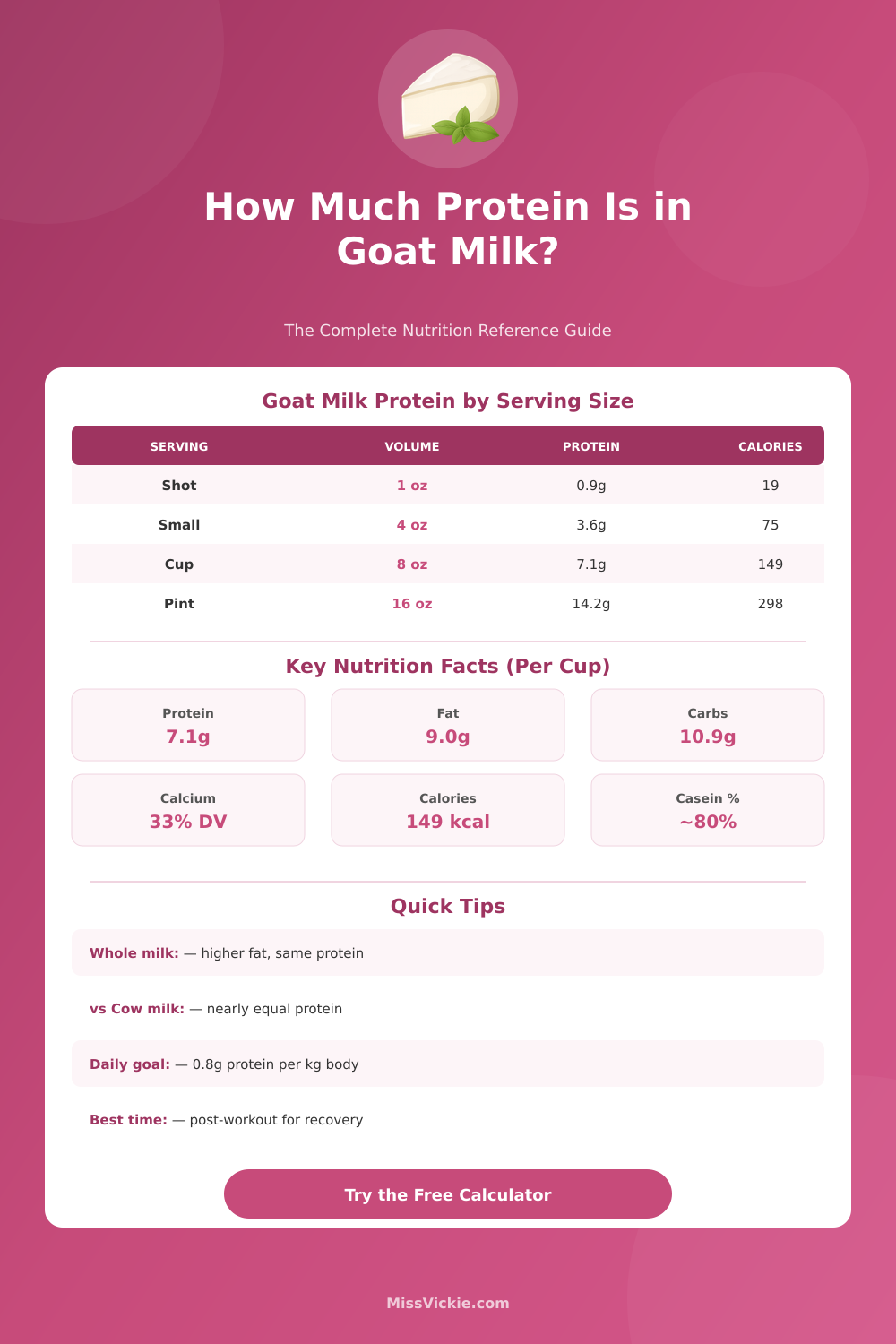
| Serving Size | Volume (Imperial) | Volume (Metric) | Protein (g) | Calories |
|---|---|---|---|---|
| 1 Tablespoon | 0.5 fl oz | 15 ml | 0.44g | 9 |
| 1 Fluid Ounce | 1 fl oz | 30 ml | 0.89g | 19 |
| Quarter Cup | 2 fl oz | 59 ml | 1.78g | 37 |
| Half Cup | 4 fl oz | 118 ml | 3.55g | 75 |
| 1 Cup | 8 fl oz | 237 ml | 7.1g | 149 |
| 1 Pint | 16 fl oz | 473 ml | 14.2g | 298 |
| 1 Quart | 32 fl oz | 946 ml | 28.4g | 596 |
| 1 Liter | 33.8 fl oz | 1000 ml | 30.0g | 630 |
| Milk Type | Protein (g) | Fat (g) | Calories | Calcium |
|---|---|---|---|---|
| Goat Milk (Whole) | 7.1g | 9.0g | 149 | 327mg |
| Cow Milk (Whole) | 7.7g | 8.0g | 149 | 276mg |
| Cow Milk (2%) | 8.1g | 4.8g | 122 | 293mg |
| Sheep Milk | 11.0g | 17.2g | 265 | 474mg |
| Oat Milk | 3.0g | 5.0g | 120 | 350mg* |
| Almond Milk | 1.0g | 2.5g | 39 | 451mg* |
| Soy Milk | 6.3g | 3.6g | 80 | 301mg* |
| Person Type | Daily Protein Need | Per kg Body Weight | Cups to Meet 30% |
|---|---|---|---|
| Child (4-13 yrs) | 19-34g | 0.85-0.95g/kg | ~1.0 cup |
| Teen (14-18 yrs) | 46-52g | 0.85g/kg | ~2.0 cups |
| Adult (19-50 yrs) | 46-56g | 0.8g/kg | ~2.0 cups |
| Senior (65+ yrs) | 60-80g | 1.0-1.2g/kg | ~2.5 cups |
| Athlete / Active | 80-150g | 1.2-2.0g/kg | ~3.5 cups |
| Pregnant / Nursing | 71-80g | 1.1g/kg | ~3.0 cups |
Goat Milk from goats of homes forms around 2% of the whole world supply of milk. One breeds some strains of goats specially to produce this milk. It has smooth makeup it is creamy and rich in Protein, so it well goes with cereals, coffee, dip of cookies or simply cold glass.
An interesting trait of Goat Milk forms the natural small size of its well mixed fat bits. Because of that the cream stays well mixed in the milk for more time than in cow milk. The whole fat part of milk from goats reaches around 2%.
All About Goat Milk
It gives a bit sharp taste with creamy texture. Sometimes one finds tiny earthy feel in the flavor, as if liquid of cheese from goats. When one handles it well, fresh Goat Milk has sweet and pure taste.
To reach good quality, it matters to give the goats proper food.
Cow milk digests naturally more hardly than Goat Milk. It stores a bit fewer casein and lactose, what helps the digestion. Compared to cow milk, it has more Protein, calcium, magnesium, copper, phosphorus, vitamin C and potassium.
Also it carries fewer carbs and sugar. One cup of Goat Milk stores around 168 calories, 10 grams of fat, 9 grams of Protein and almost just as much calcium as cow milk. The Protein has different size, what helped with better digestion.
More tryptophan is present in it than in cow milk. Even sew it yet has lactose, so it is not fully lactose-free.
In the kitchen Goat Milk shows big flexibility. One uses it to bake, prepare drinks, sauces, ice cream, cheeses and yoghurt. Powder from Goat Milk forms a practical storage item, that one mixes with water to make milk or add directly in recipes.
Cubes from freezing Goat Milk well work in shakes instead of ice cubes from water. Cajeta, caramel from Goat Milk, forms another favourite sweet. Alfredo pasta prepared with Goat Milk becomes creamy and delicious.
Cookies with chocolate chips, baked with Goat Milk, create a nice joy.
Compared to cow milk, Goat Milk is lighter. It does not clot as easily as cow milk, what helps when one prepares yoghurt. For cheese it works even more well.
Chèvre and feta form common choices, and Goat Milk works for rennet and lactic cheeses. Besides foods, one uses it to produce soap, lotions and candles.
Goat Milk costs more than cow milk. Cows give much more milk daily, and the whole selling system was built around them with big farms and machines. Because of fewer goats and fewer demand, the production of Goat Milk is more costly.
Keeping of sellable goats forms big duty, but it is worth it forthose that like the milk.