🍎 Fiber in Apple Calculator
Find out exactly how much dietary fiber is in your apple — by type, size & skin preference
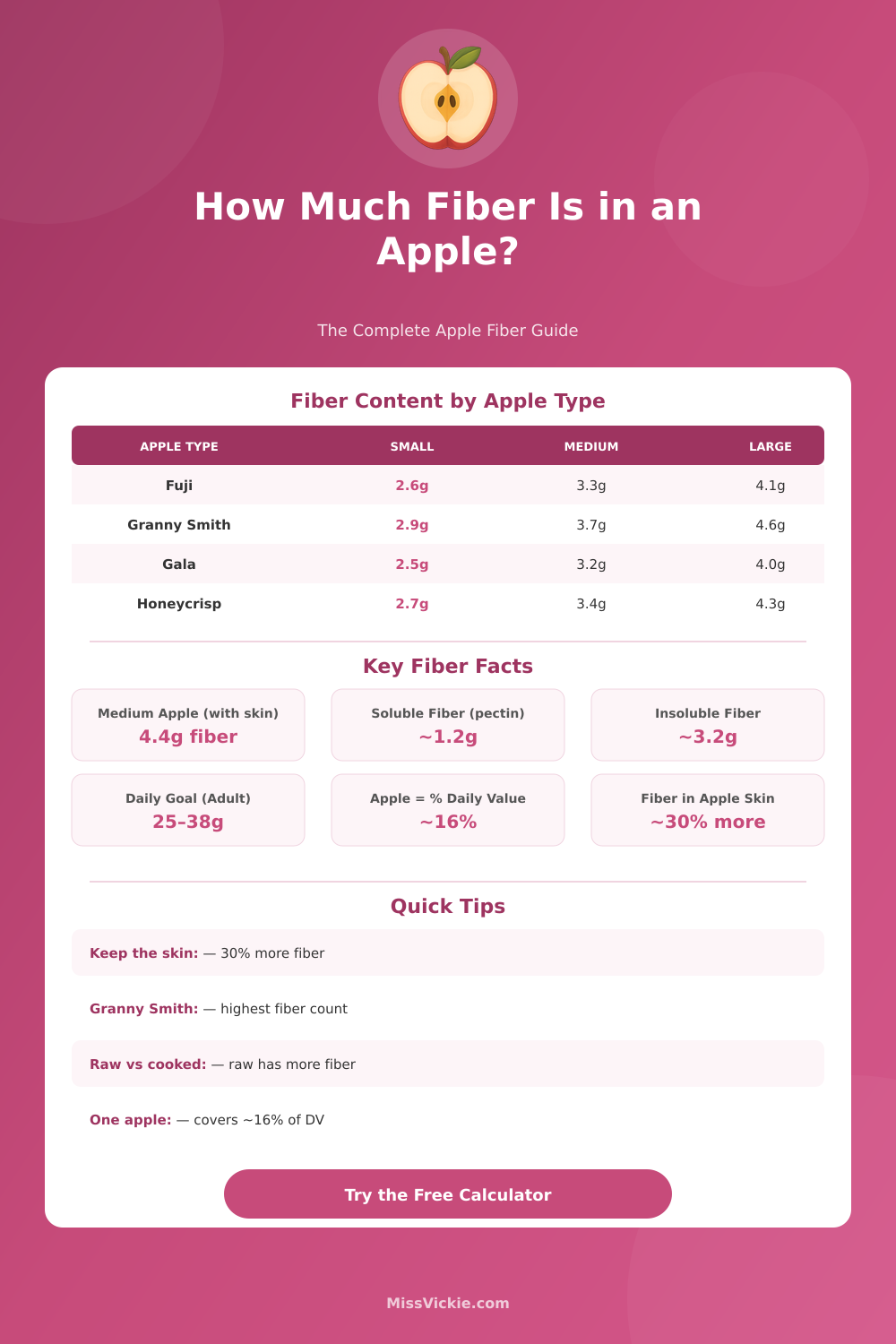
| Variety | Small (149g) | Medium (182g) | Large (223g) | X-Large (280g) |
|---|---|---|---|---|
| Fuji | 3.0g | 3.6g | 4.4g | 5.5g |
| Granny Smith | 3.3g | 4.0g | 4.9g | 6.1g |
| Gala | 2.8g | 3.4g | 4.2g | 5.2g |
| Honeycrisp | 3.0g | 3.7g | 4.5g | 5.7g |
| Golden Delicious | 2.7g | 3.3g | 4.0g | 5.1g |
| Red Delicious | 2.9g | 3.5g | 4.3g | 5.4g |
| Pink Lady | 2.9g | 3.6g | 4.4g | 5.5g |
| Braeburn | 3.0g | 3.7g | 4.5g | 5.6g |
| McIntosh | 2.6g | 3.2g | 3.9g | 4.9g |
| Generic Apple | 2.9g | 3.6g | 4.4g | 5.5g |
| Variety | With Skin | Peeled | Fiber in Skin |
|---|---|---|---|
| Fuji | 3.6g | 2.5g | 1.1g (31%) |
| Granny Smith | 4.0g | 2.8g | 1.2g (30%) |
| Gala | 3.4g | 2.4g | 1.0g (29%) |
| Honeycrisp | 3.7g | 2.6g | 1.1g (30%) |
| Golden Delicious | 3.3g | 2.3g | 1.0g (30%) |
| Red Delicious | 3.5g | 2.5g | 1.0g (29%) |
| Group | Daily Goal | Apples Needed (medium) | % per Apple |
|---|---|---|---|
| Women 19–50 | 25g | ~7 apples | 14% |
| Men 19–50 | 38g | ~11 apples | 9% |
| Women 51+ | 21g | ~6 apples | 17% |
| Men 51+ | 30g | ~8 apples | 12% |
| Children 4–8 | 25g | ~7 apples | 14% |
| Children 9–13 | 26–31g | ~7–9 apples | 12–14% |
| General Reference (FDA) | 28g | ~8 apples | 13% |
You will find apples everywhere you turn the eye, and here they do not lack, more than 21 species exist. Those fruits strike by means of their wide diversity. One can cook them in a pot, freeze, eat raw or simply bite in fresh.
Average apple weighs around 154 grams ready for use. From a nutrition viewpoint, it delivers around 95 calories for average piece. Fats almost do not exist, only a bit of protein, namely around one gram, and 25 grams of carbs.
How to Cook and Use Apples
Moreover, apples give fiber, vitamin C and a nice amount of antioxidants. What makes them even better? They are very easy to carry and put in a bag for later use.
Here the key spot, not every apple acts the same in the kitchen. Some shines when one bakes them, others best work for eating raw. The best for cooking have skin and meat that easily breaks or softens without big trouble.
A good baking apple stays togetehr nice, resisting turning into pure mush. Granny Smith apples are the classic choices, and honestly, any species that works in cake will do for baking only at little cost.
Baking with apples, the species really affects the success of the food. If the result tastes bland, probably the apples were not quite sweet already from the start. Grating them instead of cutting helps to move the flavors well.
From my experience, cooking them a bit more long in butter before mixing with other ingredients brings out there essence. In United Kingdom there is that big, hard, waxed apple called Bramley, that cooks great, although finding it in United States? Almost impossible.
Apples go well with many flavors. Ginger and vanilla form classic pairs in apple cake. Streusel cover nicely agrees with apple filling.
Moreover, apple spices stay lasting gifts. Apple cider appears also in recipes for bread, mixed with dry raisins and made rich with flour. Even you will find caramel apple turned breads, that rely on cider and fast rising.
Pork and apples simply belong one to the other. Apple-based drinks work as nice dessert after a pork meal. Apple cake is another winner, and the simpler versions skip the thick milk, using only regular milkinstead.
To create apple-based starter for bread, you need patience; for around four days, leave the apples sitting in water and sugar. The mix darkens and gives off strong smell. After straining, add the liquid to flour, beaten by your starter.
It should bubble in one day. But reaching real apple taste in bread without it disappearing? That is more hard.
The resulting bread commonly turns sweet and pleasant, however the apple smell somehow fades. One cup of fruit matches around one little apple of 2.5 inches across or half of a big apple at around 3.25 inches.