🥦 Protein in Cauliflower Rice Calculator
Enter your serving size to get exact protein and full nutrition facts
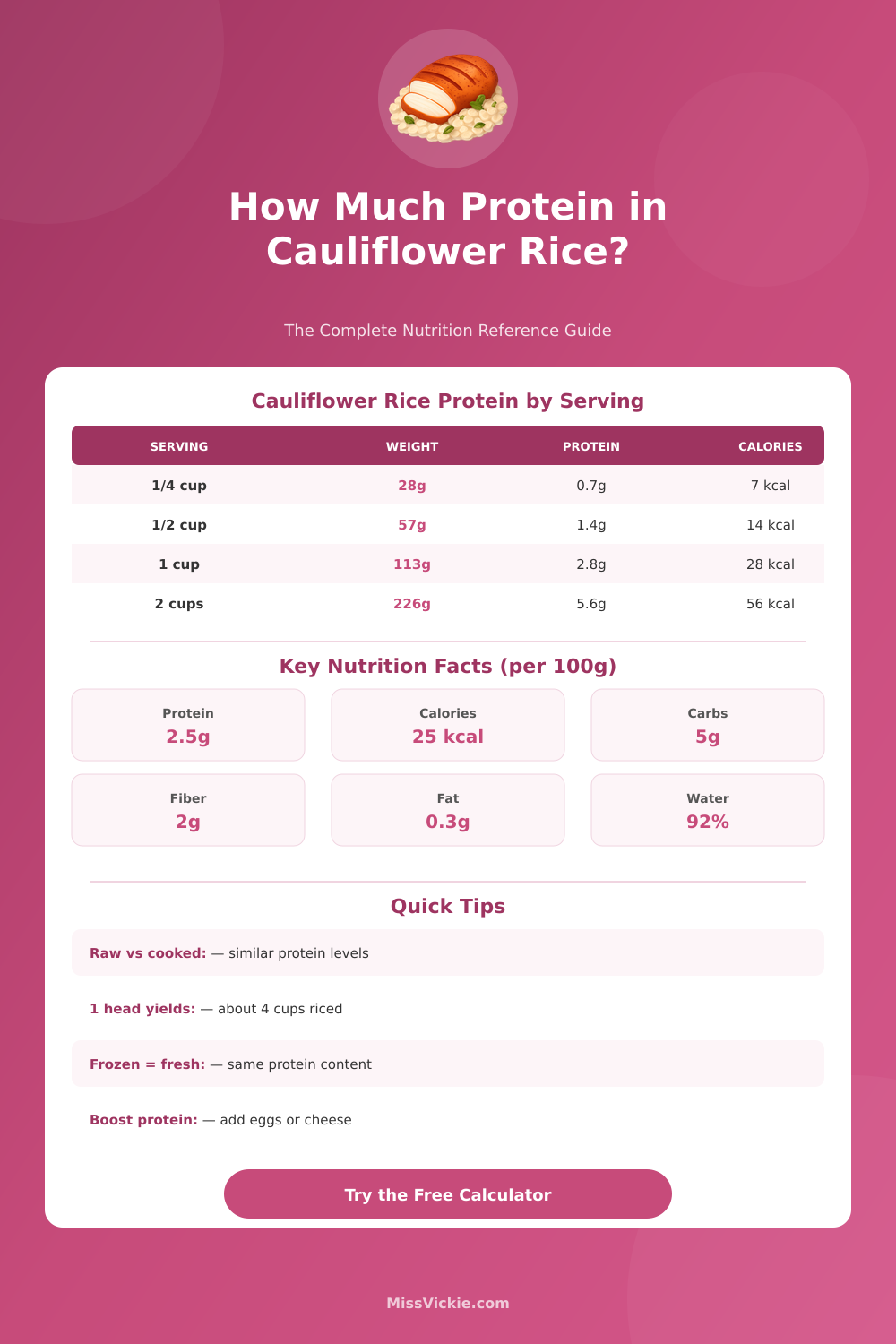
| Serving Description | Weight | Protein | Calories | Carbs |
|---|---|---|---|---|
| 2 tablespoons | 14g | 0.4g | 3.5 kcal | 0.7g |
| 1/4 cup | 28g | 0.7g | 7 kcal | 1.4g |
| 1/3 cup | 38g | 1.0g | 9.5 kcal | 1.9g |
| 1/2 cup | 57g | 1.4g | 14 kcal | 2.9g |
| 2/3 cup | 75g | 1.9g | 19 kcal | 3.8g |
| 3/4 cup | 85g | 2.1g | 21 kcal | 4.3g |
| 1 cup | 113g | 2.8g | 28 kcal | 5.7g |
| 1.5 cups | 170g | 4.3g | 43 kcal | 8.5g |
| 2 cups | 226g | 5.6g | 57 kcal | 11.3g |
| 3 cups | 339g | 8.5g | 85 kcal | 17g |
| Type | Protein | Calories | Carbs | Notes |
|---|---|---|---|---|
| Raw / Fresh | 2.5g | 25 kcal | 5.0g | Standard baseline |
| Cooked (steamed) | 2.2g | 23 kcal | 4.5g | Slight dilution from water |
| Cooked (boiled) | 1.9g | 20 kcal | 3.9g | More water absorption |
| Frozen (uncooked) | 2.5g | 25 kcal | 5.0g | Same as raw |
| Store-brand packaged | 2.3g | 24 kcal | 4.7g | May vary slightly by brand |
| Type | Protein | Calories | Carbs | Fiber |
|---|---|---|---|---|
| Cauliflower Rice (raw, 113g) | 2.8g | 28 kcal | 5.7g | 2.3g |
| White Rice (cooked, 186g) | 4.4g | 242 kcal | 53.4g | 0.6g |
| Brown Rice (cooked, 195g) | 5.0g | 216 kcal | 44.8g | 3.5g |
| Jasmine Rice (cooked, 186g) | 4.2g | 238 kcal | 52.2g | 0.4g |
| Wild Rice (cooked, 164g) | 6.5g | 166 kcal | 35.0g | 3.0g |
| Cauliflower Size | Whole Weight | Riced Yield | Approx. Protein |
|---|---|---|---|
| Small head | ~450g | ~2.5 cups (283g) | ~7.1g |
| Medium head | ~675g | ~3.5 cups (396g) | ~9.9g |
| Large head | ~900g | ~5 cups (565g) | ~14.1g |
| Extra large head | ~1200g | ~6.5 cups (735g) | ~18.4g |
Cauliflower rice quickly became very popular as alternative to rice, and honestly, I not hardly know the reason. It has little carbohydrate, no grain, no gluten, works for paleo-diet, keto, vegans and vegetarians. It fully covers all dietary choices.
Best show the nutritious benefits. It has almost a fifth of calories compared to white rice and the carb amounts too. Also, one finds around four times more fiber than in average rice.
Cauliflower Rice: Benefits and How to Make It
The level of vitamin C is much more high, and it gives almost three times more calcium. The glycemic index is only around 10, rather than 72 for white rice, what is critical, if one minds about changes in blood-sugar.
Making it at home is easy. First wash and dry the cauliflower, then remove the green parts. Break the head in florets and then cut them away from the core in good size blocks.
Then use a food processor as faithful help, beat the bits until they look like rice grains. Working in smaller parts help to avoid over-processing to wet mass. The grating insert works even better than the usual blade, because it forms nice rice-like bits.
Also a box grater with medium holes works well, if you lack a food processor.
Always use fresh ingredients, not frozen. Frozen cauliflower rice commonly becomes too soft when one heats it. One big head gives around four cups, so four servings, if one takes one cup each person.
After making it, it stays fresh in the fridge almost a whole week.
The way you cook it changes everything. Moisture is the main problem hear. Leave it wet, and you will end with watery sadness instead of something edible.
Browning it in a pan with a bit of oil beats microwaving by far. Roasting is another good option, because the edges brown and get nutty, almost toasted feel. Simply avoid adding liquid on it during cooking, or you will again have a wet problem.
Remove every moisture before adding sauce.
Spices change something, what on its own is quite simply. Onions, garlic and green onions add strong taste. Cooking with olive oil and browned onions gives it enough good flavor.
Soy sauce mixes well during cooking. Fresh lemon juice shines, when one serves it with fish or meat. Parmesan cheese adds richness, while crushed garlic, sesame oil or ginger can boost the spiciness.
It works well for stir-fried stuff, burrito-bowls, fried rice or as base under beans and meat. One can mix cauliflower rice with a small amount of white rice… That reduces the carbohydrates, while the texture stays more like usual.
That mix has around one-half of carbohydrates compared to pure white rice, so itbecomes a good low-carb choice for the meal.