🥛 Protein in Greek Yogurt Calculator
Calculate total protein from Greek yogurt servings — by brand, fat type & serving size
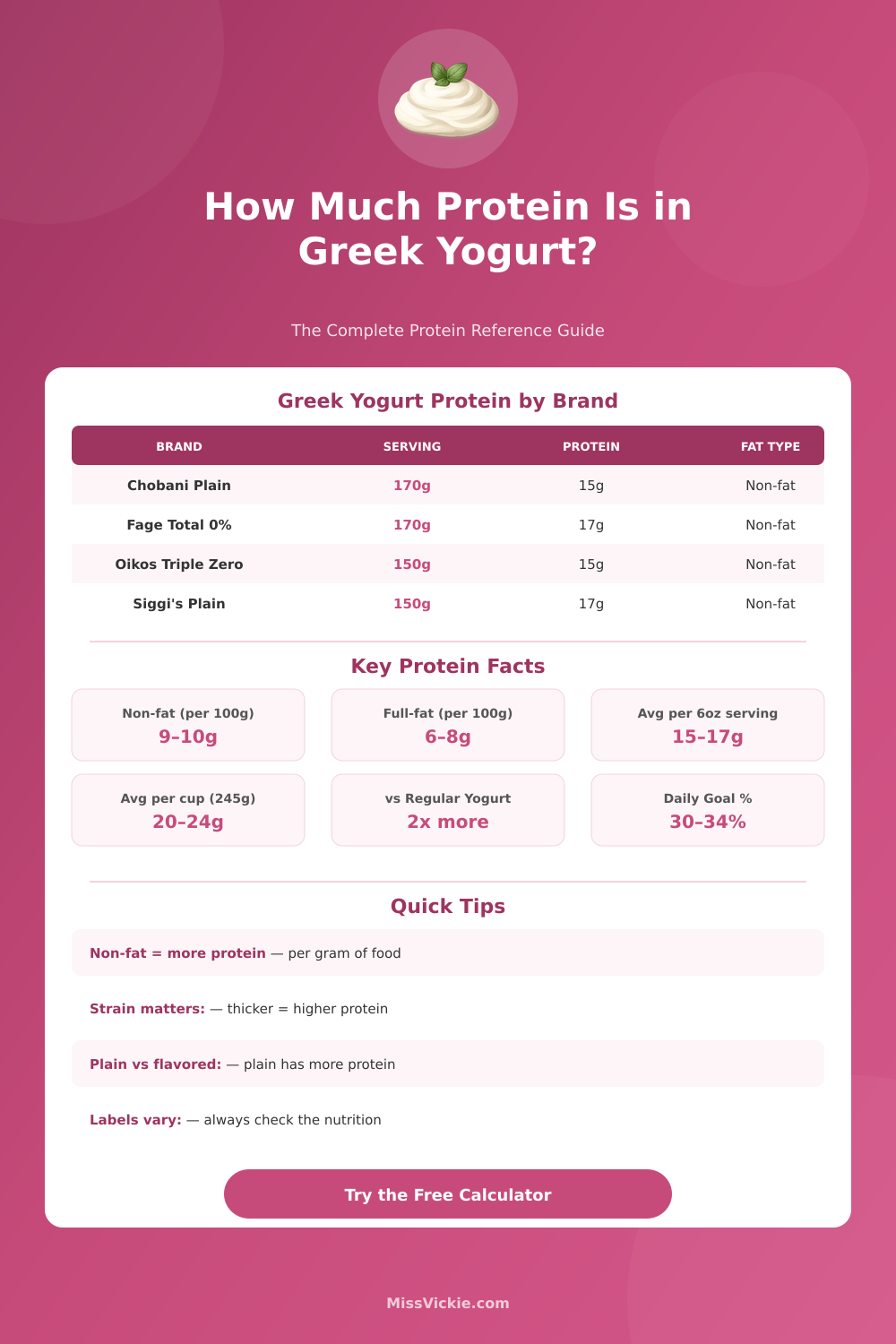
| Brand | Serving | Protein | Calories | Fat Type |
|---|---|---|---|---|
| Chobani Plain Non-fat | 170g (6oz) | 15g | 90 | Non-fat |
| Chobani Plain 2% | 170g (6oz) | 14g | 130 | Low-fat |
| Chobani Plain Full-fat | 170g (6oz) | 13g | 170 | Full-fat |
| Fage Total 0% | 170g (6oz) | 17g | 90 | Non-fat |
| Fage Total 2% | 170g (6oz) | 16g | 130 | Low-fat |
| Fage Total 5% | 170g (6oz) | 15g | 190 | Full-fat |
| Oikos Triple Zero | 150g (5.3oz) | 15g | 90 | Non-fat |
| Oikos Pro | 150g (5.3oz) | 20g | 100 | Non-fat |
| Siggi’s 0% Plain | 150g (5.3oz) | 17g | 90 | Non-fat |
| Siggi’s 4% Plain | 150g (5.3oz) | 15g | 150 | Full-fat |
| Stonyfield Organic 0% | 170g (6oz) | 14g | 80 | Non-fat |
| Generic Non-fat Greek | 100g | 9.5g | 59 | Non-fat |
| Serving Description | Grams | Ounces | Approx. Protein |
|---|---|---|---|
| 1 Tablespoon | 15g | 0.5 oz | 1.4g |
| 1/4 Cup | 61g | 2.2 oz | 5.8g |
| 1/2 Cup | 122g | 4.3 oz | 11.6g |
| 3/4 Cup | 184g | 6.5 oz | 17.5g |
| 1 Cup | 245g | 8.6 oz | 23.3g |
| Small container (5.3oz) | 150g | 5.3 oz | 14.3g |
| Standard container (6oz) | 170g | 6 oz | 16.2g |
| Large container (7oz) | 198g | 7 oz | 18.8g |
| Goal / Activity Level | Daily Protein (g/kg) | Example (70kg / 154lb) | Servings of Greek Yogurt |
|---|---|---|---|
| Sedentary adult | 0.8g/kg | 56g/day | ~3 servings |
| Moderately active | 1.2g/kg | 84g/day | ~5 servings |
| Active / Exercise 3–5x/wk | 1.5g/kg | 105g/day | ~6 servings |
| Athlete / High intensity | 1.8–2.2g/kg | 126–154g/day | ~7–9 servings |
| Muscle building | 2.0–2.4g/kg | 140–168g/day | ~8–10 servings |
Greek yogurt is made of thick, rich in protein food, that works for sweet as well as salty foods. One can eat it simply. What sets it apart from regular yogurts is the straining process, that removes the serum.
That results in higher protein levels per unit of volume and gives it more thickness than regular yogurt.
What is Greek yogurt and how to use it
In North America one usually sells thick yogurt under the name “greek yogurt” while in United Kingdom it is called “Greek-style yogurt”. One eats thick yogurt also in the Levant, East Mediterranean, Middle East and Central Asia. Interestingly, in Greece the traditional yogurt actually comes from milk of sheep.
It tends to be more watery, more bitter and less creamy than the kind, that one sells everywhere in the world.
greek yogurt works to replace sour cream almost in everything. It goes well with grains like couscous or beans. It serves as basic sauce or even as a coating for meat.
When one prepares sauce, one should add the yogurt after removing it from the boiler. Yogurt does not mix well with heat, so the sauce can seem clumpy, if one adds the yogurt during cooking.
An interesting affect is mixing flour with greek yogurt for simple dough. From that dough one can prepare bagels, flatbreads, donut bites, garlic knots, bases for pizza and even more. Greek yogurt adds also extra moisture and tenderness to baked breads.
Home prepared greek yogurt is really simple. You need only two things: milk and a tiny amount of ready yogurt as starter culture. The store bought yogurt brings the needed bacteria for the process.
When the yogurt sets and becomes as thick as possible, one can strain it to reach the typical Greek thickness. Just lay a metal coffee filter in a broad bowl and leave it in the refrigerator for some hours to finish the task.
There is no official limit that counts for all greek yogurt, because each brand differs. The best method is to check the date on the package before buying. The serum, that drains during the straining, still holds nutrients and works as a drink with a bit of bitter taste.
It works also well as a replacement for water in recipes for bread.
Some liked toppings are honey with nuts, warm berry mixes with a squirt of lemon, toasted oats or granola with cinnamon and pure cocoa powder with something sweet. Simple greek yogurt with mixed peanut butter and chocolate chips forms another option. Cut figs with a drop of honey and chia seeds also work well.
The thicker kinds have much better texture, although fat-free andlow-fat versions are also available.