🥬 Calcium in Spinach Calculator
Calculate exactly how much calcium you get from raw or cooked spinach based on your serving size & unit preference.
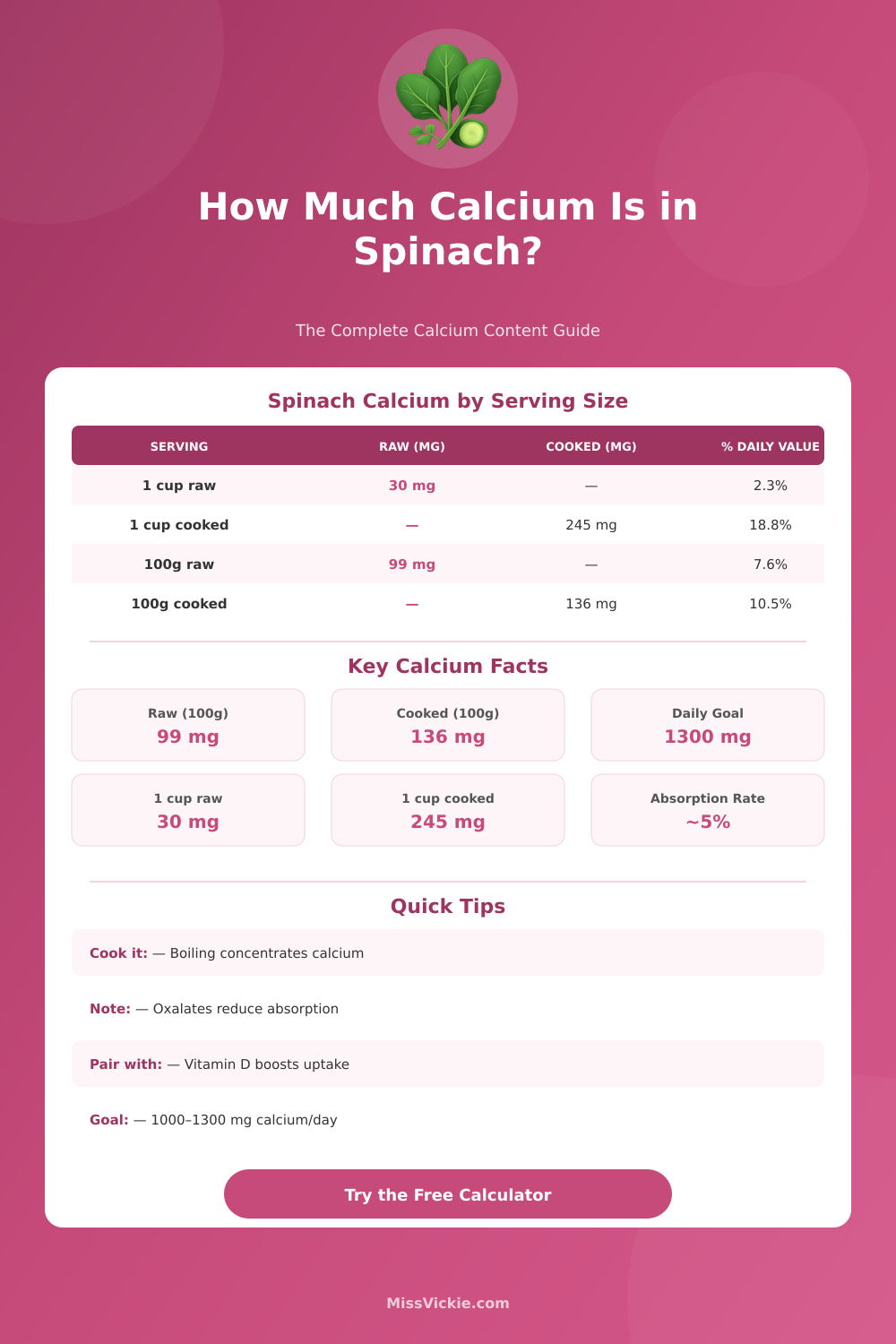
| Spinach Type | Serving Size | Weight | Calcium (mg) | % Daily Value |
|---|---|---|---|---|
| Raw | 1 cup | 30g | 30 mg | 2.3% |
| Raw | 100g | 100g | 99 mg | 7.6% |
| Raw | 1 oz | 28.4g | 28 mg | 2.2% |
| Cooked (boiled) | 1 cup | 180g | 245 mg | 18.8% |
| Cooked (boiled) | 100g | 100g | 136 mg | 10.5% |
| Cooked (boiled) | 1 oz | 28.4g | 39 mg | 3.0% |
| Frozen (cooked) | 1 cup | 190g | 277 mg | 21.3% |
| Frozen (cooked) | 100g | 100g | 146 mg | 11.2% |
| Canned (drained) | 1 cup | 214g | 272 mg | 20.9% |
| Canned (drained) | 100g | 100g | 127 mg | 9.8% |
| Age / Group | Daily Calcium (mg) | Cups Cooked Spinach Needed | Cups Raw Spinach Needed |
|---|---|---|---|
| Children 1–3 yrs | 700 mg | ~2.9 cups | ~23 cups |
| Children 4–8 yrs | 1,000 mg | ~4.1 cups | ~33 cups |
| Teens 9–18 yrs | 1,300 mg | ~5.3 cups | ~43 cups |
| Adults 19–50 yrs | 1,000 mg | ~4.1 cups | ~33 cups |
| Adults 51–70 yrs (M) | 1,000 mg | ~4.1 cups | ~33 cups |
| Adults 51–70 yrs (F) | 1,200 mg | ~4.9 cups | ~40 cups |
| Adults 70+ yrs | 1,200 mg | ~4.9 cups | ~40 cups |
| Pregnant / Lactating | 1,000–1,300 mg | ~4.1–5.3 cups | ~33–43 cups |
| Measure | Grams | Ounces | Calcium (Raw) |
|---|---|---|---|
| 1 cup raw spinach | 30g | 1.06 oz | 30 mg |
| 1 cup cooked spinach | 180g | 6.35 oz | — (cooked: 245mg) |
| 1 oz raw spinach | 28.4g | 1 oz | 28 mg |
| 1 lb raw spinach | 454g | 16 oz | 449 mg |
| 100g raw spinach | 100g | 3.53 oz | 99 mg |
| 1 standard bag (baby) | ~142g | 5 oz | ~141 mg |
Spinach comes from Persia, so from Central and West Asia, and its scientific name comes from Spinacia oleracea. It belongs to the amaranth family, and truly one finds it everywhere in the world currently. One eats the leaf fresh, cooked or preserved, and almost any kitchen imagines itself without it in some way or another.
This vegetable simply enjoys universal love.
All About Spinach
Spinach leaves have various forms. One can get flat or a bit wavy, depending on the kind. Young Spinach has bright and strong leaves, that becomes more dark while they mature, in deeper shade.
Even so here the spot: Spinach naturally has a bit of bitterness, so it needs only little cooking, possibly. Simple steps can remove that bitterness and improve the taste.
Spinach is not hard to find. It sells during the whole year in grocery stores, in many forms; bagged, opened, frozen, preserved, whatever you want. To pick fresh Spinach, avoid anything yellowish or wilted.
To preserve it crisp, lay it between paper towles or wrap it in a sealed box with paper towel on the bottom. Both ways work surprisingly well.
One cup of raw Spinach, or around half a cup cooked, forms a serving. Cook it very little, what commonly shocks folks. Because leafy green vegetables can carry bacteria, one must wash it fully before eating.
For canned Spinach, spill the liquid, rinse it and dry by means of paper towel before.
The nutritional value of Spinach truly impresses. It is rich in protein, potassium and iron, plus folate, Calcium and vitamins B, C and K. The fat is little, and cholesterol even less. It also has niacin, zinc, fiber, magnesium, phosphorus, copper and manganese, everything in one leaf.
Studies show, that Spinach helps the sight, gives energy, strengthens bones, cares about heart health and helps skin to look well. For vegetarians and vegans especially it forms a reliable plant-based source of protein and iron. Even so, too much eating can harm the health.
But there are catches. Spinach carries more oxalates, because of what your teeth occasionally feel rough and dry after eating. Raw Spinach has oxalic acid, that can block the absorbing of Calcium and iron in the body.
And Spinach entered the list of the dirty dozens, that list that ranks products according too high residues of pesticides.
The way you cook Spinach matters more, than one assumes. Sauté it in little fat and avoid boiling every occasion, especially because boiling carries nutrients into the water. Keep the heat low and the time short.
Add juice of fresh lemon above it at the end, and the flavor really lives. Sautéing with olive oil and garlic is probably the simplest way. Moreover, Spinach works in salads, sandwiches, omelets, smoothies, stir-fries, soup, pasta, pizzas, stuffings, lasagnas and quesadillas.
It evenoperates in bread.