🍅 Sugar in Tomatoes Calculator
Calculate the exact sugar content in any tomato type, weight, or serving size
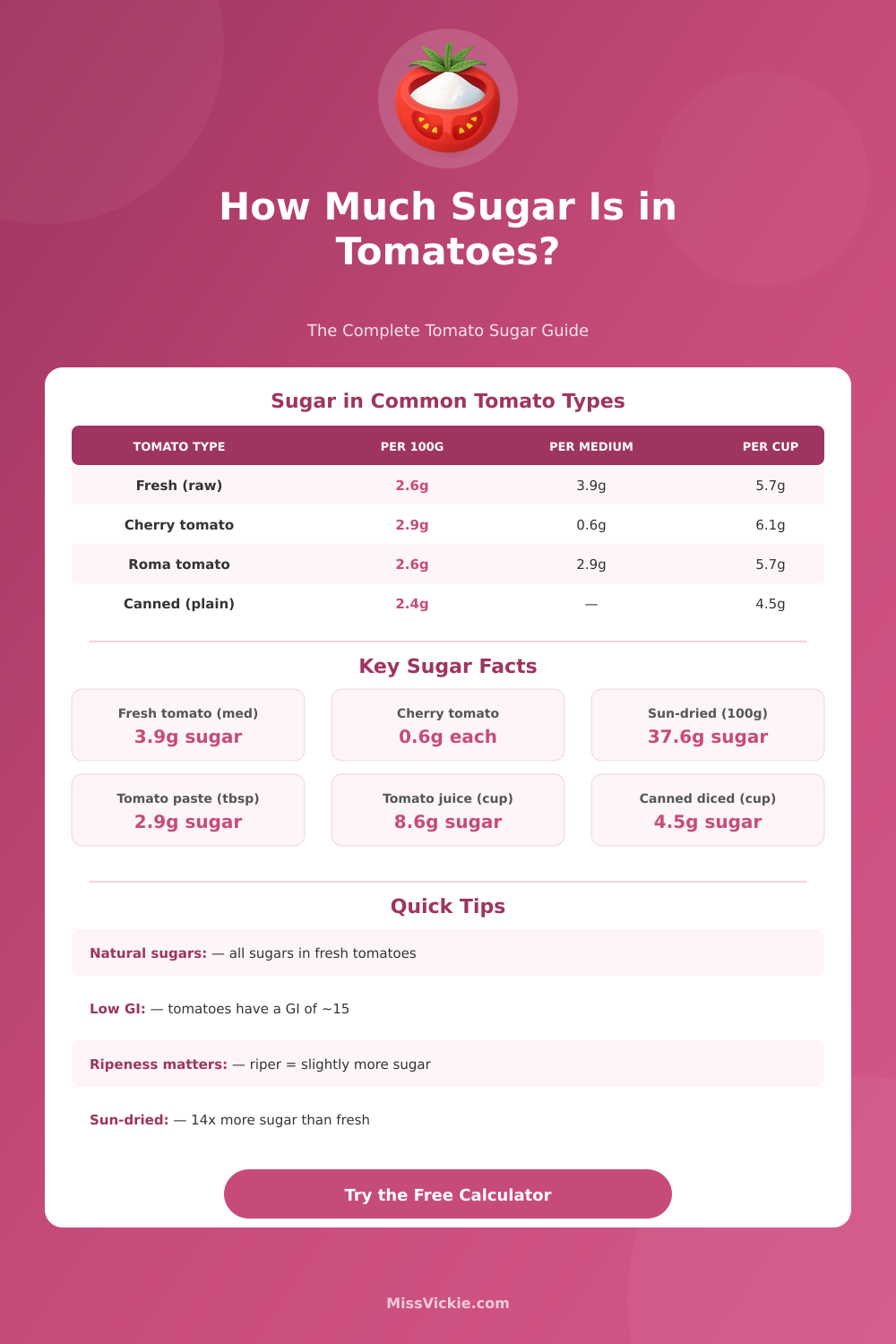
| Tomato Type | Sugar (g) | Carbs (g) | Calories | Water % |
|---|---|---|---|---|
| Fresh Tomato (raw) | 2.6g | 3.9g | 18 kcal | 94.5% |
| Cherry Tomato | 2.9g | 5.8g | 18 kcal | 93.0% |
| Roma Tomato | 2.6g | 3.8g | 17 kcal | 94.0% |
| Beefsteak Tomato | 2.5g | 3.9g | 17 kcal | 94.6% |
| Grape Tomato | 3.0g | 5.5g | 20 kcal | 93.1% |
| Canned Tomato (plain) | 2.4g | 4.0g | 17 kcal | 93.9% |
| Tomato Paste | 19.4g | 24.9g | 82 kcal | 72.0% |
| Tomato Sauce (canned) | 5.2g | 7.1g | 29 kcal | 87.0% |
| Tomato Juice | 3.6g | 4.2g | 17 kcal | 94.0% |
| Sun-Dried Tomato | 37.6g | 55.8g | 258 kcal | 14.6% |
| Serving | Approx. Weight | Sugar (g) | Type |
|---|---|---|---|
| 1 small tomato | 90g (3.2 oz) | 2.3g | Fresh |
| 1 medium tomato | 150g (5.3 oz) | 3.9g | Fresh |
| 1 large tomato | 240g (8.5 oz) | 6.2g | Fresh |
| 1 cherry tomato | 17g (0.6 oz) | 0.5g | Cherry |
| 1 cup cherry tomatoes | 150g (5.3 oz) | 4.4g | Cherry |
| 1 roma tomato | 110g (3.9 oz) | 2.9g | Roma |
| 1 beefsteak tomato | 300g (10.6 oz) | 7.5g | Beefsteak |
| 1 cup sliced tomato | 180g (6.4 oz) | 4.7g | Fresh |
| 1 tbsp tomato paste | 16g (0.6 oz) | 3.1g | Paste |
| 1 cup tomato juice | 243g (8.6 oz) | 8.7g | Juice |
| 1 cup canned diced | 240g (8.5 oz) | 5.8g | Canned |
| 10 sun-dried halves | 54g (1.9 oz) | 20.3g | Sun-dried |
The tomato is a plant whose fruit forms an edible berry, although one commonly eats it as a vegetable. According to botany, it genuinely is a fruit. Fruits are those structures that flowering plants form to bear seeds.
Even so most many cooks consider it a vegetable, that requires only a bit of work.
All About Tomatoes
Tomatoes belong to the family of nightshades, that also carries tobacco, potatoes and chili peppers. The Latin genus name Solanum comes from “solamen“, what means comforting or calming. The particular name points to “wolf peach”.
Before, one indeed called tomatoes wolf peaches. They originally come from west South America, where one probably tamed them. The name itself has origin in the Aztec word “tomatl“.
When Spaniards met with the Aztecs around the year 1600, they wrote it as “tomate“. That term later entered Enlgish and evolved to “tomato”.
Tomatoes once were believed to be poisonous for folks. Today that no longer counts, clearly.
One finds more than 25 000 varieties in a mix of colours, between which red, golden, green, black, purple and white. Between popular species are cherry tomato, beefsteak tomatoes, Brandywine, Better Boy, Grand Beef, Celebrity, Sun Gold and Yellow Pear. During buying of tomatoes, choose firm samples without black marks.
One should keep them at room temperature and use within five days.
The season of tomatoes lasts from May until October, but the peek happens at the end of July and in August. To find good tomatoes, shop during the season. Fresh, ripe heirloom tomatoes one best gets in summer and autumn.
Tomatoes form a basic ingredient for cooking during the whole year.
tomato plants are crops for warm seasons, that like sun and do not last cold. Important is do not plant them in the ground too soon. In many regions the soil does not warm enough before the end of spring or start of summer.
In USDA-zone 10 tomatoes one actually grows in autumn and winter. Plants one can start inside from seeds or buy as seedlings from a garden centre. While starting from seed, use bright soil mix and give a lot of light.
Little light causes long, weak seedlings.
Too much water can create troubles. Varied watering or scarce watering commonly causes decay at the base of tomato plants. Try to wet the soil to six until eight inches of depth.
Water the soil, not the plant itself. Remove the bottom leaves as the plant grows, because ground splash on leaves spreads diseases.
Tomatoes deliver many vitamins and minerals, between that vitamin C, that works as a natural nutrient and antioxidant. One medium tomato gives 28% of the everyday benchmark intake for vitamin C. They certainly are themost liked garden vegetables in the world.