🍵 White Tea Caffeine Calculator
Estimate exactly how much caffeine is in your white tea by type, steep time & serving size
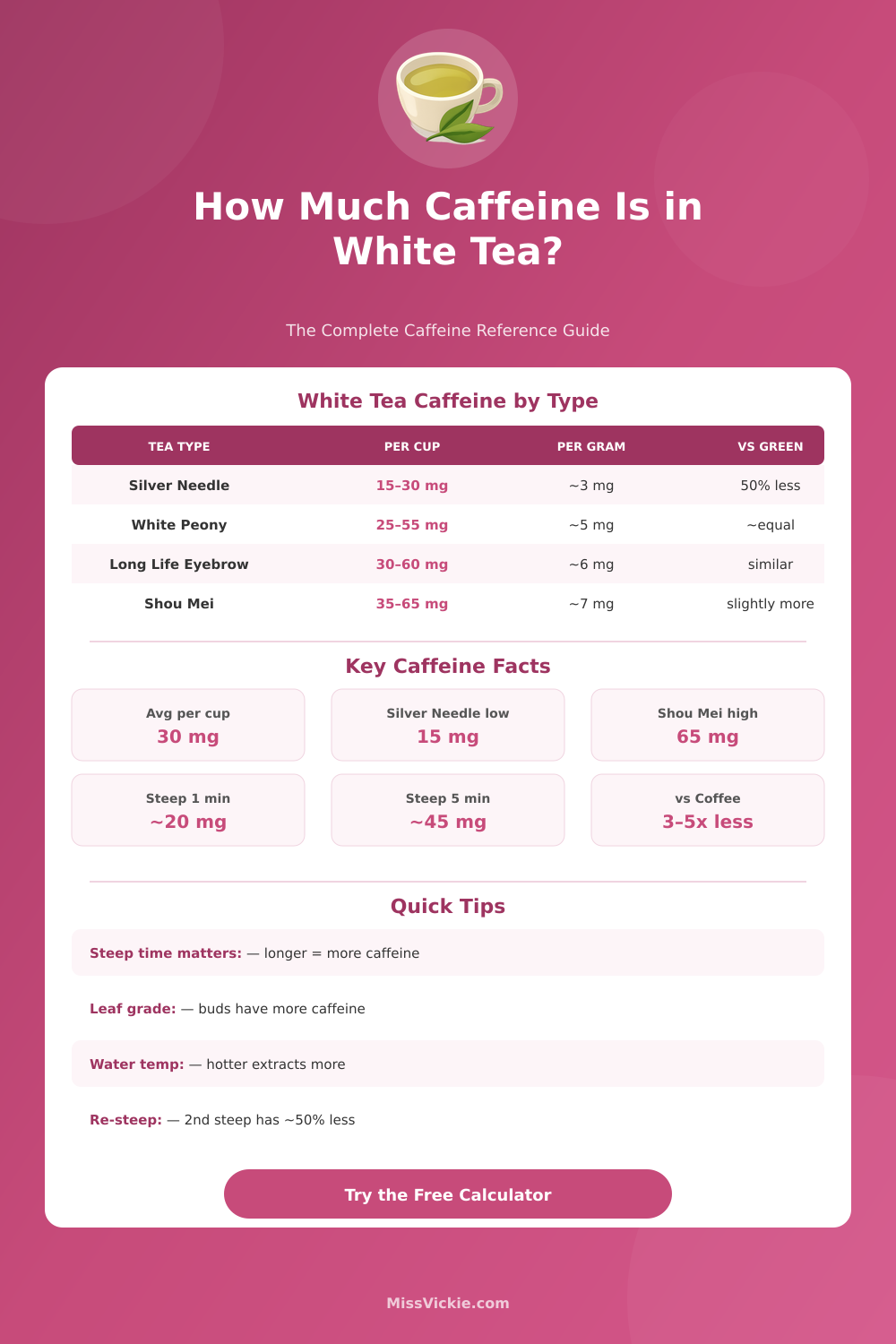
| Tea Type | Caffeine/Cup (avg) | Caffeine Range | vs Coffee (8oz) |
|---|---|---|---|
| Silver Needle | 20 mg | 15–30 mg | ~85% less |
| White Peony | 37 mg | 25–55 mg | ~70% less |
| Long Life Eyebrow (Shou Mei) | 47 mg | 35–65 mg | ~60% less |
| Tribute Eyebrow (Gong Mei) | 42 mg | 30–60 mg | ~65% less |
| Darjeeling White | 32 mg | 20–50 mg | ~75% less |
| Green Tea (reference) | 35 mg | 20–50 mg | ~70% less |
| Black Tea (reference) | 50 mg | 40–70 mg | ~55% less |
| Coffee 8oz (reference) | 95 mg | 80–130 mg | — |
| Steep Time | Extraction % | Caffeine (Silver Needle) | Caffeine (White Peony) |
|---|---|---|---|
| 30 seconds | ~20% | ~4 mg | ~7 mg |
| 1 minute | ~35% | ~7 mg | ~13 mg |
| 2 minutes | ~55% | ~11 mg | ~20 mg |
| 3 minutes | ~70% | ~14 mg | ~26 mg |
| 5 minutes | ~85% | ~17 mg | ~31 mg |
| 7 minutes | ~95% | ~19 mg | ~35 mg |
| 10+ minutes | ~100% | ~20 mg | ~37 mg |
| Water Temp | Temp (°F) | Extraction Multiplier | Notes |
|---|---|---|---|
| 65°C | 149°F | 0.65x | Cold-style, minimal extraction |
| 70°C | 158°F | 0.75x | Low temp, preserves delicacy |
| 75°C | 167°F | 0.85x | Recommended for Silver Needle |
| 80°C | 176°F | 0.92x | Recommended for White Peony |
| 85°C | 185°F | 0.97x | Good for Shou Mei |
| 90°C | 194°F | 1.0x | Near full extraction baseline |
| 100°C | 212°F | 1.05x | Boiling — max extraction |
| Leaf Amount | Imperial Equiv. | Caffeine (White Peony) | Strength |
|---|---|---|---|
| 1 g | ~½ tsp | ~18 mg | Light |
| 1.5 g | ~¾ tsp | ~28 mg | Light–medium |
| 2 g | ~1 tsp | ~37 mg | Medium (standard) |
| 3 g | ~1.5 tsp | ~55 mg | Strong |
| 4 g | ~2 tsp | ~74 mg | Very strong |
| 5 g | ~2.5 tsp | ~92 mg | Gongfu style |
| Steep # | Caffeine Retained | Example (White Peony 37mg 1st) | Flavor |
|---|---|---|---|
| 1st steep | 100% | ~37 mg | Full flavor |
| 2nd steep | ~50–60% | ~18–22 mg | Lighter, sweeter |
| 3rd steep | ~25–35% | ~9–13 mg | Very mild |
| 4th steep | ~10–20% | ~4–7 mg | Faint |
White tea belongs to the six main types of tea from the plant Camellia sinensis. It ranks between the rarest types and is easily noticed because of the tender white fluff on its leaf and bud. One gathers the young leaves and buds before they open fully when they still are covered by those fine white hairs.
Here the origin of the name white tea.
All About White Tea
Between all teas, white tea goes through the least preparation. The buds stay unrolled and unoxidized, and one must carefully watch them during the drying. Collectors take the buds right before the leaves twist around the stem, later one dries them by means of air to keep the colour and the look.
Green colour does not grow in those buds, which gives them the typical white look. One chooses white teas at the beginning of the season, when teh leaves are fresh and tender.
There is no widely accepted definition for white tea, and the global agreement about its description is very limited. Surprisingly, all this happens despite the big popularity that it got.
The most brilliant white teas are called Silver Needle, that consists only of buds of the tea plant. Silver Needle has sweeter taste, on the other hand White Peony; or Bai Mu Dan; is more strong because of the addition of leaves together with buds. Between other types are Shou Mei and Gong Mei.
White tea can also age, and aged white tea forms a quickly growing group. Aged Shou Mei teas commonly have a malt, sweet and rich taste. Right sun-dried white teas can have sharp and grassy tone.
Typical Silver Needle from Vietnam commonly is very sweet and less grassy.
White tea is the most expensive of the tea types. It does not handle trouble in the preparation as well as more black teas. For white and green teas, one should use a bit cooler water compared to oolong and black teas.
Ideal temperature to start is around 175 until 185 degrees Fahrenheit. If the water is too warm, the tea risks to become too bitter. Also the water quality plays a role.
Soft water works better, because too much calcium can mask the flavours.
Leaves of white tea are much less dense and compact then those of other teas. For good ratio, take around two spoons of white leaves in eight units of water. At more fluffy teas, one full spoon works well.
During making of iced white tea, double the amount of loosened leaves, because the ice will thin it. Three until four cups a day are enough to benefit from its advantages.
One cup of white tea holds under twenty milligrams of caffeine. That is less compared to green tea with its twenty until thirty milligrams, and is much less than in oolong or black tea. White tea offers light, gentle and delicatetaste.
It differs much from green tea, although both go through only little preparation.