🍵 Matcha Caffeine Calculator
Calculate exact caffeine in your matcha tea by grade, scoops & serving size
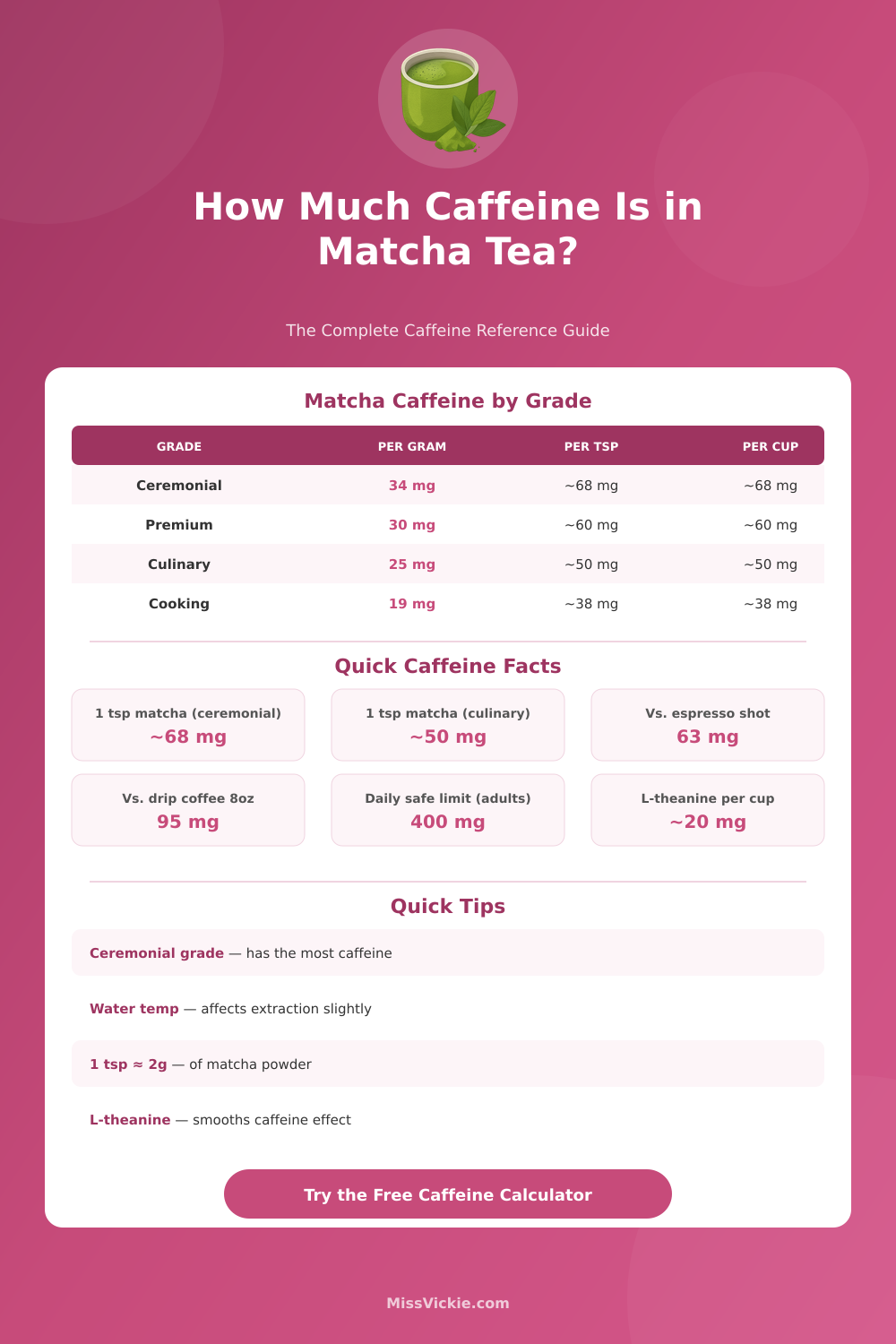
| Grade | mg / gram | 1 tsp (~2g) | 1.5 tsp (~3g) | 2 tsp (~4g) | 1 tbsp (~6g) |
|---|---|---|---|---|---|
| Ceremonial | 34 mg | 68 mg | 102 mg | 136 mg | 204 mg |
| Premium | 30 mg | 60 mg | 90 mg | 120 mg | 180 mg |
| Culinary | 25 mg | 50 mg | 75 mg | 100 mg | 150 mg |
| Cooking | 19 mg | 38 mg | 57 mg | 76 mg | 114 mg |
| Beverage / Food | Serving Size | Caffeine (mg) | Caffeine / oz |
|---|---|---|---|
| Matcha (ceremonial, 1 tsp) | 8 fl oz | 68 mg | 8.5 mg |
| Matcha (culinary, 1 tsp) | 8 fl oz | 50 mg | 6.3 mg |
| Drip Coffee | 8 fl oz | 95 mg | 11.9 mg |
| Espresso (single shot) | 1 fl oz | 63 mg | 63 mg |
| Black Tea | 8 fl oz | 47 mg | 5.9 mg |
| Green Tea (steeped) | 8 fl oz | 28 mg | 3.5 mg |
| Energy Drink (Red Bull) | 8.4 fl oz | 80 mg | 9.5 mg |
| Decaf Coffee | 8 fl oz | 2–5 mg | ~0.4 mg |
| Measure | Grams (g) | Ounces (oz) | Notes |
|---|---|---|---|
| 1/2 teaspoon | 1 g | 0.035 oz | Light serving |
| 1 teaspoon | 2 g | 0.07 oz | Standard thin matcha |
| 1.5 teaspoons | 3 g | 0.11 oz | Matcha latte standard |
| 2 teaspoons | 4 g | 0.14 oz | Double serving |
| 1 tablespoon | 6 g | 0.21 oz | Thick/koicha style |
| 1 chashaku scoop | ~1 g | 0.035 oz | Traditional bamboo scoop |
| 2 chashaku scoops | ~2 g | 0.07 oz | Typical usucha serving |
| Group | Daily Max | Matcha Equiv. (ceremonial 1 tsp) | Source |
|---|---|---|---|
| Healthy Adults | 400 mg | ~5.9 cups | FDA |
| Pregnant Women | 200 mg | ~2.9 cups | WHO / ACOG |
| Teens (13–18) | 100 mg | ~1.5 cups | Health Canada |
| Children (under 12) | Not recommended | — | AAP |
Matcha is made from finely ground dust from specially prepared green tea leaves. The tea plants grow in shade, which gives matcha its bright green colour and strong umami taste. Unlike usual tea, where one soaks the leaves and later dumps them, matcha involves drinking all of the leaf.
This way it hits much more strongly than average green teas in its effects.
What Matcha Is and How to Make and Use It
They dry the leaves and later grind them with stones into very fine dust. It is even finer than baby powder with average particle size of only 5 to 10 microns. So one does not put matcha in tea bags.
If one tries to soak it, it only becomes messy, which would be a waste of good tea. Instead, one usually mixes matcha in hot water.
matcha lately became popular partly because of its flexibility. One can add it to lattes, smoothies, baked sweets, cake, cookies, ice cream and others. The matcha bread has its origin in the Japanese bakery culture, and its strong green colour does not let itself be ignored easily.
Matcha with lemon also goes very well. For cooking work best the cooking grade of matcha, when it mingles with various ingredients in recipes.
In caffeine, matcha carries more than usual green tea. Usual green tea has around 30 to 50 mg of caffeine in a cup of 8 ounces. One spoon of matcha weighs about 2 grams and can give up to around 88 mg of caffeine.
Also, matcha has a compound called L-theanine, that is thought to stop the energy drop that commonly follows after coffee. So matcha can help people stay alert more long then coffee does.
matcha is rich in antioxidants and has anti-inflammatory traits, even more than usual green teas. It carries the antioxidant compound called Epigallocatechin-3-gallate, that relates to better brain function, gut health, controlled blood sugar and help for heart health. When one dumps soaked green tea leaves from the cup, some nutrients go with them.
With matcha, nothing is lost, because one eats the whole leaf.
Preparation is really important. Use hot water but not boiling, because it burns the dust and makes the taste bitter. Water over 80 degrees Celsius strengthens the bitterness and causes bubbles.
Too much dust also pushes it too strong. For a typical serving one uses one to two spoons. Good mixing for around 15 seconds helps to reach smooth texture.
Bamboo whisks and proper kettles ease the process. Milk proteins can bind to the useful compounds of the tea, which reduces the benefits. The best matcha comes from Japan, where Uji is thebirthplace of the tea ceremony.
Also the water quality matters, and one suggests soft water of good quality.