🧀 Cheese Per Person Calculator
Calculate exactly how much cheese you need for any occasion — from snack boards to dinner parties
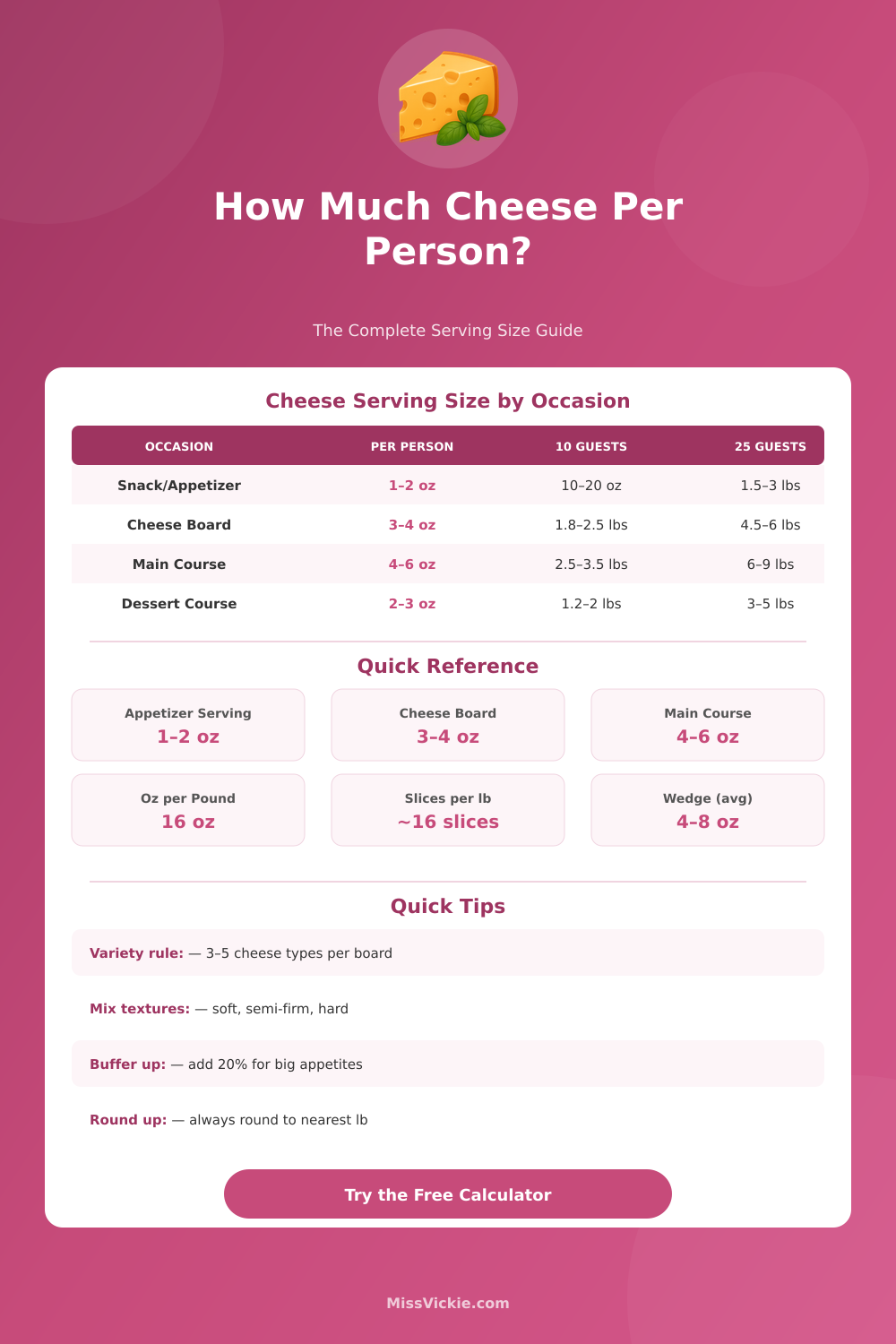
| Occasion | Per Person (oz) | Per Person (g) | 10 Guests | 25 Guests | 50 Guests |
|---|---|---|---|---|---|
| Snack / Appetizer | 1 – 2 oz | 28 – 57 g | 0.6 – 1.3 lbs | 1.6 – 3.1 lbs | 3.1 – 6.3 lbs |
| Cocktail Party | 2 – 3 oz | 57 – 85 g | 1.3 – 1.9 lbs | 3.1 – 4.7 lbs | 6.3 – 9.4 lbs |
| Cheese Board | 3 – 4 oz | 85 – 113 g | 1.9 – 2.5 lbs | 4.7 – 6.3 lbs | 9.4 – 12.5 lbs |
| Brunch | 2 – 3 oz | 57 – 85 g | 1.3 – 1.9 lbs | 3.1 – 4.7 lbs | 6.3 – 9.4 lbs |
| Dinner Side | 3 – 4 oz | 85 – 113 g | 1.9 – 2.5 lbs | 4.7 – 6.3 lbs | 9.4 – 12.5 lbs |
| Main / Formal | 4 – 6 oz | 113 – 170 g | 2.5 – 3.8 lbs | 6.3 – 9.4 lbs | 12.5 – 18.8 lbs |
| Dessert Course | 2 – 3 oz | 57 – 85 g | 1.3 – 1.9 lbs | 3.1 – 4.7 lbs | 6.3 – 9.4 lbs |
| Kids Party | 1 – 1.5 oz | 28 – 43 g | 0.6 – 0.9 lbs | 1.6 – 2.3 lbs | 3.1 – 4.7 lbs |
| Cheese | Type | Flavor Profile | Typical Block Size | Approx Slices / lb |
|---|---|---|---|---|
| Brie | Soft | Mild, buttery, creamy | 4–8 oz wheel | — |
| Cheddar | Hard | Sharp, tangy | 8 oz – 1 lb block | ~16 slices |
| Gouda | Semi-hard | Mild, nutty, sweet | 8 oz – 1 lb wheel | ~14 slices |
| Manchego | Semi-hard | Tangy, nutty, grassy | 8 oz wedge | ~14 slices |
| Brie / Camembert | Soft | Earthy, mushroomy | 8 oz round | — |
| Blue Cheese | Semi-soft | Bold, pungent, salty | 4–6 oz wedge | ~12 crumbles |
| Parmigiano | Hard | Salty, umami, nutty | 8 oz wedge | ~18 shavings |
| Mozzarella | Fresh/Soft | Mild, milky, fresh | 8 oz – 1 lb ball | — |
| Gruyere | Semi-hard | Nutty, slightly sweet | 8 oz wedge | ~14 slices |
| Cream Cheese | Soft | Mild, creamy, tangy | 8 oz block | — |
| Ounces (oz) | Grams (g) | Pounds (lbs) | Kilograms (kg) |
|---|---|---|---|
| 1 oz | 28 g | 0.06 lb | 0.028 kg |
| 2 oz | 57 g | 0.13 lb | 0.057 kg |
| 4 oz | 113 g | 0.25 lb | 0.113 kg |
| 8 oz | 227 g | 0.50 lb | 0.227 kg |
| 16 oz | 454 g | 1.00 lb | 0.454 kg |
| 32 oz | 907 g | 2.00 lbs | 0.907 kg |
| 48 oz | 1,361 g | 3.00 lbs | 1.361 kg |
| 64 oz | 1,814 g | 4.00 lbs | 1.814 kg |
Enter any cheese shop and you will find yourself surrounded by almost dizzying diversity, smells going from soft and buttery until sharp and complex textures stretching from silk-smooth until crumbly and crystalline. In the core of cheese lies the clotting of milk proteins what happens when one sours the milk during the making. The naturally present proteins and fat in the milk form the base of what ultimately ends on your plate or on your table.
Although most cheeses come from milk of cows, that is far from the whole image: goats, sheep, water buffalo, reindeer, camels and goats all add their own milk to the world of cheese making.
A Simple Guide to Cheese
The history of cheese goes surprisingly far back. Ancient peoples found it almost by accident in the early times of farming, when one first tamed sheep and goats to get milk. Truly, it is surprising, how something this fancy could be born from such humble starts.
The main method did not change a lot: one clots the protein from the milk, press it, leave it rest and remove the liquid. Here is cheese in its most basic state.
The available diversity currently is truly funny. Soft, spread types like Brie or cream cheese involve one end of the scale, while heavy, hard types like old cheddar and Parmigiano the other. There is actually something for every moment and every taste.
Cheese from goat milk tend to be creamy and fine, while strong Parmigiano gives energy and bitterness. Funny is, that mixing soft, creamy goat cheese with something mighty like Parmigiano makes a nicely pleasant difference. And then comes the group of blue cheese; think about Stilton or Cabrales, that brings strong, unique flavors too the table.
Valdeón Blue, a Spanish creation from a mix of goat and sheep milk, has a firm, almost mineral character. The rolls come wrapped in leaves, which is quite neat.
If you want to make cheese at home as a newcomer, skip mozzarella, it is more sensitive than it seems. Feta, chèvre or paneer work more well for the first tries. If any want to try pressed cheese, Caerphilly or Colby are good spots to start.
The portions entirely depend on the situation. When cheese is the main feature, something between four and six units each person works well. Go up to seven or eight units, if you prepare a whole meal around a cheese board.
For more light events, where cheese is only one part among several, fifty to seventy-five grams each person with some types feels right. Quick visual guide: one unit weighs close to two dice, so one and half units match to three or four dice stacked. Because cheese stores many grams of fat, calories and sodium, watching the portions truly matters.
Blocks almost always beat the pre-shredded versions. One common mistake in cheese sauce is relying on only one type. This causes it to become boring.
Mixing different cheeses gives much more rich depth and detail. American, Muenster and Provolone work well for grilled cheese sandwiches. For fondue, the Savoyard way is the usual.
Gruyère and Emmental? They are too dense and waxy for that use. Raclette, on the other hand, works truly well.
You can even cook cheese directly inbread, and the result is so rich, that butter is entirely not needed.