🥩 Meat Roasting Time Calculator
Get precise roasting times for any cut of meat by weight — imperial & metric supported
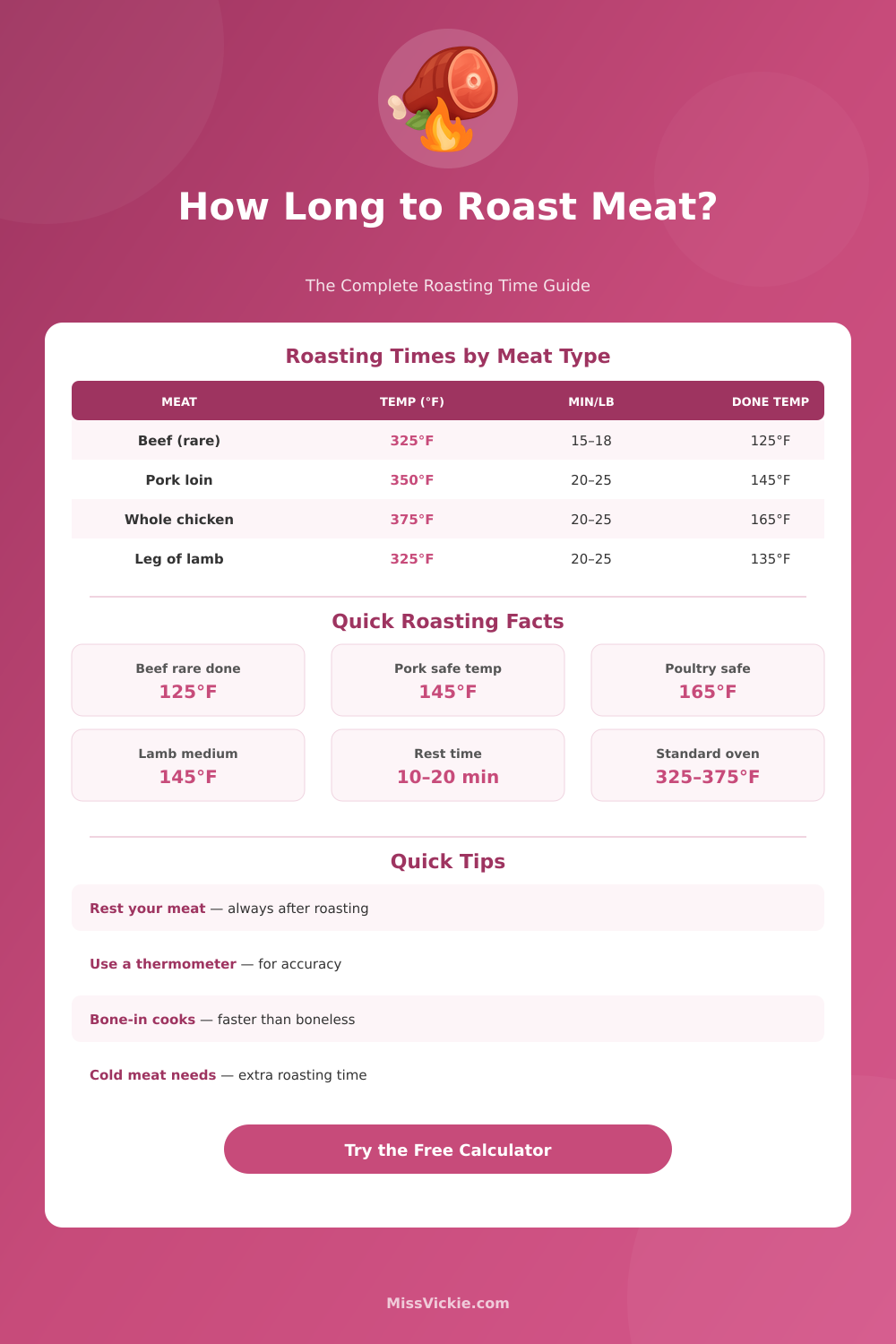
| Meat & Cut | Oven Temp (°F) | Min per lb | Min per kg | Target Internal (°F) |
|---|---|---|---|---|
| Beef – Rare | 325°F | 15–18 | 33–40 | 125°F |
| Beef – Medium Rare | 325°F | 18–20 | 40–44 | 135°F |
| Beef – Medium | 325°F | 20–23 | 44–51 | 145°F |
| Beef – Well Done | 325°F | 25–30 | 55–66 | 160°F |
| Pork Loin | 350°F | 20–25 | 44–55 | 145°F |
| Pork Shoulder | 325°F | 30–35 | 66–77 | 160°F |
| Whole Chicken | 375°F | 20–25 | 44–55 | 165°F |
| Whole Turkey (unstuffed) | 325°F | 15–20 | 33–44 | 165°F |
| Leg of Lamb – Medium | 325°F | 20–25 | 44–55 | 145°F |
| Veal Roast | 325°F | 25–30 | 55–66 | 160°F |
| Whole Duck | 350°F | 20–25 | 44–55 | 165°F |
| Beef Tenderloin | 425°F | 10–15 | 22–33 | 135°F |
| Doneness | Beef (°F) | Pork (°F) | Poultry (°F) | Lamb (°F) |
|---|---|---|---|---|
| Rare | 120–125 | — | — | 120–125 |
| Medium Rare | 130–135 | — | — | 130–135 |
| Medium | 140–145 | 145 | — | 140–145 |
| Medium Well | 150–155 | 150–155 | — | 150–155 |
| Well Done | 160+ | 160+ | 165+ | 160+ |
| Meat | Minimum Rest | Ideal Rest | Why Rest? |
|---|---|---|---|
| Beef Roast (small) | 10 min | 15 min | Juices redistribute |
| Beef Roast (large) | 20 min | 30 min | Carry-over cooking |
| Whole Chicken | 10 min | 15 min | Even moisture |
| Whole Turkey | 20 min | 30 min | Easier carving |
| Pork Loin | 10 min | 15 min | Juices settle |
| Pork Shoulder | 20 min | 30 min | Tender texture |
| Leg of Lamb | 15 min | 20 min | Juices redistribute |
At its base, Meat is made up of animal tissue, mainly muscles, that folks eat as food. Since our earliest times we hunted and raised animals to get it but everything changed around 11 000 years ago during the Neolithic Revolution. Then folks learned to tame creatures like chickens, sheep, goats, pigs, horses and cattle, that evolved to the form that we know today.
Talking about Meat, one is not limited to muscles and fat. Among the main parts belong also tendons and links. The main creatures that we depend on are cattle, pigs and sheep, although there truly exists a whole world beyond that.
All About Meat: Types, Cooking and Safety
Chicken, beef and everything in between deserves attention, including the whole body approach of nose to tail, that avoids any waste.
Here what makes Meat so precious: it is rich in protein. If you cook, preserve and prepare it well, Meat fits well into healthy eating. Common types are chicken, pig, lamb and beef.
Worth noting is that organic Meat. Eaten once or twice weekly, can truly boost your intake of nutrients and minerals. Here said, protein foods daily (Meat, bird, fish, beans, nuts) should reach around five and a half units.
Normal servings show up as roughly three units of cooked lean Meat, bird or fish.
Hard to imagine that? One unit of Meat matches the size of a matchbox. Add three units, and you have something the size of a deck of cards or a bar of soap.
For parties or light food, four to six units per folk work best. Planning boneless Meat for ten people, five pounds work for the task. Going with bones?
Then you kneed more, around seven and a half pounds.
Flank Meat is one of those cuts that does not get the praise it deserves. It hides under several names, hanging steak, sirloin flap, bavette, but however one calls it, it is surprisingly versatile. Grill it at medium rare or braise it low and slowly in rich broth.
Truly, bavette beats almost any fresh steak when it comes to grilling. Flesh asada works perfectly, likewise as Asian marinade.
Making meatballs? You have many ways. Pure beef works well, but a mix of half beef and half pork is also very liked.
Lamb and beef deserves a test. A mold for meatballs removes the trouble of forming them into real globes, and it is not limited to only Meat, anything with the right thickness, like rice or rolls, passes through it easily.
Here is something to always recall: badly cooked Meat and salmonella go hand in hand, and that is a risk of food poisoning that you want to avoid while you handle raw Meat. Ground beef deserves a separate word here. The 80-20 fat mix is the most common, even though 85-15 makes a reliable option if you prepare something from ground Meat.
Meat claws are another useful tool worth having, they are basic heat-proof finger replacements thathelp to keep a roast flat while you cut it.