🌡️ Convection Oven Converter
Convert conventional oven temperatures & cooking times to convection — both °F & °C
| Conventional °F | Conventional °C | Convection °F | Convection °C | Gas Mark |
|---|---|---|---|---|
| 275°F | 135°C | 250°F | 120°C | 1 |
| 300°F | 150°C | 275°F | 135°C | 2 |
| 325°F | 163°C | 300°F | 149°C | 3 |
| 350°F | 177°C | 325°F | 163°C | 4 |
| 375°F | 191°C | 350°F | 177°C | 5 |
| 400°F | 204°C | 375°F | 191°C | 6 |
| 425°F | 218°C | 400°F | 204°C | 7 |
| 450°F | 232°C | 425°F | 218°C | 8 |
| 475°F | 246°C | 450°F | 232°C | 9 |
| 500°F | 260°C | 475°F | 246°C | 10 |
| Original Time | −15% (Light Fan) | −20% (True Conv.) | −25% (Standard) |
|---|---|---|---|
| 20 min | 17 min | 16 min | 15 min |
| 30 min | 26 min | 24 min | 23 min |
| 45 min | 38 min | 36 min | 34 min |
| 60 min | 51 min | 48 min | 45 min |
| 75 min | 64 min | 60 min | 56 min |
| 90 min | 77 min | 72 min | 68 min |
| 120 min | 102 min | 96 min | 90 min |
| 150 min | 128 min | 120 min | 113 min |
| 180 min | 153 min | 144 min | 135 min |
| °F | °C (exact) |
|---|---|
| 275°F | 135°C |
| 300°F | 149°C |
| 325°F | 163°C |
| 350°F | 177°C |
| 375°F | 191°C |
| 400°F | 204°C |
| 425°F | 218°C |
| 450°F | 232°C |
| °C | °F (exact) |
|---|---|
| 140°C | 284°F |
| 160°C | 320°F |
| 170°C | 338°F |
| 180°C | 356°F |
| 190°C | 374°F |
| 200°C | 392°F |
| 210°C | 410°F |
| 220°C | 428°F |
A Convection Oven converter is a practical tool that helps to adapt recipes meant for regular ovens, so that they work in Convection Oven units. In Convection Oven units warm air moves around what allows to cook foods more quickly and more evenly than in regular ovens. Because of that you need to slightly adjust the recipes, to reach the wanted results.
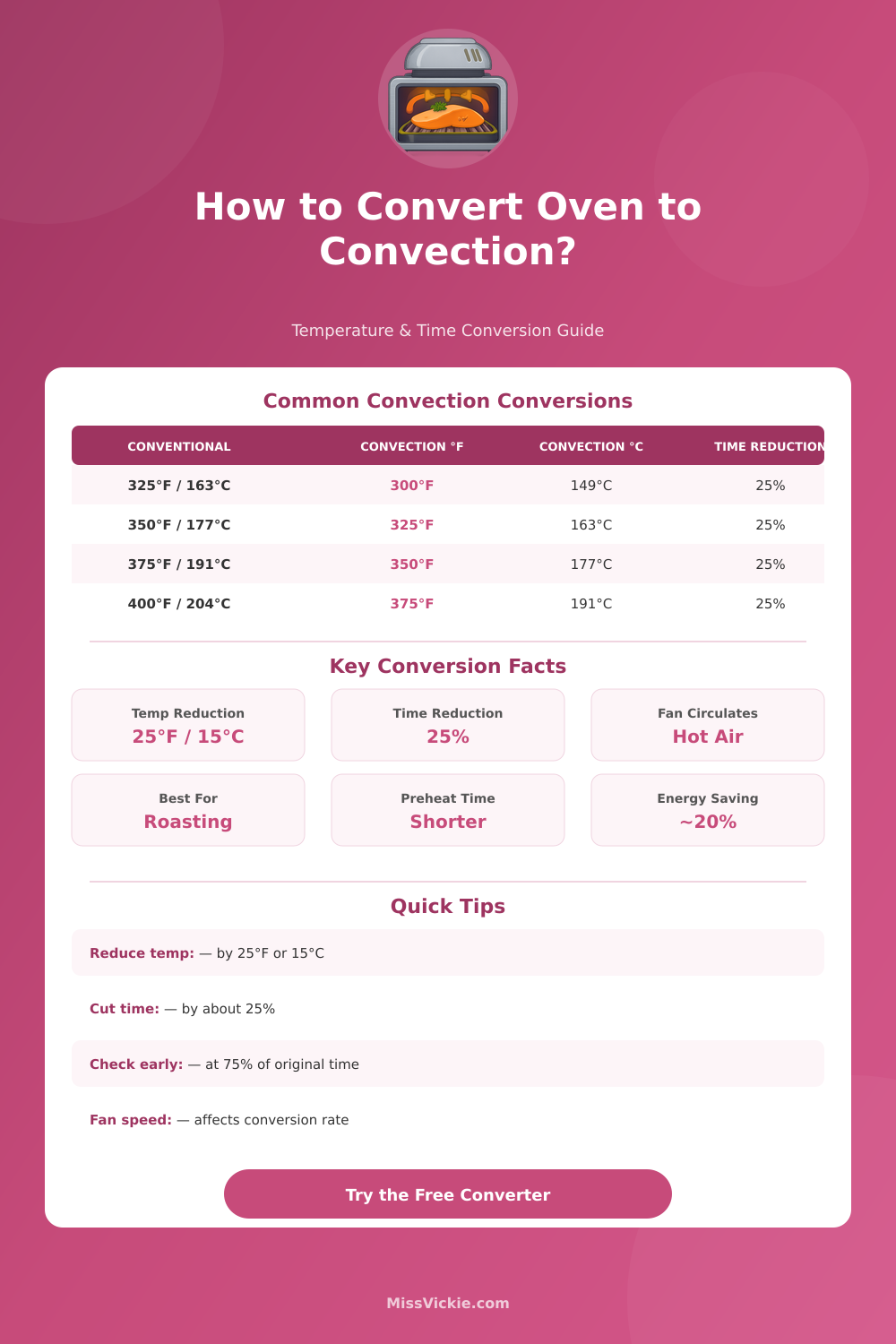
The commonly used method is to lower the temperature of the oven by 25 degrees Fahrenheit. So, if a recipe says to bake at 350 degrees in a standard oven, in a Convection Oven you should set it to 325 degrees. The same principle counts the other way too.
How to Adjust Recipes for a Convection Oven
Going from a Convection Oven to a regular oven requires to raise the temperature by 25 degeres Fahrenheit.
There are two main ways to adapt recipes. One of them is to lower only the temperature by 25 degrees and leave the cooking time the same. It works well for breads, cakes and other sweets.
The second way is to keep the temperature but reduce the time of cooking. It is best to check the progress at three quarters of the original time. Some folks cut it by 20 to 40 percent, removing more time for vegetables and less four meats.
In a Convection Oven foods can burn more quickly. Checking them 5 to 10 minutes before the full cook time helps a lot to avoid overcooking. It is especially useful, when one gets used to a new Convection Oven.
A fan oven is basically the same as a Convection Oven, that works also as an air fryer. When going from fan to non-fan oven, the general advice is to raise the temperature by 15 to 20 degrees Celsius. For instance, 180 degrees Celsius with fan switched on matches something between 383 and 392 degrees Fahrenheit in a standard oven.
Some Convection Oven units have a built-in converter. The device itself automatically changes the temperature and time of regular programs to Convection Oven ones. That removes a lot of guesswork.
Simple online calculators for Convection Oven converting also exist, which help to automatically adapt any recipe.
Even so each oven is a bit different. The rule of 25 degrees forms a good starting point, but learning the behavior of a particular model requires a bit of trial and error. For products with longer baking times, like cakes, the change of 25 degrees usually works well.
Convection Oven units give faster and more even cooking, better browning and crispyresults. Learning to adapt recipes correctly gets the most from those advantages.