🦞 Lobster Meat Per Person Calculator
Calculate exactly how much lobster or lobster meat you need for any occasion
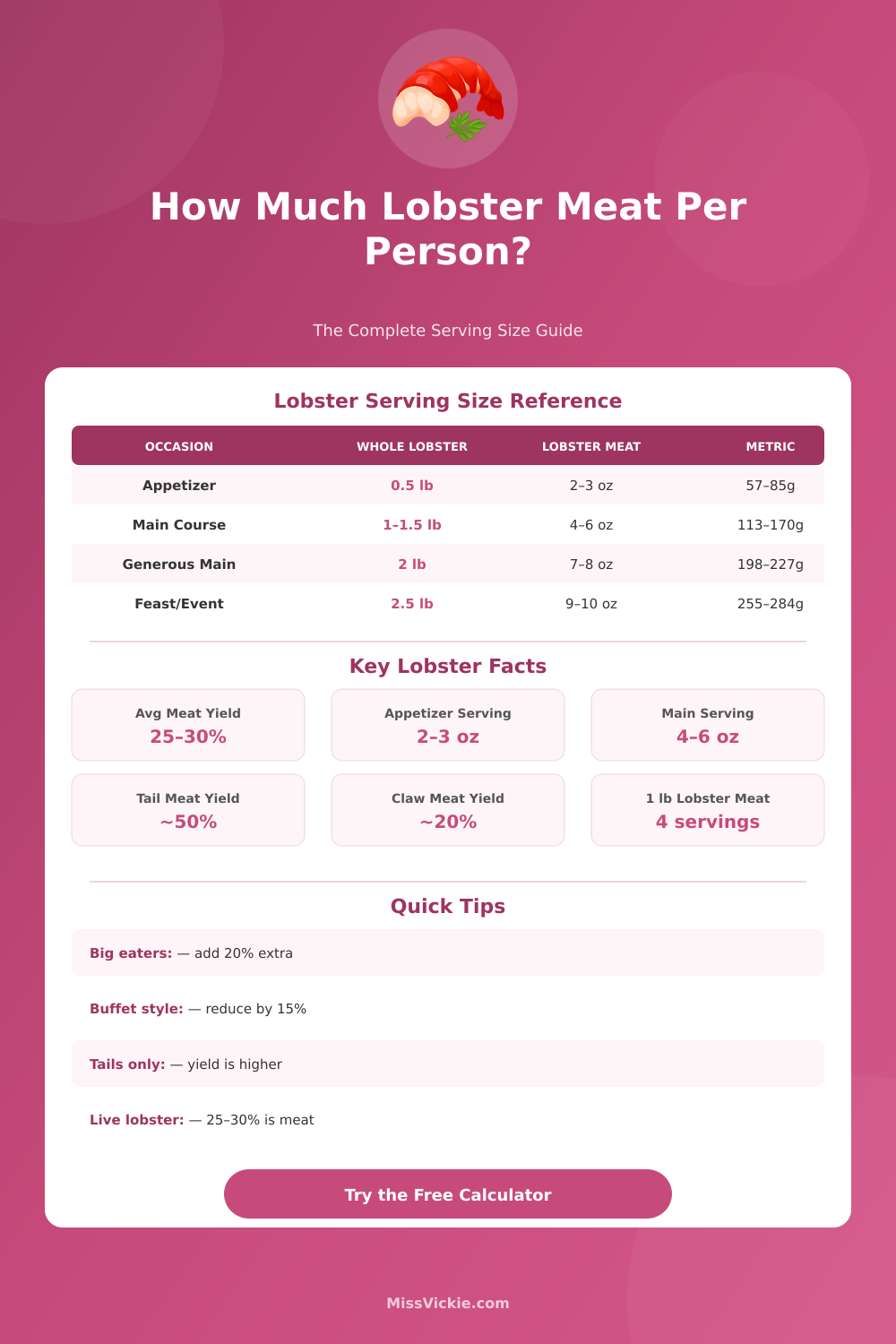
| Occasion | Whole Lobster | Lobster Meat | Metric |
|---|---|---|---|
| Appetizer | ½ lb (1 small) | 2–3 oz | 57–85 g |
| Light Main | 1 lb | 3–4 oz | 85–113 g |
| Standard Main | 1–1.5 lb | 4–6 oz | 113–170 g |
| Generous Main | 2 lb | 7–8 oz | 198–227 g |
| Feast Portion | 2.5 lb | 9–10 oz | 255–284 g |
| Buffet (shared) | N/A | 2–3 oz | 57–85 g |
| Whole Lobster Weight | Approx. Meat Yield | Metric Yield | Servings (Main) |
|---|---|---|---|
| 1 lb (0.45 kg) | 3.5–4 oz | 99–113 g | ~1 serving |
| 1.25 lb (0.57 kg) | 4–5 oz | 113–142 g | ~1 serving |
| 1.5 lb (0.68 kg) | 5–6 oz | 142–170 g | 1–1.25 servings |
| 2 lb (0.91 kg) | 7–8 oz | 198–227 g | 1.5–2 servings |
| 2.5 lb (1.13 kg) | 9–10 oz | 255–284 g | 2 servings |
| 1 lb picked meat | 16 oz (100%) | 454 g | 3–4 servings |
| Tail Size | Raw Weight | Cooked Meat | Best For |
|---|---|---|---|
| Small | 4–5 oz (113–142g) | 2–2.5 oz (57–71g) | Appetizer |
| Medium | 6–8 oz (170–227g) | 3–4 oz (85–113g) | Light main |
| Large | 10–12 oz (284–340g) | 5–6 oz (142–170g) | Standard main |
| Jumbo | 14–16 oz (397–454g) | 7–8 oz (198–227g) | Generous main |
| Colossal | 18–24 oz (510–680g) | 9–11 oz (255–312g) | Feast/sharing |
The meat of lobster is thin and rich in nutrients it forms ideal protein for healthy eating. One finds it in various parts of the creature, especially in the claw, the knuckle and the tail. Each of those has a bit different flavor and texture.
The meat from the claw has more buttery taste, to that contrast the tail, that is more muscular, juicy and heavy meat. Not every tail has fishy taste. Overall, the lobster does bear salt, somehow fishy and mildly sweet smell.
Lobster Meat: Parts, Taste, Cooking and Buying
Getting the meat can be difficult work. One requires tools for breaking the shell, and later even clean it carefully. When dealing with the tail, cut the top of the shell along the centre down and then gently separate it works well.
Around 98% of the meat releases itself, leaving only little bit stuck in the shell. Some kinds of lobster meat arrives pre-picked, so no need to care about shells during the process. That shows a strong advantage for those, that simply want to escape the preparation and choice of lobsters.
For one person, the usual serving matches around four units of lobster meat. In a good lobster roll, one gets around that much roughly. Commonly one arranges one pound of meat for four rolls.
One alive lobster weighing one and half of pounds gives about five to six units of meat, or around one and third of cups. From the whole wait of lobster, only around 25% forms edible meat.
For lobster rolls, best use meat from claw and knuckle instead of from tail. One cooks it buttery, grilled in a split warm dog roll, covered with mayo, salt and black pepper. Traditionally one chooses wet white rolls or alike cheap rolls for warm dogs.
When only tail meat is available, one chops it and gently jumps in butter, what works surprisingly.
In various foods like soup, ravioli, macaroni with cheese, lobster cakes or salads, the lobster meat shines. Shells from the claws of lobster give nice accent to dishes like broth. One can put the meat in hot broth and cook for around four minutes.
Truly, the fresh lobster meat from New England, bought locally and recently cooked, stays thebest.
One can get frozen lobster meat from many stores, commonly delivered directly home. Some comes from lobsters caught in cold waters of the North Atlantic, and they are fully cleaned for safety. Commonly it is made up of hand picked pieces from claw and knuckle.
Buying in big amounts commonly gives excellent price. Compared to other seafood, lobster costs a lot, and the amount of meat for spent money can seem poor compared to big shrimp. Alive lobsters have blue-black colour and only turn bright red after cooking.
When the meat changes from clear to not clear and solid, the lobster is ready.