🍚 Parboiled Rice Per Person Calculator
Calculate exact dry & cooked parboiled rice amounts for any group size
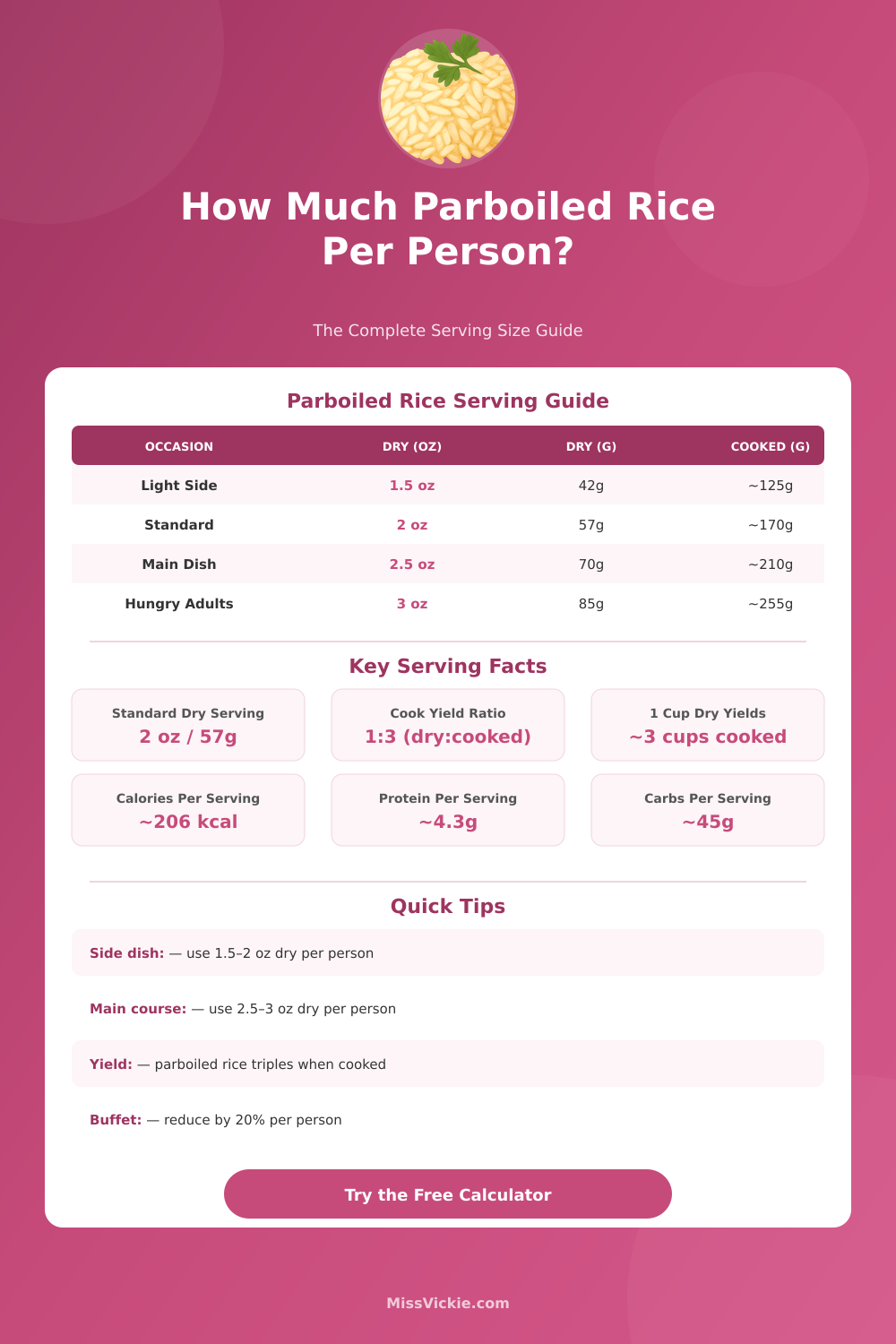
| Serving Occasion | Dry (g) | Dry (oz) | Dry (cups) | Cooked (g) |
|---|---|---|---|---|
| Light Side Dish | 42g | 1.5 oz | ¼ cup | ~125g |
| Standard Side Dish | 57g | 2 oz | ¼–⅜ cup | ~170g |
| Main Course | 70g | 2.5 oz | ⅜ cup | ~210g |
| Hungry Adults | 85g | 3 oz | ⅜–½ cup | ~255g |
| Children (under 12) | 40g | 1.4 oz | ¼ cup | ~120g |
| Buffet Style | 50g | 1.75 oz | ¼ cup | ~150g |
| Dry Amount | Dry Weight | Cups Dry | Cooked Weight | Cups Cooked |
|---|---|---|---|---|
| 1 serving (std) | 57g / 2 oz | ~¼ cup | ~170g / 6 oz | ~¾ cup |
| ½ cup dry | 100g / 3.5 oz | ½ cup | ~300g / 10.5 oz | ~1.5 cups |
| 1 cup dry | 200g / 7 oz | 1 cup | ~600g / 21 oz | ~3 cups |
| 2 cups dry | 400g / 14 oz | 2 cups | ~1200g / 42 oz | ~6 cups |
| 1 lb dry | 454g | ~2.25 cups | ~1362g / 3 lbs | ~6.75 cups |
| 1 kg dry | 1000g | ~5 cups | ~3000g / 6.6 lbs | ~15 cups |
| Group Size | Side (g dry) | Main (g dry) | Side (cups dry) | Main (cups dry) |
|---|---|---|---|---|
| 2 people | 114g | 140g | ~½ cup | ~¾ cup |
| 4 people | 228g | 280g | ~1 cup | ~1.4 cups |
| 6 people | 342g | 420g | ~1.7 cups | ~2.1 cups |
| 8 people | 456g | 560g | ~2.3 cups | ~2.8 cups |
| 10 people | 570g | 700g | ~2.85 cups | ~3.5 cups |
| 20 people | 1140g | 1400g | ~5.7 cups | ~7 cups |
| 50 people | 2850g | 3500g | ~14.3 cups | ~17.5 cups |
Parboiled Rice goes under many names depending on the place in the world. One can hear it called converted rice, easy to cook rice or sella rice. In India and Bangladesh folks commonly say miniket for it.
Here the main point: do not matter, as you call it, the idea behind it stays simple. One partly cooks the rice while it is still covered by its shell, and later one ends the preparation.
What Is Parboiled Rice?
The real process splits into three main steps: soaking, steaming and drying. The rice first soaks, later one steams it under pressure and finally one dries it, while the outer shell stays whole. Only after the drying one removes the shell.
That middle state between brown rice and white rice helps, that Parboiled Rice keeps part of the bran, that white rice fully loses.
There is good reason, that Parboiled Rice became popular, everything deals about nutrients. During the steaming, vitamins and minerals from the shell and core moves into the core of the grain, the endosperm. That indeed locks those nutrients inside.
Like this you receive more vitamins and minerals in Parboiled Rice than in usual white rice. White rice, on the other hand, loses both the bran and the core, what means loss of fibers, vitamins, minerals, proteins and fat in one go. In terms of nutrition, Parboiled Rice stands between white and brown rice.
Better then white, but not as heavily nutritious as brown.
Other benefit is the glycemic index. Parboiled Rice has lower value than white rice, because it has more resistant starch because of the process. Your body digests it more slowly, what makes it good choice for control the blood sugar.
Also, the boiling process also helps to remove a bit of arsenic, that naturally shows up in rice, so it becomes a bit safer food.
For nutritious details, normal serving of cooked Parboiled Rice, around one cup (has about 200 calories). Most come from carbs, with tiny amount of protein and almost no fat. If you choose enriched version, you receive extra amounts of calcium, iron, thiamine and folic acid.
It naturally does not carry fat, what is an advantage.
How to cook Parboiled Rice? It is very flexible. The stove works well, but a rice cooker, slow cooker or microwave also work, if that is your gear.
Folks usually use two and half to four cups of water for one cup of rice. It needs more water than average white rice and cooks longer because of the dense grains. Nice thing is, that the grains do not stick one to the other, what is great for fried rice or pilaf, where you wantseparate grains.
Parboiled Rice has no too strong taste. Many describe it as a bit nutty. It is long grain, usually between 5.5 and 7.5 millimeters long, with slim form.
The word parboil comes from old French parbouillir, what means “to cook partly”.