🍚 Bomba Rice Per Person Calculator
Get the exact amount of bomba rice needed — for paella, arros negre, or any Spanish rice dish
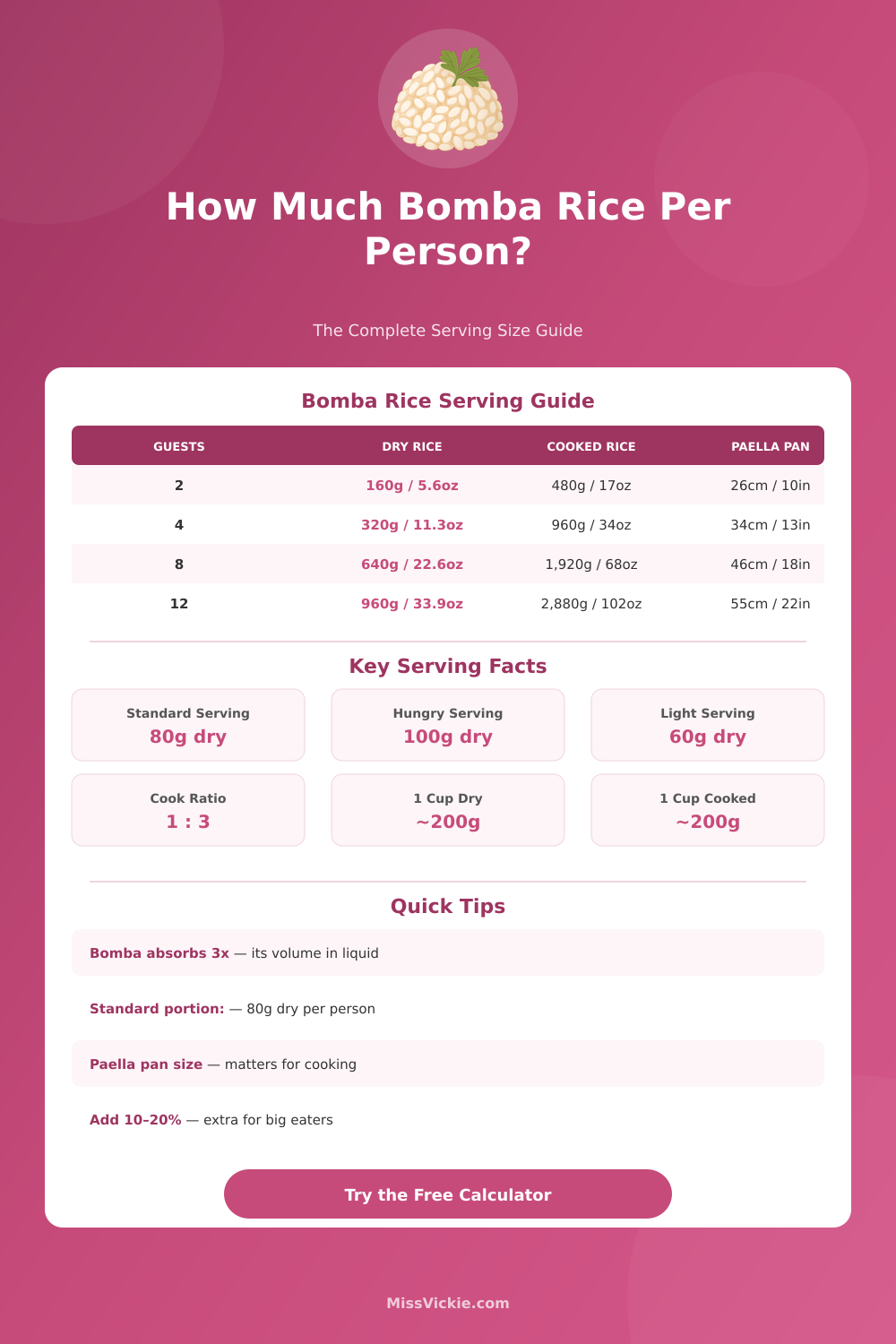
| Guests | Dry Rice (g) | Dry Rice (oz) | Dry Rice (cups) | Cooked Weight | Liquid Needed |
|---|---|---|---|---|---|
| 1 | 80g | 2.8oz | ⅓ cup | 240g | 240ml |
| 2 | 160g | 5.6oz | ⅔ cup | 480g | 480ml |
| 4 | 320g | 11.3oz | 1⅔ cups | 960g | 960ml |
| 6 | 480g | 16.9oz | 2‒ cups | 1,440g | 1.44L |
| 8 | 640g | 22.6oz | 3– cups | 1,920g | 1.92L |
| 10 | 800g | 28.2oz | 4 cups | 2,400g | 2.4L |
| 12 | 960g | 33.9oz | 4⅔ cups | 2,880g | 2.88L |
| 16 | 1,280g | 45.2oz | 6– cups | 3,840g | 3.84L |
| 20 | 1,600g | 56.4oz | 8 cups | 4,800g | 4.8L |
| 30 | 2,400g | 84.7oz | 12 cups | 7,200g | 7.2L |
| Pan Size | Servings | Dry Rice (g) | Dry Rice (oz) | Rice Depth |
|---|---|---|---|---|
| 26cm / 10in | 2 people | 160g | 5.6oz | 1cm / 0.4in |
| 30cm / 12in | 3–4 people | 280g | 9.9oz | 1cm / 0.4in |
| 34cm / 13in | 4–5 people | 360g | 12.7oz | 1cm / 0.4in |
| 38cm / 15in | 6–7 people | 520g | 18.3oz | 1cm / 0.4in |
| 42cm / 17in | 8–9 people | 680g | 24oz | 1cm / 0.4in |
| 46cm / 18in | 10–12 people | 880g | 31oz | 1cm / 0.4in |
| 55cm / 22in | 14–16 people | 1,200g | 42.3oz | 1cm / 0.4in |
| 65cm / 26in | 20–25 people | 1,800g | 63.5oz | 1cm / 0.4in |
| Grams | Ounces | US Cups | Cooked (g) | Liquid (ml) |
|---|---|---|---|---|
| 50g | 1.8oz | ¼ cup | 150g | 150ml |
| 80g | 2.8oz | ⅓ cup | 240g | 240ml |
| 100g | 3.5oz | ½ cup | 300g | 300ml |
| 150g | 5.3oz | ⅔ cup | 450g | 450ml |
| 200g | 7.1oz | 1 cup | 600g | 600ml |
| 250g | 8.8oz | 1¼ cups | 750g | 750ml |
| 400g | 14.1oz | 2 cups | 1,200g | 1,200ml |
| 500g | 17.6oz | 2½ cups | 1,500g | 1,500ml |
| 1,000g | 35.3oz | 5 cups | 3,000g | 3,000ml |
Bomba Rice is a kind of short-grain rice that one mainly grows in the east regions of Spain. One commonly uses it for paella and various Valencian foods and one calls it also Valencian rice. That pearly white grain has around five millimeters of length and one grows it on the Iberian Peninsula already since the Middle Ages.
Do we know what truly separates Bomba Rice? It is able to absorb a lot of liquid. It takes in more than triple its volume of broth, while typical rice absorbs only double.
What is Bomba Rice?
This way the grains stay separate after cooking and do not stick together. Also, it stores little of amylopectin, which forms part of the starch, and that stops it from becoming creamy or gluey. On the other hand, the high amylose content ensures that the grains do not stick togehter.
The mild flavor of the rice carries the tastes of the other ingredients well.
In Spanish, “bomba” means “bomb”. One gave it that name thanks to its special skill to absorb water. During cooking, it more than doubles in size.
It grows more in width than in length. If one cooks it long, it keeps a firm and nice structure, that has a feeling of al dente.
Growing Bomba Rice is not simple work. The amount of production stays limited, because the plants are sensitive and hardly grow. During the 1960s, the species almost disappeared.
Thanks too some Spanish chefs, who loved its special way of cooking, one did not forget it entirely. One preserved it through genetic selection at the Rice Station in Sueca, Valencia, since 1929.
In the rich lands of the nationally preserved L’Albufera Park beside Valencia, where one considers the origin of paella, one grows a bit of Bomba Rice. Also bomba and calasparra rice grow around the city Calasparra in the Murcian hills, close to Valencia, along the river Segura. That river delivers cold water from the heights of the mountain.
The rice from the rich valley of the river in Valencia bears the label Denominación de Origen.
Bomba Rice works great for paella, arroz negro, arroz caldoso and risotto. It goes well with seafood, chicken and meat dishes. To prepare paella, use one cup of Bomba Rice for three cups of water or broth.
Cook the rice without a cover for around eighteen minutes, until thin crusts form on the bottom. One calls that crispy bottom layer socarrat, and it forms the main treat in paella cooking. Before paella cooking, do not wash the rice, because the starch helps to create that crust.
Compared to other rice for paella, Bomba Rice is the less common and more expensive choice. It does not contain gluten. Some popular brandspack it in nice tin packets to preserve the freshness.