🥩 Beef Jerky Yield Calculator
Find out exactly how much raw beef you need to make your desired amount of jerky — with cut-by-cut yield data
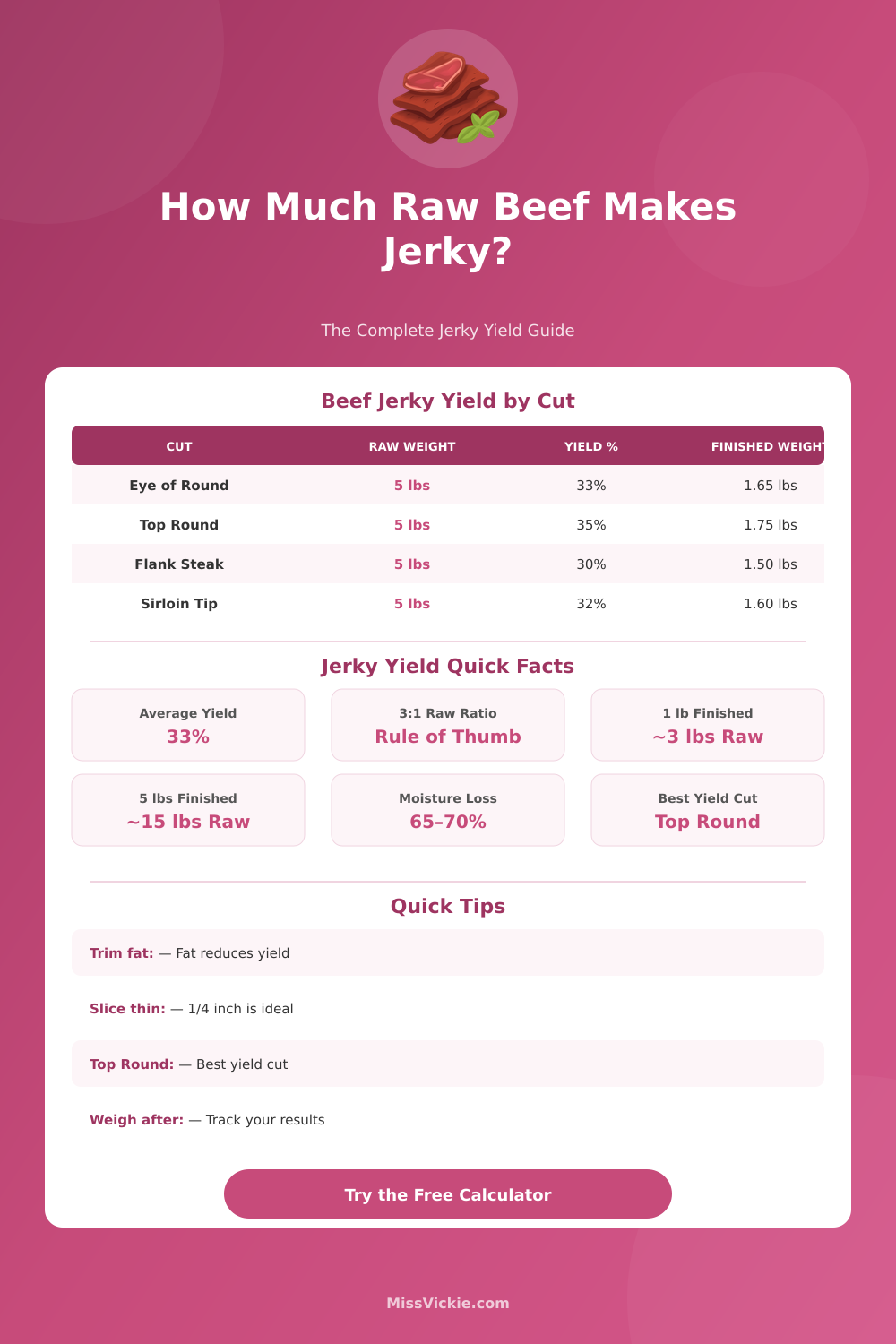
| Beef Cut | Avg Yield % | Raw for 1 lb Jerky | Raw for 1 kg Jerky | Fat Level |
|---|---|---|---|---|
| Top Round | 35% | 2.86 lbs (1.30 kg) | 2.86 kg | Very Low |
| Eye of Round | 33% | 3.03 lbs (1.37 kg) | 3.03 kg | Very Low |
| Bottom Round | 32% | 3.13 lbs (1.42 kg) | 3.13 kg | Low |
| Sirloin Tip | 32% | 3.13 lbs (1.42 kg) | 3.13 kg | Low |
| Flank Steak | 30% | 3.33 lbs (1.51 kg) | 3.33 kg | Low–Medium |
| Brisket (lean) | 28% | 3.57 lbs (1.62 kg) | 3.57 kg | Medium |
| Chuck Roast | 27% | 3.70 lbs (1.68 kg) | 3.70 kg | Medium–High |
| Raw Beef (lbs) | Raw Beef (kg) | Finished Jerky @ 30% | Finished Jerky @ 33% | Finished Jerky @ 35% |
|---|---|---|---|---|
| 1 lb | 0.45 kg | 4.8 oz (136g) | 5.3 oz (150g) | 5.6 oz (159g) |
| 2 lbs | 0.91 kg | 9.6 oz (272g) | 10.6 oz (300g) | 11.2 oz (318g) |
| 3 lbs | 1.36 kg | 14.4 oz (408g) | 15.8 oz (450g) | 16.8 oz (476g) |
| 5 lbs | 2.27 kg | 24 oz (680g) | 26.4 oz (749g) | 28 oz (794g) |
| 10 lbs | 4.54 kg | 48 oz (1.36 kg) | 52.8 oz (1.50 kg) | 56 oz (1.59 kg) |
| 15 lbs | 6.80 kg | 72 oz (2.04 kg) | 79.2 oz (2.25 kg) | 84 oz (2.38 kg) |
| 20 lbs | 9.07 kg | 96 oz (2.72 kg) | 105.6 oz (2.99 kg) | 112 oz (3.18 kg) |
| Pounds (lbs) | Ounces (oz) | Grams (g) | Kilograms (kg) |
|---|---|---|---|
| 0.25 lb | 4 oz | 113 g | 0.113 kg |
| 0.5 lb | 8 oz | 227 g | 0.227 kg |
| 1 lb | 16 oz | 454 g | 0.454 kg |
| 2 lbs | 32 oz | 907 g | 0.907 kg |
| 5 lbs | 80 oz | 2268 g | 2.268 kg |
| 10 lbs | 160 oz | 4536 g | 4.536 kg |
Beef jerky is liked a lot, that works well for those, that follow diets with few carbs, for instance paleo or keto. One considers it both healthy food and something what can be ignored because of some reasons. That well shows the rows, that surround it.
Dry meat prepares from various types of animals. Domestic creatures, like cows, pigs, goats and sheep, commonly use for that. Wild creatures, for instance deer, kudus, springboks, kangaroos and bison, also work well.
How to Make, Buy, and Store Beef Jerky
Except usual beef jerky, one finds buffalo and elk dried meat and they are sold. For the daring folks exist even weird types of dry meat.
For slices of beef, one choose the thin parts. Fat meat does not suit, because the fat does not dry well and stays damp, what helps the growth of bacteria. The round of beef works a lot, because it has the least fat.
Top round, eye of round, flank steak and rump roast all work. Even so flank steak and sirloin cost more. London broil usually is cheap and good for dry meat.
Cut the meat against teh fiber, no more than quarter inch thick, gives dried meat, that is not too chewy. One can cut also along the fiber, and many bought dry meats do that.
Making dry meat at home is possible easily without special tools. Oven on bottom heat works well. Dryers with strong air flow is other favorite method.
Some folks first smoke the meat in low temperature, later end it in dryer. The main step is simple: one cuts the meat, marinates it and dry slowly. The most difficult part stays the long wait.
Domestic dry meat allows you control, what enters in it. Commercial beef jerky commonly carries sugar, sodium nitrate, sodium nitrite, maltodextrin and monosodium glutamate. Domestic making escapes all that.
Dry meat without sugar is among the best foods. The trouble of domestic dry meat is the keeping. That helps to understand, why bought dry meats cost this much.
Good beef jerky can sell four 35 dollars or more.
Standard serving of beef jerky is around one ounce or 28 grams. That amount usually gives about 80 calories, 10 grams of protein and around 1.5 grams of fat. Dry meat is rich in lean protein and has little carbs.
It is handy and rich in protein, so it perfectly works for energy boost. Even little strip gives energy, that hardly matchother foods.
Domestic beef jerky does not last this long as the commercial. The fridge is the best place for keeping domestic dried meat, because it helps to keep its quality and taste more time. Dry meat should reach room temperature before one packs it well.