🍖 Pork Loin Cooking Time Calculator
Enter your roast weight & oven temperature to get precise cooking times
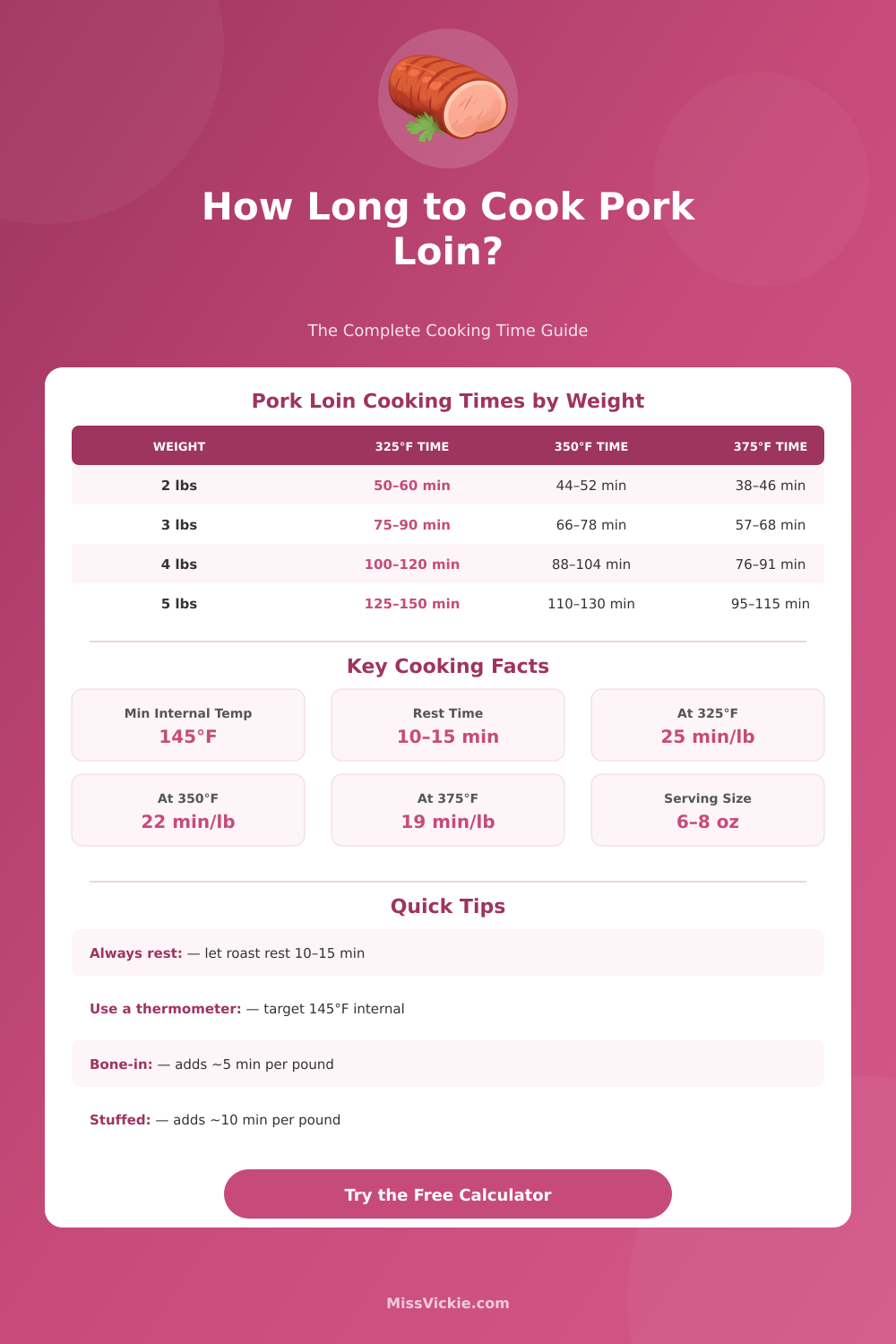
| Weight (lb) | Weight (kg) | 325°F / 163°C | 350°F / 177°C | 375°F / 191°C |
|---|---|---|---|---|
| 1 lb | 0.45 kg | 25–30 min | 22–26 min | 19–23 min |
| 1.5 lb | 0.68 kg | 38–45 min | 33–39 min | 28–34 min |
| 2 lb | 0.91 kg | 50–60 min | 44–52 min | 38–46 min |
| 2.5 lb | 1.13 kg | 63–75 min | 55–65 min | 48–57 min |
| 3 lb | 1.36 kg | 75–90 min | 66–78 min | 57–68 min |
| 4 lb | 1.81 kg | 100–120 min | 88–104 min | 76–91 min |
| 5 lb | 2.27 kg | 125–150 min | 110–130 min | 95–115 min |
| 6 lb | 2.72 kg | 150–180 min | 132–156 min | 114–137 min |
| Cut Type | Time Adjustment | Min/lb at 350°F | Notes |
|---|---|---|---|
| Boneless (unstuffed) | Baseline | ~22 min/lb | Standard calculation |
| Bone-In (unstuffed) | +5 min/lb | ~27 min/lb | Bone slows heat transfer |
| Boneless (stuffed) | +10 min/lb | ~32 min/lb | Filling adds mass & density |
| Bone-In (stuffed) | +15 min/lb | ~37 min/lb | Maximum adjustment needed |
| Roast Weight | Cooked Yield (~75%) | Servings (6 oz) | Servings (8 oz) |
|---|---|---|---|
| 2 lb (0.91 kg) | 1.5 lb (0.68 kg) | 4 servings | 3 servings |
| 3 lb (1.36 kg) | 2.25 lb (1.02 kg) | 6 servings | 4–5 servings |
| 4 lb (1.81 kg) | 3 lb (1.36 kg) | 8 servings | 6 servings |
| 5 lb (2.27 kg) | 3.75 lb (1.70 kg) | 10 servings | 7–8 servings |
| 6 lb (2.72 kg) | 4.5 lb (2.04 kg) | 12 servings | 9 servings |
When prepared correct, pork loin is a perfect centerpiece for any dinner table. However, one of the biggest challenge for home cooks is determining the exact cooking time to cook the pork loin to perfection. Several factor will play a role in the cooking time, including the weight of the pork loin, the cut of the pork loin, and whether it is bone in, boneless, or stuffed. Using a pork loin cooking time calculator can make this aspect of roasting pork loin much easier for home cooks.
Pork loin is a lean cut of meat and should be roasted at moderate temperature between 325. 375°F. The United States Department of Agriculture recommend cooking the pork loin to internal temperature of 145°F and resting the roast for 3 minutes to allow the juices to redistribute throughout the roast. Use a meat thermometer to determine the internal temperature of the roast; seasoning the loin with salt, pepper, garlic, or herbs will enhance the flavor of the roast.
Factors Affecting Pork Loin Cooking Time
The weight of the pork loin will primarily influence the cooking time for a pork loin. Generally, a pork loin will take 20 (30 minutes to cook per pound at 350°F). If the pork loin have bone-in features, the cooking time will increase by 5 minutes per pound. If the loin is stuffed, the cooking time will increase by 10 minutes per pound. Additionally, if the roast is cooked at higher temperatures, the cooking time will be more shorter. A 375°F roast will take 10, 15% of the time then a roast cooked at 325°F.
The cooking time charts listed above can be another reference for the cooking time of a pork loin. A 3 lb boneless pork loin cooked at 350°F will take between 66 and 78 minutes to cook and will yield around 6 serving of pork loin. Bone-in pork loin will take longer to cook due to the slower conductive heat from the bone. If the pork loin has stuffing, it will take longer to cook due to the moisture in the stuffing. The best way to determine cooking time for a pork loin is to remove the roast from the oven 5°F below the target internal temperature. This is because the roast will continue to cook after being taken out of the oven due to carryover cooking. The roast will reach the target internal temperature after resting for 10, 15 minutes in foil on the counter.
To properly cook a pork loin, you should first dry it with paper towels, season it with oil and seasonings, and roast it on a rack within the oven. Basting the roast during cooking will ensure even cooking and add flavor. A single serving of roasted pork loin contains around 289 calories, 40g of protein, and minimal carbohydrate. Leftovers can be stored in the fridge for up to four day or frozen in individual portion for later use.
By knowing the factor affecting the cooking time for a pork loin, including the time-saving pork loin cooking time calculator listed above, cooks can prepare pork loin dishes with confidence and serve there loved ones restaurant quality pork loin every time.