🍷 Wine Making Calculator
Calculate sugar additions, ABV, yeast amount, SO₂ & batch volumes for home wine making
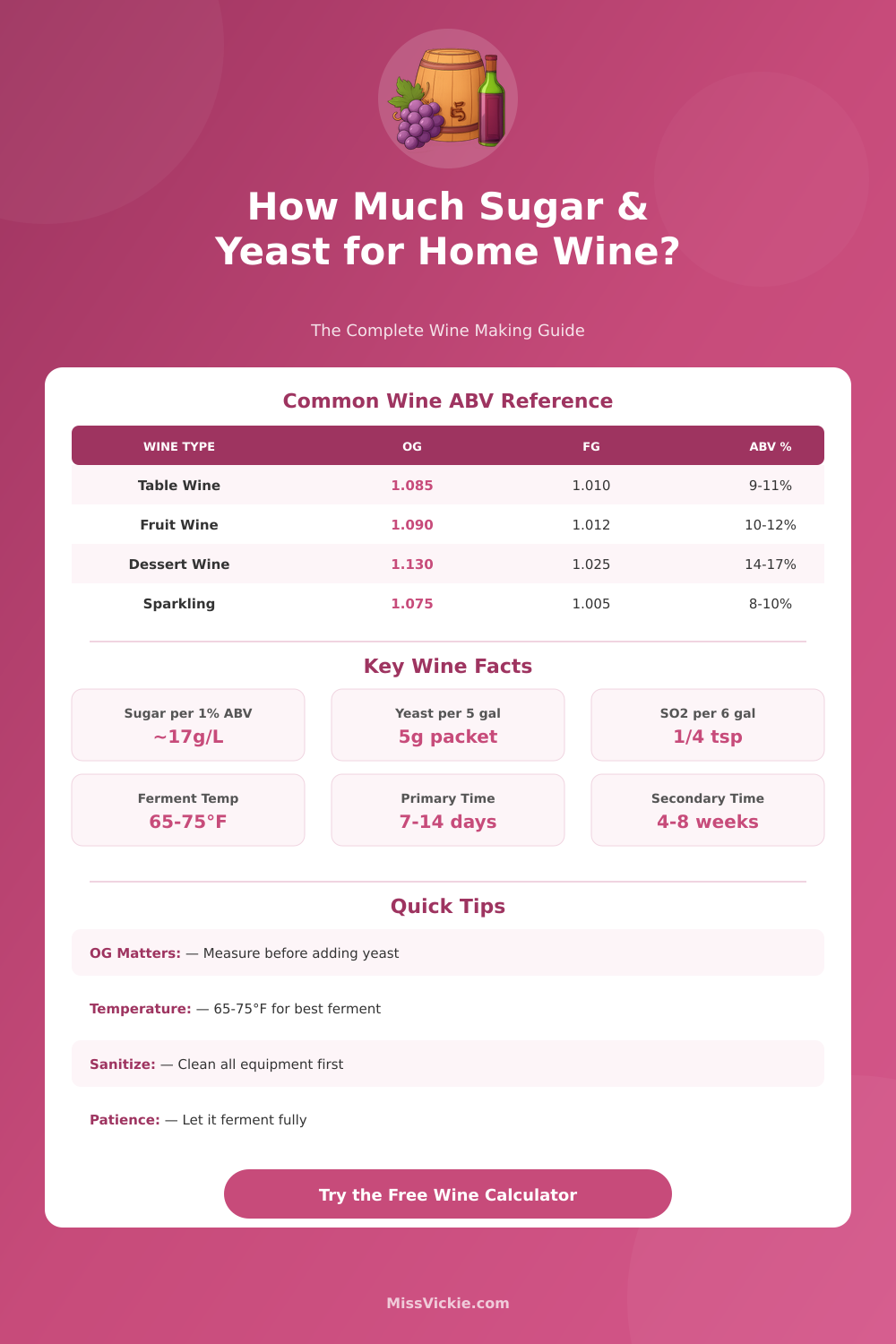
| Wine Type | Target OG | Target FG | ABV Range | Style |
|---|---|---|---|---|
| Dry Red Wine | 1.085 – 1.095 | 0.995 – 1.005 | 11 – 13% | Dry |
| Dry White Wine | 1.080 – 1.090 | 0.995 – 1.005 | 10 – 12% | Dry |
| Semi-Sweet | 1.085 – 1.095 | 1.008 – 1.015 | 9 – 11% | Semi-Sweet |
| Sweet Wine | 1.100 – 1.115 | 1.015 – 1.025 | 11 – 13% | Sweet |
| Dessert Wine | 1.130 – 1.155 | 1.020 – 1.035 | 14 – 17% | Very Sweet |
| Sparkling Wine | 1.070 – 1.080 | 1.000 – 1.005 | 8 – 10% | Dry |
| Fruit Wine | 1.085 – 1.095 | 1.010 – 1.015 | 10 – 12% | Variable |
| Mead | 1.100 – 1.130 | 1.010 – 1.020 | 12 – 15% | Variable |
| Country Wine | 1.080 – 1.095 | 1.005 – 1.015 | 10 – 12% | Variable |
| Yeast Strain | ABV Tolerance | Temp Range | Best For | Packet Size |
|---|---|---|---|---|
| EC-1118 (Champagne) | 18% | 50–86°F | Sparkling, High ABV | 5g |
| 71B (Lalvin) | 14% | 59–86°F | Fruit, Rosé | 5g |
| RC-212 (Bourgogne) | 13% | 59–86°F | Red Wines | 5g |
| D47 (Lalvin) | 14% | 50–65°F | White, Rosé | 5g |
| K1-V1116 | 18% | 50–95°F | Aromatic Whites | 5g |
| Red Star Premier Blanc | 18% | 45–95°F | All-purpose | 5g |
| Sugar Type | Gravity Points / lb / gal | Gravity Points / kg / L | Notes |
|---|---|---|---|
| Cane / Beet Sugar | 46 pts | 384 pts | Standard addition |
| Honey | 35 pts | 290 pts | For mead, 80% fermentable |
| Corn Sugar (Dextrose) | 44 pts | 368 pts | Cleaner ferment |
| Brown Sugar | 44 pts | 367 pts | Slight molasses flavor |
| Grape Juice Concentrate | 30 pts | 250 pts | Per 6 oz can |
| Invert Sugar | 46 pts | 384 pts | Easier for yeast |
| Purpose | Target Free SO₂ | Campden Tablets / 5 gal | K-Meta (tsp / 5 gal) |
|---|---|---|---|
| Pre-ferment sanitize | 50 ppm | 2.5 tablets | 1/4 tsp |
| Aging protection | 30 ppm | 1.5 tablets | 1/8 tsp |
| Bottling protection | 25–35 ppm | 1.5 tablets | 1/8 tsp |
| High pH must (>3.6) | 75 ppm | 4 tablets | 3/8 tsp |
| Low pH must (<3.2) | 25 ppm | 1 tablet | 1/16 tsp |
Wine is made up of alcohol, that one prepares from fermented juice of grapes, and one produces it and drinks it around the whole world in very various ways. What determines those ways? Everything since the type of grapes, that one uses, until the area, where they grow, the ways of farming and the fact, as the winemaker truly acts.
There are five main kinds: white, red, pink, sparkling and strengthened. Here the fun about white wines, one prepares them usually from grapes with green, yellow, pink or orange skins, what no truly matches with the name.
Wine Basics: Types, Taste, Serving and Cooking
Wine is alive, changing cause. It starts fresh and well scented, full of energy and life. When time passes, it gets bigger depth and richness, taking on entirely new sides of flavor.
Some wines truly please, others no, and for that are clear reasons. The most important part is the balance between bitterness, tannins, oak and leftover sugar. Except that, one finds the fruit hints, the non-fruit parts, as far as how clear those flavors are and how mnay time the aftertaste stays on the palate.
Standard serving of wine stores around five ounces. Most bottles carry about 25 ounces, so one can pour around five glasses from one bottle. If you do taste, the servings will be more little, almost two or three ounces.
Wines with high alcoholic content (for instance Bordeaux, Shiraz or Zinfandel) deserve a bit bigger pour, between 4.5 and 5 ounces. Big bottles, that store 1.5 liters, match to too average bottles together and last for four until six folks comfortably. The 750-ml bottle became the standard size in the wine industry during the 1970s, when European lands agreed about it.
Making wine of good quality requires much money. The ground itself costs a lot, and one requires expert folks for care about the vineyard. Growers on purpose limit the amount of fruit in their vines, so that the quality stays high, like this one ensures it.
Here something notable: left wine stays good only if one keeps it right. Some wines, that one kept well, can even stay drinkable after hundreds of years.
Wine also works well for cooking. The main step is removing the alcohol burn before adding other liquids in the dish. If you lay wine in sauce or stew, it goes in the pan together with your spices first, and one leaves it cook until the alcohol fully goes away, before adding the broth or tomato sauce.
After loosening from the pan by means of wine, it usually must boil softly until two-thirds go, before you carry on with the other ingredients. In kitchens of restaurants, the cooking wines are simply table wines from a jug… Nothing fancy.
Bottled cooking wine, rather, commonly has doubtful quality and too much salt. Strong, very oaky red wines do not work for some classic recipes. Some Italian wines from Puglia have that burning wooden smell and taste saltier than one would hope.
Here what makes wine like thisunique (the smells), the flavor hints and the way, as it ends.