🧂 Brine Calculator
Calculate exact salt & water amounts for any container size — wet or dry brine
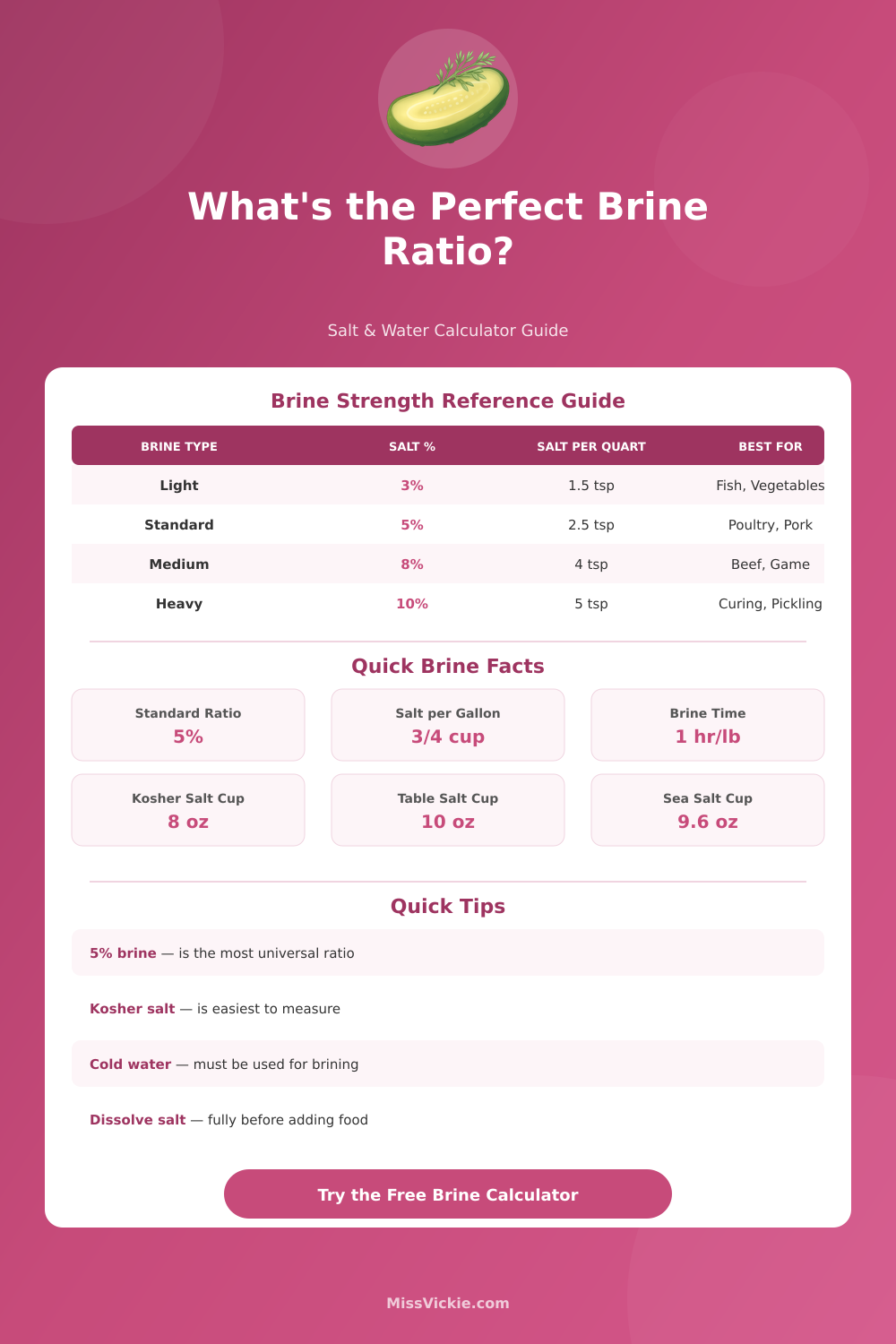
| Brine Type | Salt % | Salt per Quart (Kosher) | Salt per Liter (g) | Best Used For |
|---|---|---|---|---|
| Very Light | 2% | 1 tsp | 20 g | Delicate fish, cucumbers |
| Light | 3% | 1.5 tsp | 30 g | Fish fillets, shrimp, vegetables |
| Standard | 5% | 2.5 tsp | 50 g | Chicken, turkey, pork chops |
| Medium | 6–7% | 3–3.5 tsp | 60–70 g | Whole turkey, beef, game meats |
| Strong | 8% | 4 tsp | 80 g | Pork belly, duck, brisket |
| Pickle Brine | 10% | 5 tsp | 100 g | Pickles, olives, capers, feta |
| Cure / Preservation | 15–25% | 7.5–12 tsp | 150–250 g | Long-term curing, preservation |
| Salt Type | Grams per Tbsp | Grams per Cup | Relative to Table Salt | Notes |
|---|---|---|---|---|
| Table Salt (iodized) | 18 g | 288 g | 1.0x (baseline) | Finest grain, most dense |
| Pickling Salt | 18 g | 288 g | 1.0x | No additives, pure NaCl |
| Fine Sea Salt | 17 g | 272 g | 0.95x | Slightly coarser than table |
| Morton Kosher Salt | 15 g | 240 g | 0.83x | Hollow flakes, medium density |
| Diamond Crystal Kosher | 10 g | 160 g | 0.56x | Light flakes, least dense |
| Coarse Sea Salt | 12 g | 192 g | 0.67x | Large crystals, variable |
| Volume (Imperial) | Volume (Metric) | Fluid Ounces | Cups |
|---|---|---|---|
| 1 teaspoon | 4.9 mL | 0.17 fl oz | 1/48 cup |
| 1 tablespoon | 14.8 mL | 0.5 fl oz | 1/16 cup |
| 1 cup | 236.6 mL | 8 fl oz | 1 cup |
| 1 pint | 473.2 mL | 16 fl oz | 2 cups |
| 1 quart | 946.4 mL | 32 fl oz | 4 cups |
| 1 gallon | 3,785 mL | 128 fl oz | 16 cups |
Brine is simply water with a lot of salt mixed in it. Usually it is made up of sodium chloride so only from regular table salt. The amount of salt ranges from around 3.5 percent, like water from the sea, until fully packed solution, where no more salt dissolves.
Water from the sea can be looked at as Brine, but it finds itself at the lowest end of the scale of salinity.
What Brine Is and How It Is Used
Brining is the method of soaking meat in this solution of salty water before cooking it. That enters the meat from the inside to the outside, helping it stay moist and making every piece more tender. The base is salt mixed in water, but one can add also sugar, herbs and spices.
Even so without salt it no truly deserves the name Brine and does not have the effect of brining.
Two main kinds exist. Wet Brine is a bath of salty water. Dry brining is made up of a rub from salt, herbs and spices, applied directly on the surface of the meat.
For dry brining one covers the whole meat with generous salt, later one lays it in the refrigerator without covering on a rack. The salt pulls out the moisture, that mixes with the salt and later gets absorbed back. Both ways work well.
Brining is especially liked for poultry. Even some hours of brining shorten the time for cooking, adds moisture and gives more evenly cooked bird. Brined chicken has its muscle fibers a bit broken, what results in more juicy meat.
Brining of turkey became very usual, although the size of the bird can make the whole cause a bit scary. It requires much Brine, a big container ore bag and enough space in the refrigerator.
The ratio between salt and water matters. Typical wet Brine has around 6 percent of salt by weight, what matches to about one cup of table salt per gallon of water. Because brining commonly lasts up to 14 hours, one commonly uses half a cup of regular kosher salt per gallon of water.
Also the kind of salt matters, because different salts have different sizes and dissolve differently.
Brining does not limit to meat. For centuries one used it to preserve foods. For instance, Brine for pickles mixes salt with other liquids to ferment or preserve vegetables.
Brine from cheese and from olives is useful also. Even Brine from olives can go in the dough for bread, but then one must reduce the salt in the recipe to balance the saltiness of the Brine.
Wet Brine superbly adds moisture to meat, but it is less good for creating deep taste than marinades, that use acids and fat. Brining can also prepare corned beef and works well for pork and fish before smoking them. The secret lies in reaching the right amount of salt and water in the meat, sothat it has correctly the right taste.