🧈 Deep Frying Oil Calculator
Calculate exactly how much oil you need based on your pan or fryer dimensions
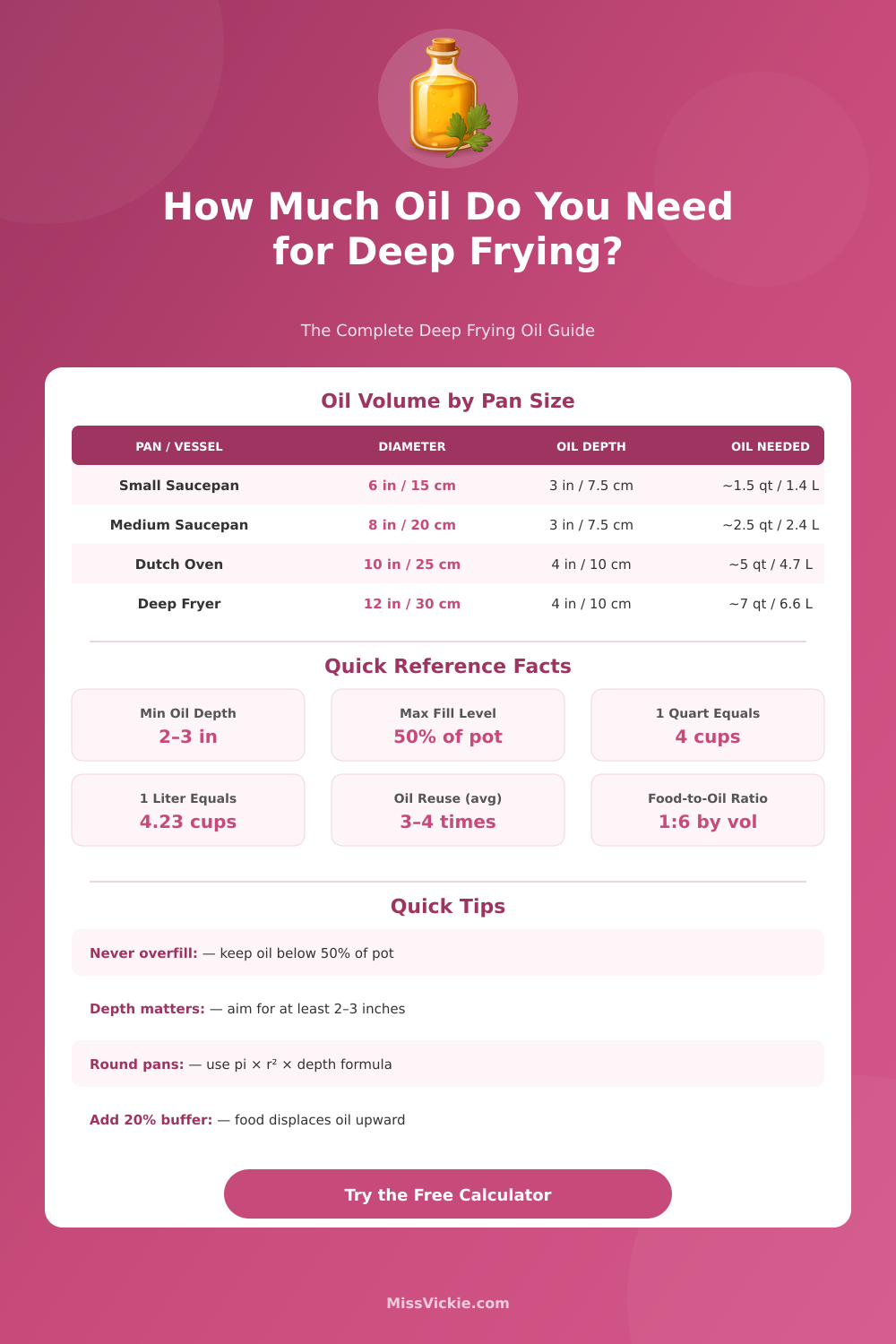
| Vessel | Diameter | Oil Depth | Oil Volume (qt) | Oil Volume (L) |
|---|---|---|---|---|
| Small Saucepan | 6 in / 15 cm | 3 in / 7.5 cm | ~1.5 qt | ~1.4 L |
| Medium Saucepan | 8 in / 20 cm | 3 in / 7.5 cm | ~2.5 qt | ~2.4 L |
| Large Saucepan | 10 in / 25 cm | 3 in / 7.5 cm | ~3.9 qt | ~3.7 L |
| Dutch Oven (5 qt) | 10 in / 25 cm | 4 in / 10 cm | ~5.2 qt | ~4.9 L |
| Wok (14 in) | 14 in / 36 cm | 3 in / 7.5 cm | ~7.7 qt | ~7.3 L |
| Cast Iron Skillet | 12 in / 30 cm | 2 in / 5 cm | ~3.8 qt | ~3.6 L |
| Home Deep Fryer | 12 in / 30 cm | 4 in / 10 cm | ~7.5 qt | ~7.1 L |
| Large Stock Pot | 14 in / 36 cm | 5 in / 12.7 cm | ~16 qt | ~15.1 L |
| Imperial | Fluid Oz | mL | Liters |
|---|---|---|---|
| 1 tablespoon | 0.5 fl oz | 14.8 mL | 0.015 L |
| 1 cup | 8 fl oz | 236.6 mL | 0.237 L |
| 1 pint | 16 fl oz | 473 mL | 0.473 L |
| 1 quart | 32 fl oz | 946 mL | 0.946 L |
| 1 gallon | 128 fl oz | 3785 mL | 3.785 L |
| Food Item | Recommended Depth | Typical Pan | Approx. Oil Needed |
|---|---|---|---|
| French Fries (1 lb batch) | 3–4 in / 7.5–10 cm | Dutch Oven 10 in | 2–3 qt / 1.9–2.8 L |
| Chicken Wings (8 pcs) | 4 in / 10 cm | Large Saucepan | 3–4 qt / 2.8–3.8 L |
| Donuts (batch of 6) | 2–3 in / 5–7.5 cm | Large Saucepan | 2 qt / 1.9 L |
| Fish Fillets (2–3 pcs) | 2 in / 5 cm | Cast Iron 12 in | 1.5–2 qt / 1.4–1.9 L |
| Shrimp (1 lb) | 2–3 in / 5–7.5 cm | Medium Saucepan | 1–2 qt / 0.9–1.9 L |
| Whole Turkey (deep fry) | Full immersion | 30 qt Outdoor Fryer | 3–5 gal / 11.4–18.9 L |
Oil is liquid that changes its form according to the temperature. It is made up of many chemicals, mostly from hydrocarbons. This oil does not mix with water, even so it well blends with similar oils.
Most of them burn easily. That main trait makes it useful for many uses.
Oil: What It Is and How It Affects Our World
Common oil and crude belongs to fossil fuels. They form from mixes of hydrocarbons, that was born from remains of creatures and plants, that lived before millions of years in ocean waters. Everything happened even before the appearance of dinosaurs.
During centuries and centuries, those materials transformed in the oil, that we find under the soil today.
Two thirds of the world use of oil goes to transport. One uses it to heat houses and as fuel for cars with gas engines. It ranks between the non-renewable resources, so after one runs out of it, it is possible not to replace.
Burning, oil changes chemical energy in heat, but it causes also important pollution of air and changes in the climate. The use of oil products produces carbon dioxide, that taints cities and nature. Rather, it helped to increase of economy and populations, that could crash dramatically, when oil no more will be cheap and easy to get.
If the supply of oil will end, our modern society would fall in some months. Oil matters almost just like the crops for the growing world. It delivers the main part of basic energy, making up about a third of whole human energy use.
Prices of oil depend strongly on events in the Middle East. Conflicts between United States and Iran caused prices skip a bit. Closed Strait of Hormuz did the supply tight, and Brent-crude jumped to nearly 109 dollars.
Most of world oil transport passes through that channel. During conflict with Iran, Brent-crude passed 90 dollars per barrel. Loss of oil flows in that region raised common price above 100 dollars per barrel, what caused even stronger increase for diesel, airplane fuel and liquid crude-gas.
Futures of WTI common oil climbed too 64 dollars per barrel, when reports pointed, that Washington maybe thinks about stopping of ships with Iranian crude. One talked also about sending extra strong group, if talks about the nuclear program of Iran will fail. Prices of oil swung wildly, during dealers reacted quickly to changes.
In kitchen, oil works as cooking fat. Eating fat fills because of its high calories. Cooking in fat helps, because it handles higher heat than water.
Fats bring also good taste. The smoke point of oil is an important cause. If oil starts smoking, it can ruin the food, giving it bitter or burning taste.
Canola, rapeseed, sunflower oil and thistle seed oil work well for cooking, because they stay neutral and handle strong heat. Olive oil has a lower smoke point, so it doesnot suit for fast and warm frying.