🦃 Deep Frying Turkey Oil Calculator
Calculate exactly how much oil you need to safely deep fry your turkey
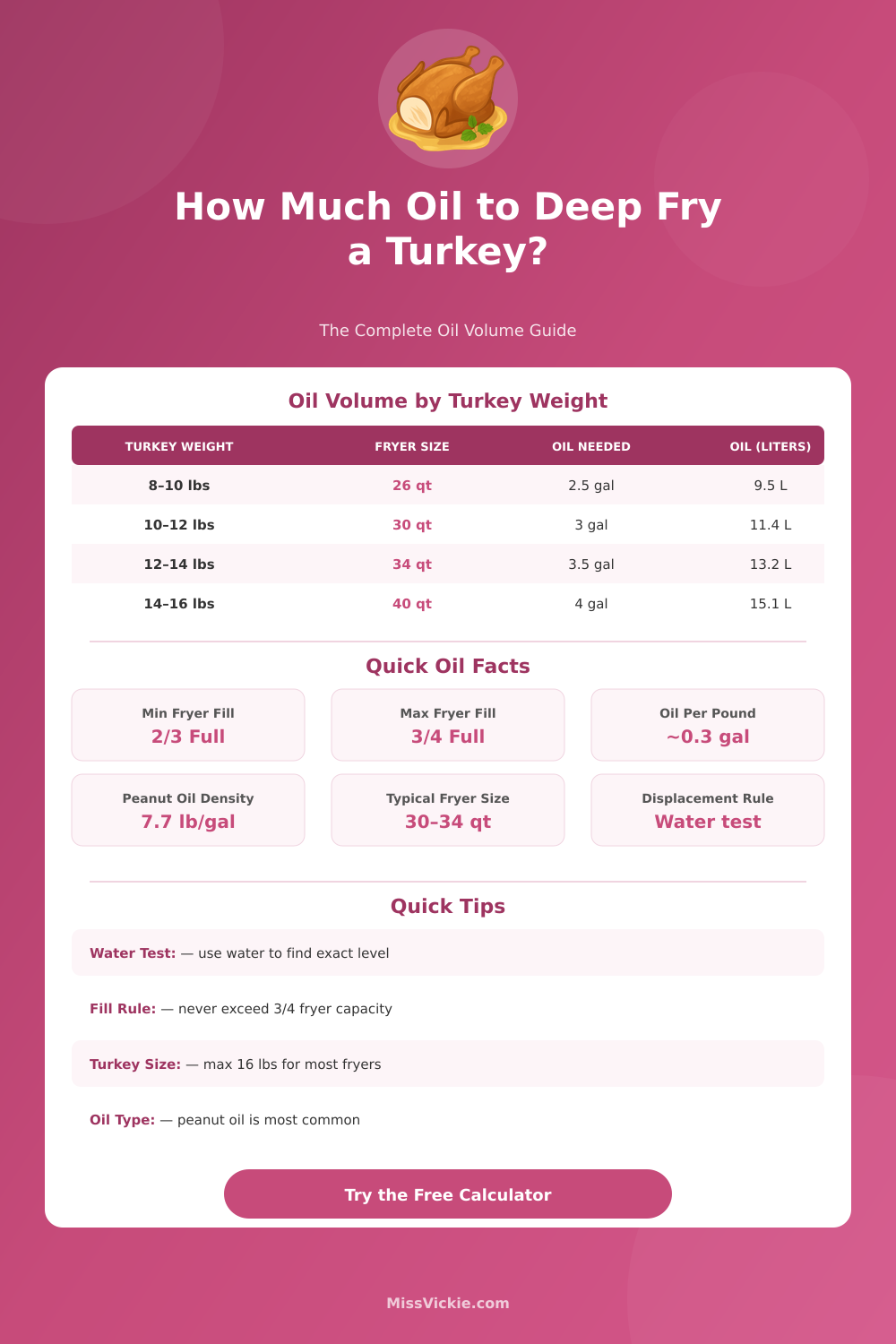
| Turkey Weight | Fryer Size (qt) | Oil Needed (gal) | Oil Needed (L) | Fill % |
|---|---|---|---|---|
| 8 lbs (3.6 kg) | 26 qt | 2.5 gal | 9.5 L | ~72% |
| 10 lbs (4.5 kg) | 30 qt | 3.0 gal | 11.4 L | ~72% |
| 12 lbs (5.4 kg) | 30 qt | 3.0 gal | 11.4 L | ~72% |
| 12 lbs (5.4 kg) | 34 qt | 3.4 gal | 12.9 L | ~72% |
| 14 lbs (6.4 kg) | 34 qt | 3.4 gal | 12.9 L | ~72% |
| 15 lbs (6.8 kg) | 34 qt | 3.4 gal | 12.9 L | ~72% |
| 16 lbs (7.3 kg) | 40 qt | 4.0 gal | 15.1 L | ~72% |
| Oil Type | Smoke Point | Density (lb/gal) | Density (kg/L) | Best For |
|---|---|---|---|---|
| Peanut Oil | 450°F (232°C) | 7.70 | 0.922 | Best flavor & heat |
| Canola Oil | 400°F (204°C) | 7.60 | 0.910 | Budget-friendly |
| Vegetable Oil | 400°F (204°C) | 7.60 | 0.910 | Widely available |
| Sunflower Oil | 440°F (227°C) | 7.65 | 0.916 | Neutral flavor |
| Corn Oil | 450°F (232°C) | 7.62 | 0.912 | High heat stable |
| Fryer Size (qt) | Fryer Size (L) | Max Turkey Size | Max Oil (2/3 fill) | Max Oil (3/4 fill) |
|---|---|---|---|---|
| 24 qt | 22.7 L | Up to 8 lbs | 2.3 gal / 8.7 L | 2.6 gal / 9.9 L |
| 26 qt | 24.6 L | Up to 10 lbs | 2.5 gal / 9.5 L | 2.8 gal / 10.6 L |
| 30 qt | 28.4 L | Up to 12 lbs | 2.9 gal / 11.0 L | 3.2 gal / 12.1 L |
| 34 qt | 32.2 L | Up to 15 lbs | 3.3 gal / 12.5 L | 3.7 gal / 14.0 L |
| 40 qt | 37.9 L | Up to 20 lbs | 3.9 gal / 14.8 L | 4.3 gal / 16.3 L |
Oil is liquid that changes its thickness according to the temperature. It is made up of many chemical materials, mostly from hydrocarbons. Oil does not mix with water, but it does mix with other oils.
Most of those oils burn well.
What Is Oil and How People Use It
Common oil and crude belongs to fossil fuels. They form mixes from hydrocarbons, that came from remains of animals and plants, that lived before millions of years in sea settings. Everything happened even before the time of the dinosaurs.
During centuries, those remains slowly changed into that, what spills from the soil today.
One also calls oil crude. Around two thirds of the global use of oil goes to transport. It is a non-renewable resource, what means, that after use it can not be replaced.
We burn oil to change chemical energy into heat. It seriously contributes to pollution of the air and to climate change. Except transportation, folks use it for home heating and as fuel for cars with gasoline engine.
Usage of oil products cause carbon pollution, that harms folks in cities and on countryside. It also helped to increase in economy, farming and population, but everything can crash with bad results, when oil no more will be cheap and easily available. Modern civilisation would fall in ruins after some months, if oil would stop flowing.
Oil is almost this important for the modern world as farming work. It forms the single biggest source of basic energy, reporting about around third of all energy, that folks consume.
Prices of oil change quickly according to world events. Brent-crude reached almost 109 dollars in one moment, during the Hormuz Strait were closed during the third week, what keeps the supply strained. Tense relations between United States and Iran also raised the prices.
Futures of WTI crude oil climbed to 64 dollars per barrel in one case, when reports pointed, that Washington maybe considers seizing tankers with Iranian crude. Loss of oil flows swept crude prices above 100 dollars per barrel and caused even more severe increases in fancy products, as diesel, jet fuel and liquid crude.
From the viewpoint of cooking, oil is edible fat. Eating fat pleases because of its high calorie density. Cooking in fat helps, because it reaches higher heats then water or wine.
Fats also carry flavor. Key spot for recall during choice of cooking oil is its smoke temperature. That marks the heat, in which oil smokes and starts to break down.
If oil smokes, it can ruin the food by means of bitter or burned taste. Canola, rapeseed, sunflower and safflower oil work well for cooking, because they stay flavorless and last strong heat. Olive oil has a lower smoke spot, so it does not well serve for fast andwarm frying.
For standard olive oil, a serving matches one spoon, what is around 15 milliliters. It holds roughly 120 calories and 14 grams of fat. For most adults, one to two spoons daily are a good dose.