🍽️ Restaurant Food Cost Calculator
Calculate food cost percentage, per-portion cost & ingredient breakdown for any dish
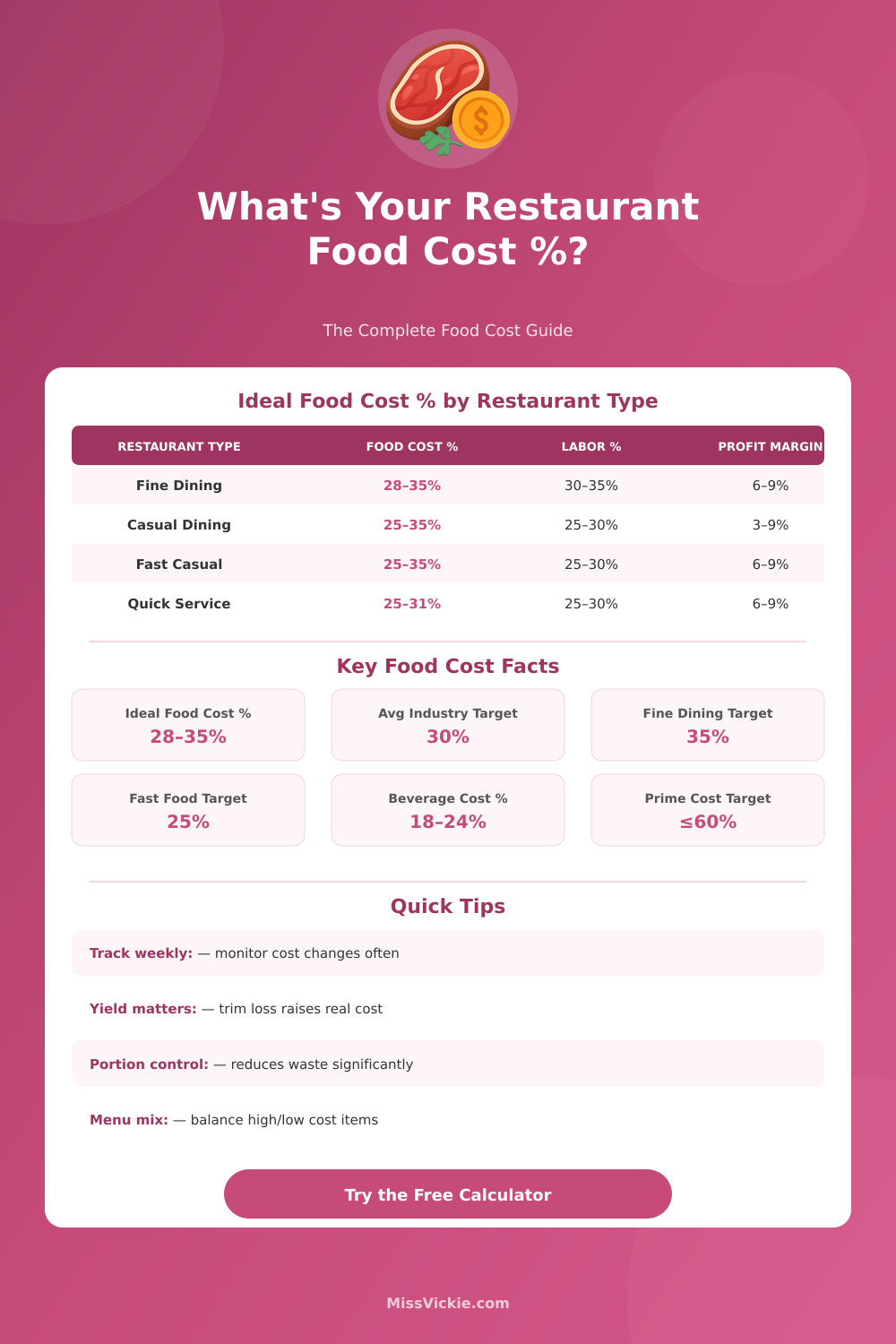
| Restaurant Type | Food Cost % | Beverage Cost % | Prime Cost Target | Net Profit Margin |
|---|---|---|---|---|
| Fine Dining | 28–35% | 25–35% | ≤60% | 6–9% |
| Casual / Full Service | 25–35% | 20–30% | ≤65% | 3–9% |
| Fast Casual | 25–32% | 20–28% | ≤60% | 6–9% |
| Quick Service (QSR) | 22–28% | 18–24% | ≤55% | 6–9% |
| Bar / Pub | 20–28% | 18–24% | ≤55% | 5–10% |
| Bakery / Cafe | 25–35% | 20–25% | ≤60% | 4–8% |
| Food Truck | 28–35% | — | ≤65% | 6–15% |
| Protein | As Purchased (AP) | Edible Portion (EP) | Yield % | Loss Factor |
|---|---|---|---|---|
| Beef Strip Loin | 16 oz (454g) | 13.3 oz (378g) | 83% | 1.20 |
| Chicken Breast (bone-in) | 16 oz (454g) | 11.5 oz (325g) | 72% | 1.39 |
| Chicken Breast (boneless) | 16 oz (454g) | 14.2 oz (402g) | 89% | 1.12 |
| Salmon Fillet | 16 oz (454g) | 13.1 oz (371g) | 82% | 1.22 |
| Whole Shrimp (shell-on) | 16 oz (454g) | 11.2 oz (317g) | 70% | 1.43 |
| Pork Tenderloin | 16 oz (454g) | 14.4 oz (408g) | 90% | 1.11 |
| Ground Beef | 16 oz (454g) | 12.8 oz (362g) | 80% | 1.25 |
| Whole Duck | 16 oz (454g) | 8.8 oz (250g) | 55% | 1.82 |
| Lamb Rack | 16 oz (454g) | 10.4 oz (295g) | 65% | 1.54 |
| Produce Item | AP Weight | EP Weight | Yield % | Notes |
|---|---|---|---|---|
| Broccoli | 1 lb (454g) | 0.61 lb (277g) | 61% | Trim florets only |
| Romaine Lettuce | 1 lb (454g) | 0.74 lb (335g) | 74% | Remove outer leaves |
| Onion (yellow) | 1 lb (454g) | 0.88 lb (400g) | 88% | Peel & trim ends |
| Tomato | 1 lb (454g) | 0.93 lb (422g) | 93% | Core removed |
| Potato (russet) | 1 lb (454g) | 0.81 lb (368g) | 81% | Peeled |
| Carrot | 1 lb (454g) | 0.82 lb (372g) | 82% | Peeled & trimmed |
| Bell Pepper | 1 lb (454g) | 0.82 lb (372g) | 82% | Seeds & ribs removed |
| Mushroom (button) | 1 lb (454g) | 0.97 lb (440g) | 97% | Stems trimmed |
| Avocado | 1 lb (454g) | 0.71 lb (322g) | 71% | Pit & skin removed |
| Imperial | Metric | Common Use | Cost Conversion Note |
|---|---|---|---|
| 1 oz | 28.35 g | Small ingredients | $/oz × 35.27 = $/kg |
| 1 lb (16 oz) | 453.59 g | Meat, produce | $/lb × 2.205 = $/kg |
| 1 cup (liquid) | 236.6 mL | Sauces, stocks | $/cup × 4.23 = $/L |
| 1 fl oz | 29.57 mL | Oils, spirits | — |
| 1 gallon | 3.785 L | Soups, oils | $/gal ÷ 3.785 = $/L |
| 1 tbsp | 14.79 mL | Spices, sauces | — |
| 1 tsp | 4.93 mL | Spices, extract | — |
Restaurant foods changed a lot over time. Before the pandemic, going to eat outside or ordering for takeout almost always promised good taste. Even so, the quality of foods in restaurants, at least in United States, got worse.
The world of restaurants became even more commercial than before and always tried to reduce expenses. That usually results in use of average pre-made products instead of fresh cooking.
Why Restaurant Food Is Worse and More Expensive
Many restaurant dishes look like TV meals, only heated in microwave. Even the expensive places, that require a reservation, can disappoint clients. Asking for extra egg with fried rice at Chinese or Thai stores rarely works.
Asking for pasta al dente almost never works either. In restaurants, many foods are partially cooked before to spare time during the service. Partially cooked means cooked only partially before not fully finished until the end.
Restaurants like to add too much salt, sugar and fat. They focus on the taste instead of caring about the health of the eaters. At well known places with Italian, Mediterranean and other styles of cooking, many dishes depend too strongly on thick sauces and salt.
Traditional American restaurant foods also stress the amount instead of the quality. Little portions with genuinely good food for same food cost would be better than big plates of average stuff.
Portion sizes are also a big topic. Today’s typical restaurant portions are much bigger than half a century before. The trend to bigger portions spread also outside of restaurants, with muffins, milkshake bottles and sliced pizza parts, that all grew in size during the years.
The serving portion on labels of foods commonly is a lot more small than what restaurants genuinely lays on teh plate. For instance, the Cheesecake Factory portions could feed a whole family of four, according to official serving sizes.
So, here comes the problem of costs. Going out to eat became more expensive. Cooking at home now almost costs the same as eating in a simple restaurant.
The prices at Mcdonald’s are terrible, unless one uses the deals and loyalty program, and the quality of food is worse compared to past years. That many restaurants have either bad atmosphere, or average food, or overpriced dishes for what they offer. That level of competition should close such places, but they stay everywhere.
Thai cuisine is one of those that commonly costs less to buy in a restaurant. The dishes use cuts of ingredients that are hardly used up when one cooks at home, and the leftovers simply go to waste. Some foods simply make more sense to order outside.
Eating out always saves energy a bit, even when the bill seems too high. The art of cooking in restaurants is made up of counting what parts of a dish can be prepared before and what must be done just before the service. The expectations of eaters aboutfood are the main cause, not the other way around.