🍕 Biga Pizza Dough Calculator
Calculate exact biga & final dough ingredient amounts for any batch size
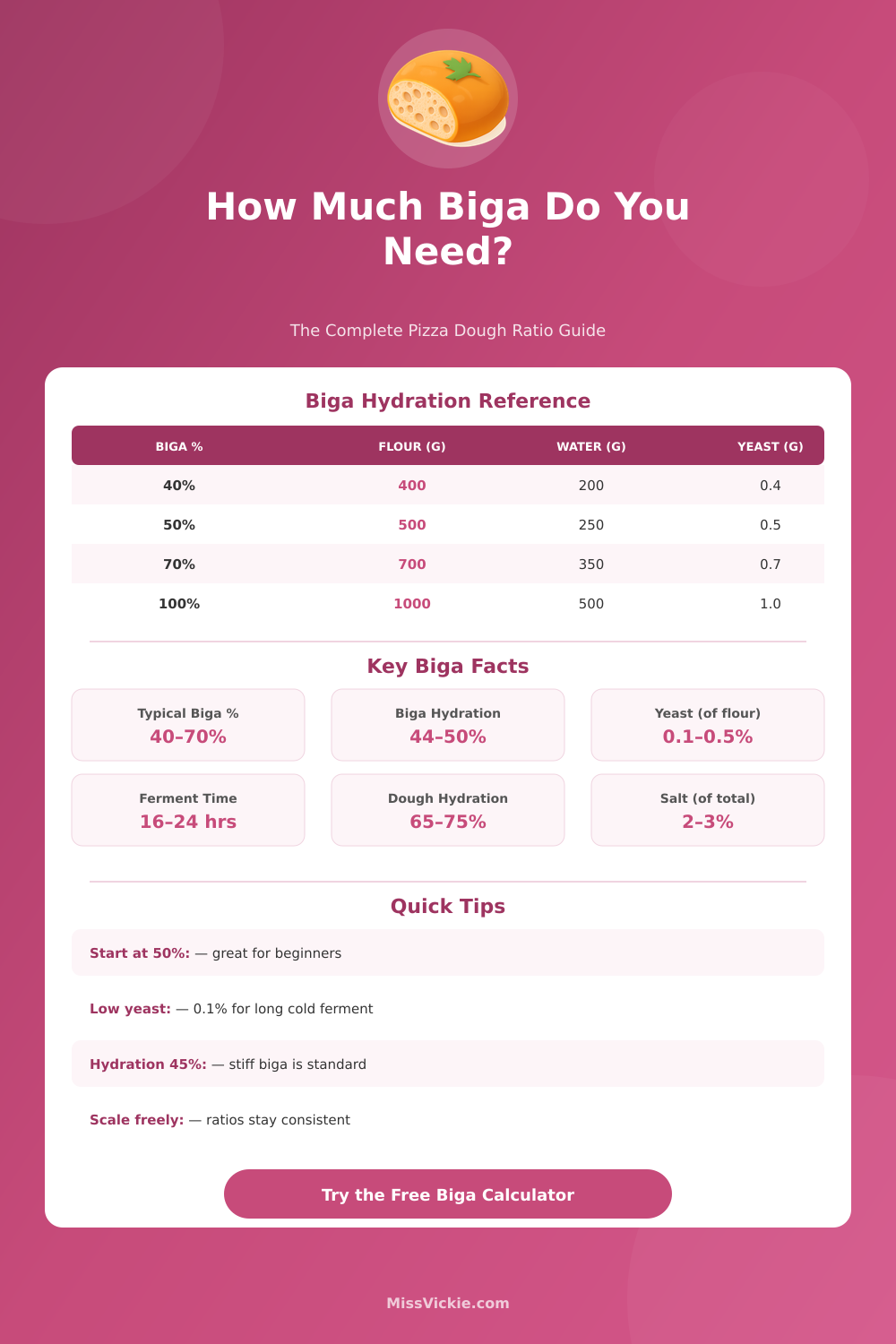
| Biga % | Flavor Profile | Ferment Time | Biga Hydration | Best Style |
|---|---|---|---|---|
| 20–30% | Light tang | 12–16 hrs | 44–48% | Quick pizza |
| 40–50% | Balanced flavor | 16–20 hrs | 44–50% | Neapolitan |
| 50–70% | Complex, airy | 18–24 hrs | 44–50% | Roman / Pan |
| 80–100% | Strong fermented | 20–48 hrs | 45–52% | Artisan |
| Pizza Style | Ball Weight (g) | Ball Weight (oz) | Pan Size (approx) | Dough Hydration |
|---|---|---|---|---|
| Neapolitan (12") | 220–280 g | 7.8–9.9 oz | 12" round | 62–68% |
| New York Slice | 250–320 g | 8.8–11.3 oz | 14" round | 60–65% |
| Roman (al taglio) | 600–900 g | 21–32 oz | Half-sheet pan | 75–85% |
| Detroit Style | 400–550 g | 14–19 oz | 8" x 10" pan | 68–75% |
| Thin Crust (10") | 150–200 g | 5.3–7.1 oz | 10" round | 58–62% |
| Sicilian / Focaccia | 500–700 g | 17.6–24.7 oz | 13" x 9" pan | 70–80% |
| Flour Amount | Biga Yeast (0.1%) | Biga Yeast (0.2%) | Biga Yeast (0.5%) |
|---|---|---|---|
| 200 g | 0.2 g | 0.4 g | 1.0 g |
| 500 g | 0.5 g | 1.0 g | 2.5 g |
| 1000 g | 1.0 g | 2.0 g | 5.0 g |
| 1500 g | 1.5 g | 3.0 g | 7.5 g |
| 2000 g | 2.0 g | 4.0 g | 10.0 g |
The biga for pizza dough is a real recipe in Neapolitan style, that gives you crust, that is bright, tasty and well scented. Biga is made up of a kind of Italian pre-ferment, prepared from flour, water and only a bit of yeast. One mixes it simply and leaves it ferment quickly.
That firm pre-ferment works as the main way to ferment the dough which helps it start well the process of ferment activity and gluten-formation before the main mixing.
How to Make and Use Biga for Pizza Dough
The difference of biga compared to others lies in its low water content. It has fairly little water, sometimes only around 50 percent. Such low water levels result in more slow fermentation, denser structure and nutty aroma.
Its dry, rough texture separates it from poolish, that has much more water and ends almost as liquid. Both use flour, water and store-bought yeast, however the final results differ a lot. Poolish works more for light, thin bread-pizzas.
Biga suits more for firm, well shaped doughs.
One must prepare the biga the day before cooking the pizza dough. One way is mix the biga roughly in a bowl and leave it rest at room temperature for around 18 to 24 hours. The mix looks crumbly and dry (not smooth as normal dough), but without too much free flour.
After that ferment time, one adds the remaining water, salt and any other ingredients, to reach the final water level of the dough.
Some recipes require full 100 percent biga method, which means that all flour goes in the biga already the first day. The next day one simply adds only water and salt. Other versions use 20 or 50 percent of the whole flour for the biga.
The whole biga process can stretch threw longer times, for instance 24 hours for the biga itself, followed by more 24 to 48 hours. Such long timing stops over-ferment, because fresh flour feeds to keep the fermentation active.
During fermentation, the yeast breaks down the flour and forms protein like gluten, together with carbon dioxide. Like this one gets stronger, yet light dough, that has more flavor and is more easily digested. When the dough is ready, each ball should weigh around 250 grams.
To form, one presses the dough in one hand and dumps the excess by means of the second, to create the ball.
The ready pizza can reach up to 14 inches, if one does it slim. A stand mixer with dough tools helps mix the biga, although one can mix also by hand. If one cuts the biga in little bits before adding the water and flour, the mixing becomes simpler.
A pizzastone in a regular oven can give great results with that type of dough.