🍯 Sugar to Honey Converter
Get exact honey measurements to substitute sugar in any recipe — imperial & metric
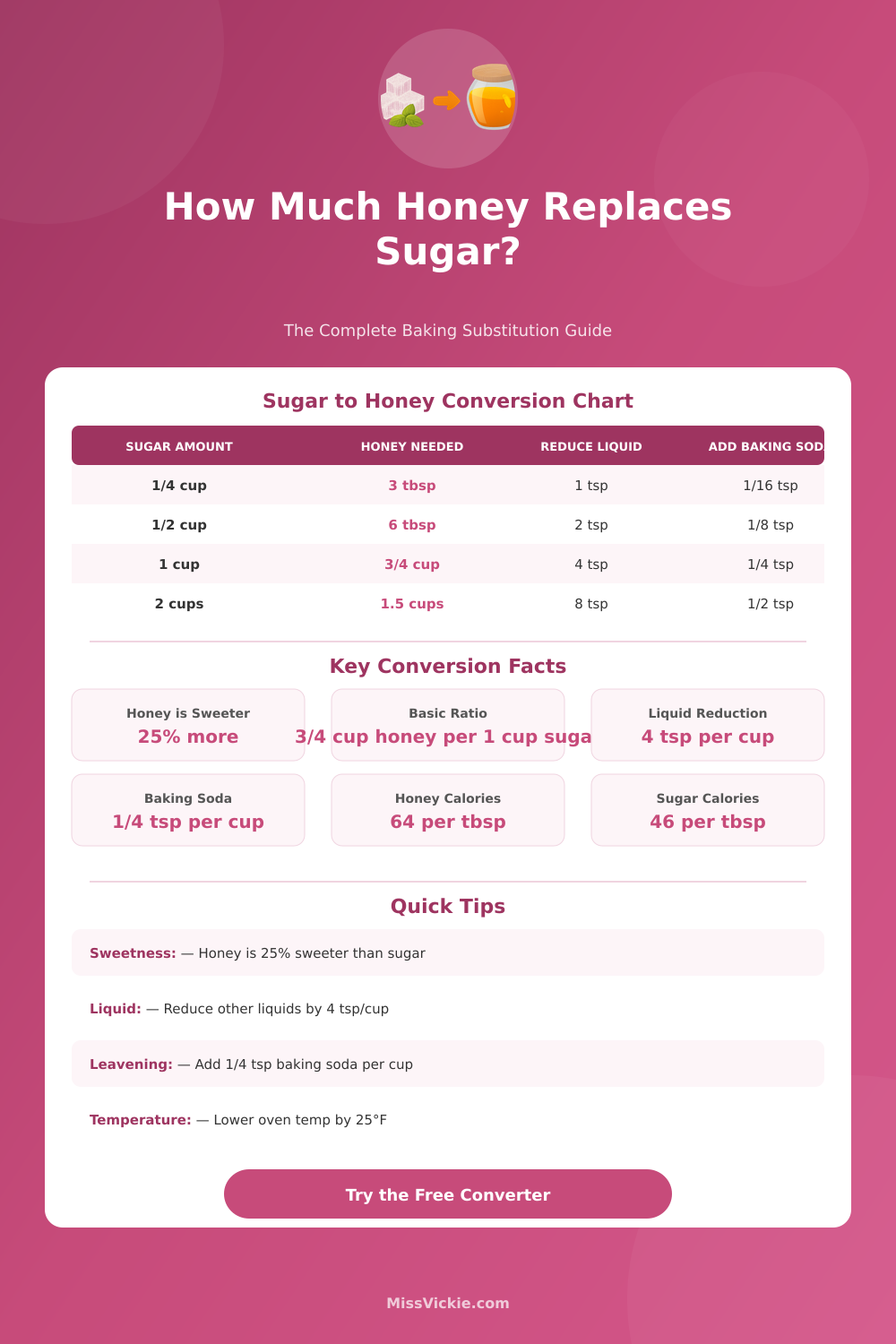
| Sugar (Cups) | Honey Needed | Reduce Liquid By | Add Baking Soda |
|---|---|---|---|
| 1 tsp | ¾ tsp | — | Pinch |
| 1 tbsp | 2¼ tsp | ½ tsp | Pinch |
| ¼ cup | 3 tbsp | 1 tsp | ⅛ tsp |
| ½ cup | 6 tbsp | 2 tsp | ¼ tsp |
| ¾ cup | 9 tbsp | 1 tbsp | ¼ tsp |
| 1 cup | ¾ cup | 4 tsp | ¼ tsp |
| 1½ cups | 1⅛ cups | 2 tbsp | ⅜ tsp |
| 2 cups | 1½ cups | 8 tsp | ½ tsp |
| Honey Measure | Grams | Ounces | Milliliters |
|---|---|---|---|
| 1 teaspoon | 7g | 0.25 oz | 5 ml |
| 1 tablespoon | 21g | 0.75 oz | 15 ml |
| ¼ cup | 85g | 3 oz | 60 ml |
| ½ cup | 170g | 6 oz | 120 ml |
| ¾ cup | 255g | 9 oz | 177 ml |
| 1 cup | 340g | 12 oz | 237 ml |
| Honey Type | Sweetness vs Sugar | Flavor Profile | Best For |
|---|---|---|---|
| Clover / Regular | 25% sweeter | Mild, neutral | All-purpose baking |
| Raw Honey | 25% sweeter | Floral, complex | Dressings, marinades |
| Manuka Honey | 20–25% sweeter | Earthy, bold | Wellness drinks |
| Buckwheat Honey | 20% sweeter | Robust, molasses | Breads, dark bakes |
| Acacia Honey | 25% sweeter | Delicate, light | Tea, light desserts |
Sugar forms a group of sweet, easily dissolved carbohydrates, and many types find use in foods. Simple sugars, or basic sugars store glucose, fructose, and galactose. Double sugars, commonly called double sugars, are made up of two simple sugars bound together.
The body breaks down carbohydrates into basic sugars, for instance glucose, that one can use right away. As all carbohydrates, sugars give energy to the body. Usually, the word “sugar” means sucrose, the common table sugar.
All About Sugar
In the body, glucose is made by several processes. Fructose from fruits restores the sugar stored in the liver, which helps for good sleep and for recovery after long sporting efforts. Sugar has an effect on the brain’s signal senders in the brain.
Basically, it boosts the dopamine, which relates to teh feeling of pleasure.
Cooks and bakers use many various kinds of sugar. Natural sugars in honey or other ingredients give sugar to cakes, beer, meat rubs, and partly dried fish. Brown sugar delivers deep taste, that white sugar does not have.
To create light brown sugar, mix one spoon of molasses with a cup of white sugar. Dark brown sugar requires two spoons of molasses for the same amount of white sugar. Turbinado sugar, rough and little processed, adds pleasant crunch too cakes.
Chinese brown sugar comes in one-pound packages from pressed sugar canes. Muscovado sugar stays a natural choice, because it does not have separated molasses and has more force than usual dark brown sugar.
Sugar works also as a sweetener and preservative in foods. It even preserves a bouquet of flowers fresh, extending their life in days or even weeks.
Working with warm sugar, mind safety. One should not eat warm sugar before it cools, because it is very dangerous. To reach the wanted firmness, use a proper thermometer for candy.
Without such a tool, the old way is to drop a chip of cooked sugar in water and check, whether it forms a soft ball. During making of candy, mixing stays minimal. A silicone spatula works best, and everything should be clean, because bits can make the sugar stick.
Non-stick jars ease the cleanup, in case that something fails.
Yeast does not truly need sugar to act. It eats flour with pleasure. Many breads are made without any extra sugar.
Even so, sugar helps yeast prove, and fermentation is a process, in that yeast uses sugar and turns it into ethanol andcarbon dioxide.
The advised daily limit for extra sugar matches 25 grams for females and 36 grams for males. A typical American eats more than 17 spoons of extra sugar daily, which almost doubles the wanted amount. Also the serving size matters.
When the listed serving on the label differs from what one eats, the real sugar intake can beat the expectations a lot.